
The biblical word worship appears simple because it compresses a complex relationship into a single term. We speak of worshipping God as though worship were one indivisible act. Yet once the relation is examined, several distinguishable concepts emerge.
This essay argues that these concepts belong together without being identical.
At the centre lies allegiance: the constitutional orientation of the creature toward the authority ultimately recognized as governing. Allegiance itself depends upon a referent—the one to whom allegiance is directed—and upon the standingattributed to that referent: who this being is and what authority or jurisdiction that identity entails.
From allegiance proceed several related but distinguishable relations.
Submission concerns the yielding of one's will to an acknowledged authority.
Obedience is the enactment of what that authority requires.
Service is the sustained ordering of activity toward that authority.
Profession is the verbal or symbolic declaration of the relation.
Manifestation is the outward expression through which allegiance becomes visible in conduct.
Habitus is the formed disposition by which such manifestation becomes increasingly reliable rather than episodic.
Delight describes a further affective possibility: not merely doing God's will, but positively desiring it.
None of these is individually identical with worship.
Nor are they necessarily congruent at every moment.
A person may obey under coercion without possessing allegiance. A person may profess allegiance while acting contrary to it. Conversely, genuine allegiance may temporarily fail to manifest itself adequately through fear, as Peter's denial demonstrates. And a person may understand and accept God's jurisdiction while remaining profoundly unhappy about what that jurisdiction requires or permits.
The distinctions can therefore be summarized as follows:
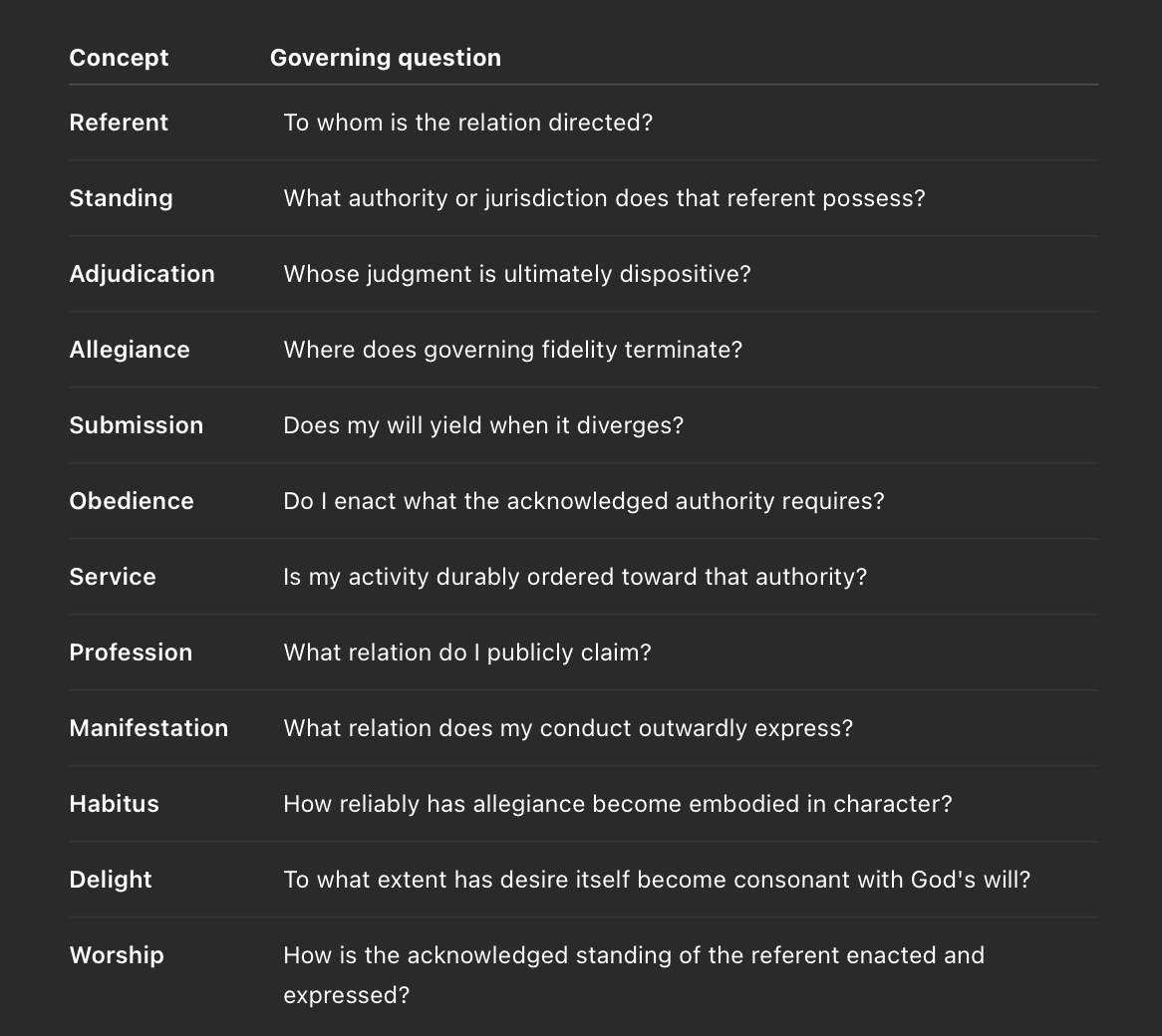
This disaggregation produces the central distinction of the essay: constitutional allegiance is not identical with habituated manifestation.
Constitution concerns where ultimate authority actually resides for the creature. Habitus concerns how reliably that constitutional allegiance has become embodied in character. God requires the former; the latter is progressively formed. Failure of manifestation need not therefore prove the absence of allegiance, but neither can inward allegiance become a permanent justification for outward contradiction.
Three biblical cases clarify the distinction.
Gethsemane demonstrates that understanding and allegiance do not require affective satisfaction: Christ can know what lies before Him, recoil from the cup, and nevertheless say, “Not as I will, but as thou wilt.”
Daniel demonstrates that allegiance need not depend upon favourable outcome: “But if not…”
Peter demonstrates that constitutional allegiance can coexist temporarily with failed manifestation, while repentance, restoration and subsequent formation show that such incongruence is not intended to remain permanent.
The resulting conception of allegiance is therefore one of invariant jurisdiction rather than invariant emotion. Understanding may vary. Agreement may vary. Desire may diverge. Fear may temporarily overwhelm an inadequately formed habitus. What cannot ultimately be relocated without altering the relation itself is the locus of final authority.
This also explains the importance of repentance and transformation. If allegiance has become misoriented, restoration cannot consist merely in repeating the language of dedication. It requires reorientation. Confession acknowledges the breach; repentance turns from it; transformation progressively reconstructs habitus around the restored constitutional relation. A corporate ceremony may therefore possess the vocabulary of rededication while omitting the relational movement that rededication claims to signify.
Finally, the distinction illuminates Revelation's conjunction of worship, deception and coercion. Deception operates principally upstream, contesting identity, truth, legitimacy and authority in order to relocate allegiance. Coercion operates initially downstream, attempting to force manifestation into contradiction with allegiance. Liberty of conscience protects the space in which inward conviction can receive truthful outward expression.
The argument can therefore be summarized in one proposition:
Worship is not synonymous with allegiance, obedience, submission, profession or delight. It is the enacted acknowledgment of an attributed relation of standing and authority which, when truthful, manifests an underlying allegiance; and mature allegiance progressively integrates submission, obedience, profession, habitus and manifestation without requiring that every divine providence become emotionally desirable.
The task of the essay is to decompress that proposition, test its constituent relations against Scripture, and then ask why Revelation can finally recompress this entire controversy into the deceptively simple question of worship.
Revelation places worship near the centre of its final conflict. The inhabitants of the earth are repeatedly distinguished according to whom they worship: God and the Creator on the one hand, or the dragon, beast, and image on the other (Rev. 13:4, 8, 12, 15; 14:7, 9–11). Yet the apparent simplicity of the term can conceal the complexity of the relation being described. Worship may involve homage, service, profession, obedience, submission, devotion, and allegiance, but these cannot simply be treated as synonyms.
The lexical evidence provides an important first constraint. The principal term proskuneō commonly denotes bowing, prostration, or the rendering of homage. This sense remains visible even within Revelation. John twice falls before an angel to worship him and is immediately redirected: “Worship God” (Rev. 19:10; 22:8–9). The bodily act is intelligible as homage, but its legitimacy depends upon the identity and standing of its referent. Latreuō, by contrast, characteristically denotes religious or sacred service: those before God's throne “serve him day and night in his temple” (Rev. 7:15; cf. 22:3). Neither term, considered lexically, contains the entire theological architecture that subsequently gathers around worship.
The surrounding biblical material nevertheless prevents worship from being reduced to bodily action. Satan's temptation of Christ is particularly instructive: “All these things will I give thee, if thou wilt fall down and worship me.” Christ answers, “Thou shalt worship the Lord thy God, and him only shalt thou serve” (Matt. 4:9–10; cf. Deut. 6:13). Homage and service are associated, but the controversy reaches beyond posture. The question is whether a creature may receive what belongs uniquely to God.
Several distinctions therefore become necessary. Obedience is not identical with allegiance, since coercion can produce compliance. Profession is not identical with allegiance, since Christ explicitly distinguishes those who say “Lord, Lord” from those who do the Father's will (Matt. 7:21). External manifestation is not identical with constitution, since an outward act can be performed hypocritically, instrumentally, or under pressure. Conversely, episodic failure of manifestation need not establish the total absence of allegiance, as Peter's denial and subsequent restoration will later demonstrate.
Nor should allegiance be confused with emotional satisfaction. Scripture contains faithful agents who grieve, protest, lament, or desire another outcome without thereby transferring their allegiance elsewhere. The distinction will become particularly important in Gethsemane.
Four analytical levels should therefore be kept separate throughout the essay:
Constitution asks what the underlying relation actually is.
Profession asks what relation the agent claims to possess.
Manifestation asks how that relation is expressed in observable action.
Evidence asks what profession and manifestation permit another observer reasonably to infer about the underlying constitution.
The distinction works in both directions. Outward conformity does not infallibly establish inward allegiance. But neither does the invisibility of allegiance make outward manifestation irrelevant. Christ can warn both against empty profession—“This people draweth nigh unto me with their mouth… but their heart is far from me” (Matt. 15:8)—and against outward denial: “Whosoever shall deny me before men, him will I also deny before my Father” (Matt. 10:33).
The relation between constitution and manifestation is therefore neither identity nor independence. Scripture permits temporary incongruence during moral formation while nevertheless requiring that rightly ordered allegiance increasingly receive truthful expression.
The first conclusion can consequently remain modest:
Worship is not itself a synonym for allegiance, obedience, profession, or devotion. Rather, biblical worship is an enacted relation whose significance depends upon who receives it, what standing is attributed to that referent, and what underlying relation the act expresses.
The remaining task is to identify that underlying architecture.
If worship is an enacted relation, its structure can be decomposed further.
At minimum, four questions arise.
Referent: Who is being acknowledged?
Standing: What status and authority are attributed to that referent?
Allegiance: Where does governing fidelity terminate?
Adjudication: When competing judgments arise, whose judgment remains finally dispositive?
The first two are already apparent in Scripture's treatment of worship. John's attempted worship of the angel is rejected not because homage is intrinsically meaningless but because the referent is wrong relative to the standing being expressed: “I am thy fellowservant… worship God” (Rev. 22:9). Conversely, the heavenly proclamation grounds worship of God in His identity and standing as Creator: “Worship him that made heaven, and earth, and the sea, and the fountains of waters” (Rev. 14:7). Who God is supplies the ground for the authority acknowledged in worship.
Allegiance becomes more difficult to identify when creaturely judgment and divine judgment coincide. If God requires X and I independently prefer X, my obedience is entirely compatible with allegiance, but the agreement itself does not tell us what would happen were the two to diverge.
The more revealing case is therefore:
God judges X.I would prefer Y.
Several distinct questions may then arise.
I may ask whether I understand God's reason. That is epistemic.
I may ask whether I would independently have reached the same conclusion. That is evaluative.
I may ask whether I want the outcome God has chosen or permitted. That is affective.
But none of these is identical with the jurisdictional question:
Whose judgment finally governs?
This distinction matters because understanding need not produce happiness. Even if God completely explained why some painful circumstance had been permitted, the explanation would not logically require the creature to become pleased that the circumstance occurred. Comprehension and affect belong to different categories.
Nor does Scripture appear to demand their collapse. Job receives no exhaustive causal explanation for his suffering before his encounter with God redirects the controversy toward the relation between creaturely and divine epistemic standing (Job 38–42). Habakkuk receives an answer concerning what God is doing and nevertheless continues to confront circumstances of deprivation, eventually resolving: “Yet I will rejoice in the LORD” (Hab. 3:17–18). Acceptance of divine jurisdiction does not require the circumstances themselves to become desirable.
This permits an important distinction between accepting God's authority and liking everything that follows under His providence.
The constitutional question of allegiance is therefore not:
Do God's judgment and mine always coincide?
Nor:
Am I emotionally satisfied with everything God permits?
It is:
When they do not coincide, does the disagreement cause me to relocate the authority by which God's judgment itself is finally assessed?
If God's judgment becomes binding only after I independently ratify it, then I remain, functionally, the superior tribunal:
God judges → I adjudicate God's judgment → I determine whether it shall govern me.
Allegiance has a different structure:
God judges → I may understand, question, dislike, or desire otherwise → God's rightful jurisdiction nevertheless remains dispositive.
This is not a prohibition upon reasoning, questioning, lament, or even petition for another outcome. Scripture contains all four. It concerns instead the locus at which adjudicative authority finally terminates.
The constitutional core of allegiance can therefore be stated:
Allegiance is the durable orientation of governing fidelity toward an acknowledged authority whose rightful jurisdiction is not displaced merely because creaturely understanding, evaluation, preference, or affect diverges from it.
This is what will later permit us to distinguish Gethsemane from Eden. Both contain divergence. Only one contains relocation.
Constitutional allegiance still does not tell us how reliably an agent will act according to it.
For that, a further distinction is required between constitution and habitus.
Constitution concerns the fundamental orientation already described: where allegiance lies and whose authority is acknowledged as finally governing.
Habitus concerns the dispositions through which that orientation has become sufficiently formed to produce characteristic action. In biblical language, something close to this idea appears in the repeated association between inward orientation, practiced obedience, and developed character. Christ describes the tree as becoming known by its fruit (Matt. 7:16–20), while Hebrews speaks of those who “by reason of use have their senses exercised to discern both good and evil” (Heb. 5:14). Paul similarly describes tribulation as producing patience, experience, and hope (Rom. 5:3–4). Repeated encounter and response form the person.
The distinction matters because Scripture plainly does not portray every person whose allegiance has turned toward God as possessing immediately perfected dispositions.
Peter is the obvious example, although his case will be considered fully later. His confidence exceeds his formed capacity. “Though all men shall be offended because of thee, yet will I never be offended” (Matt. 26:33) is followed within hours by denial. Whatever judgment is ultimately made concerning Peter's inward state at that moment, the narrative indisputably demonstrates a disparity between professed fidelity and demonstrated capacity under pressure.
Christian formation therefore cannot simply mean establishing the correct proposition in the mind. Nor can it mean merely compelling the correct external behaviour. It concerns the progressive integration of the person.
Three different forms of congruence should consequently be distinguished.
Semantic congruence exists when what I profess corresponds to the allegiance I actually possess.
Manifestational congruence exists when what I do corresponds to that allegiance.
Volitional or affective congruence exists insofar as what I desire increasingly corresponds to what God wills.
These need not mature simultaneously.
Someone may sincerely acknowledge God's authority yet remain fearful in its manifestation. Another may perform exemplary external conduct while inwardly motivated principally by reputation or coercion. A third may obey faithfully while finding the required circumstance deeply unwanted.
This prevents delight from becoming an inappropriate minimum threshold for allegiance. “I delight to do thy will, O my God” (Ps. 40:8) describes something profoundly positive, but it does not follow that every faithful creature must emotionally delight in every circumstance through which God's purposes are accomplished.
The distinction is crucial:
One may delight in God's will as good without delighting in every experience that fidelity to that will entails.
Gethsemane will demonstrate precisely why that qualification matters.
Sanctification can therefore be considered along at least two developmental axes. Along one, desire itself is transformed: reluctant submission may become willing acceptance, increasing consonance, and eventually delight in what is good. Along the other, conduct is formed: unstable manifestation gives way through repeated faithful action to increasingly reliable behaviour under pressure.
Neither trajectory should be converted into a rigid psychological sequence. Their significance is structural.
God does not require a perfectly formed habitus as the precondition of beginning the relationship; otherwise restoration after failure would become unintelligible. But neither does He treat the continuing disparity between constitution and conduct as the desired endpoint. “If ye love me, keep my commandments” (John 14:15) and “he that saith he abideth in him ought himself also so to walk, even as he walked” (1 John 2:6) place manifestation downstream from the professed relation.
The developmental principle can therefore be stated:
Constitutional alignment is logically prior to habituated fidelity, but rightly ordered allegiance carries within it a normative trajectory toward character increasingly congruent with that allegiance.
Or more simply:
Constitution progressively becomes character.
This preserves both grace and moral formation. Failure need not prove that constitutional alignment never existed. But constitutional alignment cannot be invoked indefinitely to make persistent contradictory manifestation irrelevant.
The biblical stress tests of Gethsemane, Daniel, and Peter will show what this distinction looks like when desire, consequence, fear, and allegiance are actually pulled apart.
The distinctions developed above can now be tested against three biblical cases in which allegiance is placed under different kinds of pressure. Gethsemane tests allegiance against unwanted experience; Daniel tests it against adverse consequence; Peter tests it against fear and failed manifestation. Together they show why allegiance cannot be identified simply with agreement, emotional consonance, or flawless conduct.
Gethsemane provides perhaps the clearest biblical separation between desire and jurisdiction. Christ prays:
“O my Father, if it be possible, let this cup pass from me: nevertheless not as I will, but as thou wilt.”— Matthew 26:39
The force of the passage would be diminished if Christ's reluctance were reduced simply to ignorance. His ministry had repeatedly anticipated His death (Matt. 16:21; 20:18–19; John 12:27). The tension in Gethsemane is therefore not adequately described as failure to understand. The cup remains genuinely unwanted.
Yet divergent desire does not produce divergent allegiance.
Christ does not reason that because He would prefer another outcome, His preference becomes the final tribunal. Instead, the divergence itself exposes the underlying jurisdiction:
“not as I will” → “but as thou wilt.”
This yields an important principle:
Perfect allegiance does not require invariant affect. It requires invariant jurisdiction.
This also prevents submission from being confused with agreement. Submission becomes morally significant precisely where another will could have been preferred.
Daniel 3 introduces a different variable. Nebuchadnezzar demands a visible act of worship and makes compliance the condition of survival (Dan. 3:4–6).
The three Hebrews answer:
“Our God whom we serve is able to deliver us… But if not… we will not serve thy gods, nor worship the golden image.”— Daniel 3:17–18
Their allegiance is not conditional upon receiving the outcome they desire.
The structure is:
God may deliver → allegiance remains.
God may not deliver → allegiance remains.
The celebrated phrase “But if not” therefore identifies an important property of invariant allegiance: consequence does not acquire jurisdiction over fidelity.
Daniel also begins to illuminate the relation between allegiance and manifestation. Nebuchadnezzar is not satisfied that the Hebrews privately retain their God. He demands an outward act whose public meaning signifies another religious relation. The coercive demand is therefore aimed precisely at the correspondence between constitution and manifestation.
Peter presents the difficult converse.
Before Christ's arrest he professes unwavering fidelity:
“Though I should die with thee, yet will I not deny thee.”— Matthew 26:35
Yet under social threat he denies Christ three times (Matt. 26:69–75).
If outward manifestation were an infallible measure of constitution at every instant, Peter's denial would establish complete relocation of allegiance. But the narrative does not end there. Peter weeps bitterly; Christ later restores him through the repeated question, “Lovest thou me?” and commissions him, “Feed my sheep” (John 21:15–17).
The case therefore resists two opposite errors.
The first is:
Peter denied Christ; therefore no underlying allegiance existed.
The second is:
Peter inwardly loved Christ; therefore his denial did not matter.
Neither adequately represents the narrative.
Peter demonstrates instead that constitutional allegiance may coexist episodically with manifestational failure when the habitus has not yet become adequate to the pressure placed upon it. Yet Christ's own warning remains: “Whosoever shall deny me before men, him will I also deny before my Father” (Matt. 10:33). Manifestation therefore cannot be permanently detached from allegiance.
Peter's restoration is consequently transformative rather than merely declarative. The one who failed under pressure must become capable of fidelity under pressure. Christ's prediction that Peter would eventually be carried where he would not choose to go (John 21:18–19) closes the narrative with precisely that trajectory.
The three cases can therefore be placed together:
Gethsemane: unwanted experience does not relocate allegiance.
Daniel: adverse consequence does not relocate allegiance.
Peter: fear can temporarily disrupt manifestation without necessarily constituting final relocation.
Together they establish the distinction upon which the remainder of the argument depends:
Allegiance is constitutionally located, but mature allegiance tends toward increasingly reliable manifestation across variations in desire, consequence, and pressure.
The distinction between constitution and manifestation also clarifies why Scripture treats coercion and deception as related but distinguishable threats.
They enter the architecture at different points.
Daniel 3 provides the clearest model. Nebuchadnezzar does not initially need to alter what the Hebrews privately believe. He requires them to perform the mandated act:
“Ye fall down and worship the golden image.”— Daniel 3:5
The threat of the furnace supplies the coercive mechanism.
Coercion therefore initially says:
Manifest an allegiance that you do not possess, or suffer the consequence.
This explains why coerced religious behaviour cannot simply be taken as proof of inward allegiance. Phenomenologically, the coerced subject may perform exactly the same act as the willing worshipper. Ontologically, the relations may be entirely different.
Phenomenological equivalence does not entail ontological equivalence.
Yet Daniel also prevents the distinction from becoming an excuse for compliance. The Hebrews do not reason that bowing is irrelevant because God knows their hearts. They refuse the manifestation itself.
The biblical expectation is therefore not merely inward fidelity but, increasingly, truthful manifestation of inward fidelity.
Peter shows why this expectation must nevertheless accommodate moral development. Fear may defeat manifestation episodically without necessarily relocating constitution. Daniel shows the mature form toward which that allegiance tends: pressure no longer succeeds in severing the two.
Deception operates differently.
Its immediate purpose is not to force an agent to act against what he believes, but to alter what he believes concerning the relevant referent, claim, or authority.
Genesis 3 provides the primordial structure:
“Yea, hath God said…?”— Genesis 3:1
and:
“Ye shall not surely die.”— Genesis 3:4
The serpent contests revelation, credibility, consequence, and motive before the prohibited act occurs.
Revelation similarly associates the final counterfeit with deception. The second beast “deceiveth them that dwell on the earth” through signs and thereby directs them toward the image and its worship (Rev. 13:13–15). Revelation 19:20 again associates the signs with those “with which he deceived them that had received the mark of the beast.”
The initial target of deception is therefore farther upstream:
Who is trustworthy?
What is true?
What authority is legitimate?
What judgment should govern?
Successful deception can consequently relocate allegiance without the subject experiencing the change as coercion.
Thus:
Coercion initially pressures manifestation; deception initially pressures adjudication.
The distinction is one of primary entry point rather than permanent limitation. Sustained coercion can eventually reshape conviction; successful deception naturally produces changed conduct.
Liberty of conscience becomes intelligible within this architecture.
It is sometimes reduced to permission to believe privately. But Daniel 3 demonstrates why that is inadequate. Nebuchadnezzar could theoretically have permitted the Hebrews any private theology he pleased provided they bowed when the music sounded.
The protected good is therefore not merely private cognition.
It is the integrity of the relation between conviction and manifestation.
The coercive religious authority demands:
retain your conviction privately if you must → publicly manifest the allegiance I prescribe.
Liberty of conscience rejects that compulsory severance.
This does not mean every conscientious belief is true. Conscience possesses no magical capacity to convert error into truth. The point concerns jurisdiction: another human authority cannot manufacture genuine religious allegiance merely by compelling its external signs.
There is therefore a striking asymmetry between divine and coercive demands. Coercive power says:
Manifest an allegiance you do not possess.
God's demand upon the faithful is:
Manifest truthfully the allegiance you do possess.
The distinction explains both why compelled worship can be ontologically false and why outward fidelity nevertheless remains morally significant.
Liberty of conscience protects the space in which the two may remain congruent.
The argument can now return to Eden, but with an important methodological qualification.
Genesis 3 is not presented here as though worship were the lexical subject of the chapter. It is instead an antecedent case concerning authority, judgment, and creaturely relation to divine command. Its relevance is structural rather than lexical.
God establishes a prohibition and supplies its judgment:
“In the day that thou eatest thereof thou shalt surely die.”— Genesis 2:17
The serpent does more than propose disobedience. He introduces a rival interpretation of reality:
“Ye shall not surely die.”— Genesis 3:4
and then:
“Ye shall be as gods, knowing good and evil.”— Genesis 3:5
The temptation therefore concerns not merely which action shall I perform? but who shall finally determine the judgment by which the action is evaluated?
The creature is presented with:
divine judgment
and
rival judgment.
But a third operation then occurs. The creature begins to adjudicate between them. Eve sees that the tree is “good for food,” “pleasant to the eyes,” and “to be desired to make one wise” (Gen. 3:6). Divine prohibition is now subjected to creaturely assessment according to an alternative evaluative frame.
This suggests a deeper structure:
God judges
→ rival judgment is presented
→ the creature assumes the position of adjudicating God's judgment
→ creaturely judgment becomes dispositive
→ conduct manifests the relocation.
The decisive transition is therefore not the mere existence of divergence.
Gethsemane also contains divergence:
“not as I will…”
But Gethsemane terminates:
“…but as thou wilt.”
Eden terminates differently. The creature's judgment becomes governing.
Hence:
Divergence is not rebellion. Jurisdictional relocation is.
This provides a structural account of repentance.
If moral failure involved only the performance of an isolated prohibited act, repentance might conceivably mean little more than regret concerning that act. But where the deeper disorder concerns the orientation of judgment and allegiance, restoration requires a corresponding reorientation.
John the Baptist's proclamation captures this movement succinctly:
“Repent ye: for the kingdom of heaven is at hand.”— Matthew 3:2
He then refuses merely verbal or inherited religious status as sufficient:
“Bring forth therefore fruits meet for repentance.”— Matthew 3:8
Christ similarly begins His proclamation with:
“Repent ye, and believe the gospel.”— Mark 1:15
And Paul's account of his commission describes repentance dynamically: people should “repent and turn to God, and do works meet for repentance” (Acts 26:20).
The recurrent structure is therefore not merely say, but turn.
Repentance contains an orientation toward transformation:
recognition of disorder
→ repentance
→ turning
→ conduct appropriate to the new orientation.
Confession belongs naturally within this movement because it names the breach rather than concealing it. “If we confess our sins, he is faithful and just to forgive us” (1 John 1:9); Proverbs similarly contrasts covering sin with confessing and forsaking it (Prov. 28:13).
This does not make confession a magical verbal operation. Words themselves can be semantically empty. Rather, confession is the appropriate truthful acknowledgment of the relation that repentance seeks to repair.
The distinction established earlier therefore returns in another form:
profession of allegiance is not allegiance;
and
profession of return is not necessarily reorientation.
Where allegiance has been mislocated, restoration cannot be achieved merely by reproducing the vocabulary of dedication while leaving the underlying orientation uninterrogated.
Repentance is therefore important to the present argument because it prevents semantic restoration from being mistaken for relational restoration.
That distinction becomes particularly significant when the language of repentance, dedication, and renewed allegiance is transferred from individuals to corporate religious ceremonies.
The distinction between profession and reorientation applies not only to individuals but, with appropriate qualification, to corporate religious acts. A nation, church, institution, or community does not possess a single psychological interior in the manner of an individual person. It can nevertheless act corporately through declarations, ceremonies, covenants, representatives, and publicly enacted commitments.
Scripture itself permits this kind of corporate analysis. At Sinai, Israel collectively enters covenant: “All that the LORD hath spoken we will do” (Exod. 19:8; cf. 24:3, 7). Joshua later gathers the tribes at Shechem and places before them an explicit question of corporate allegiance: “Choose you this day whom ye will serve” (Josh. 24:15). The people respond by repudiating rival gods and professing fidelity to the LORD (Josh. 24:16–18, 21–24).
Yet Scripture also demonstrates that corporate profession and corporate reality can diverge. Isaiah records God's judgment:
“This people draw near me with their mouth, and with their lips do honour me, but have removed their heart far from me.”— Isaiah 29:13
The existence of a corporate profession therefore establishes neither the inward state of every participant nor the actual fidelity of the community.
This limitation is epistemically important. An observer cannot infer from a public ceremony that every participant possesses, or lacks, genuine repentance. The inward constitution of particular persons is not publicly available merely because they participate in a corporate act.
But it does not follow that the ceremony itself is beyond analysis.
A corporate ceremony possesses a publicly accessible grammar. It identifies referents, invokes authorities, recounts history, makes declarations, requests blessing, confesses or omits breaches, repudiates or retains former commitments, and specifies what relationship is supposedly being enacted.
The relevant question is therefore not:
Have the participants truly repented in their hearts?
It is:
What relational movement does the corporate act itself publicly instantiate?
This distinction becomes particularly important when a ceremony is described as a rededication.
Dedication identifies an orientation or commitment. Rededication adds a temporal and relational claim: something previously dedicated is being dedicated again. The term therefore presupposes some deficiency in the continuity of the original relation—whether departure, neglect, breach, corruption, or loss of orientation—that makes renewed dedication meaningful.
Biblical covenant renewal provides an instructive pattern. At Shechem, Joshua does not simply invite Israel to repeat its former profession. He commands:
“Put away the strange gods which are among you, and incline your heart unto the LORD God of Israel.”— Joshua 24:23
Likewise, Samuel's summons to Israel connects return with repudiation and reorientation:
“If ye do return unto the LORD with all your hearts, then put away the strange gods… and prepare your hearts unto the LORD, and serve him only.”— 1 Samuel 7:3
Josiah's reform similarly combines renewed covenant with the removal of practices contrary to that covenant (2 Kings 23:1–25). Ezra and Nehemiah place confession of corporate failure within covenant renewal (Ezra 9; Neh. 9).
The pattern is not merely:
renew the vocabulary of allegiance.
It is:
recognize breach → confess or acknowledge disorder → turn from it → renew the relation → manifest the renewed orientation.
This is why confession and repentance matter to rededication. They are not ceremonial embellishments. They identify the direction of the claimed movement.
A ceremony may therefore possess all the semantics of Christian allegiance—God, prayer, blessing, providence, nation, faith, dedication—while leaving the relevant reorientation unspecified.
It may say:
We dedicate ourselves again.
without answering:
From what are we returning? What breach is being acknowledged? What is being relinquished? What authority is being restored?
The resulting criticism remains carefully bounded. The absence of such elements does not prove that no individual present has repented. Nor does it establish the spiritual condition of an entire nation.
It establishes something narrower:
A corporate profession of renewed allegiance is not, by virtue of its profession alone, equivalent to the corporate-symbolic reorientation that rededication purports to signify.
Where confession, repentance, repudiation, and turning are systematically circumvented, a ceremony risks becoming semantic rededication without enacted reorientation.
That possibility is particularly important to an inquiry into worship because it demonstrates how extensive religious similarity can coexist with a decisive relational difference. The vocabulary may remain recognizably Christian while the underlying question—where authority and allegiance actually terminate—remains unresolved.
The argument can now return to the book from which the inquiry began.
Revelation repeatedly presents the final controversy through the apparently simple category of worship, but the surrounding narrative contains nearly every relation distinguished in the preceding analysis.
The first angel announces:
“Fear God, and give glory to him… and worship him that made heaven, and earth, and the sea, and the fountains of waters.”— Revelation 14:7
The command identifies both referent and standing. The one to be worshipped is identified through His relation to creation. Worship is therefore not an abstract religious disposition; it is directed toward a particular referent whose identity grounds the authority being acknowledged.
The competing system also presents a referent and a claim to authority. The dragon gives the beast “his power, and his seat, and great authority” (Rev. 13:2), after which the inhabitants of the earth worship both dragon and beast (13:4). Worship, authority, and attributed standing therefore appear together within the narrative itself.
Revelation then adds the two pressures already distinguished.
The first is deception. The second beast performs signs and “deceiveth them that dwell on the earth” (Rev. 13:14). The deception precedes and facilitates the construction and recognition of the image. Revelation 19:20 later associates those signs with the deception of those who received the mark and worshipped the image.
The second is coercion. Those who refuse the required worship face death (Rev. 13:15), while economic participation is restricted to those possessing the required mark, name, or number (13:16–17).
The architecture is therefore strikingly complete:
identity and referent
→ claim to authority
→ deception concerning legitimacy
→ demand for allegiance
→ required manifestation
→ coercion when manifestation is withheld.
Against this, Revelation describes the faithful through endurance:
“Here is the patience of the saints: here are they that keep the commandments of God, and the faith of Jesus.”— Revelation 14:12
The controversy therefore cannot be reduced either to inward belief or to external ritual.
If worship were merely external behaviour, deception would be conceptually unnecessary: coercion alone could produce the required movements.
If inward allegiance alone were sufficient, the demand for visible worship, the mark, economic exclusion, and threatened death would become strangely superfluous.
Instead, Revelation places pressure upon the integrity of constitution and manifestation together.
Deception seeks to alter adjudication so that false authority is accepted as legitimate.
Coercion seeks to compel manifestation where allegiance has not been successfully relocated.
Endurance describes fidelity when both pressures are applied.
This permits the earlier lexical category to be recompressed without making it carry more than it can bear:
Worship is an enacted acknowledgment of the standing attributed to its referent which, when rightly ordered and truthfully expressed, manifests the creature's underlying allegiance.
Worship therefore does not mean allegiance.
Nor does every act phenomenologically recognizable as worship prove corresponding allegiance.
But under conditions of competing sovereignty, worship becomes a privileged manifestation of the answer to the deeper question of jurisdiction.
This also explains the peculiar importance of deception in a religious counterfeit. A crude alternative can simply announce itself as rival authority. A sophisticated counterfeit need not abandon familiar religious vocabulary at all. It may preserve substantial semantic similarity while altering the referent, standing, or authority encoded beneath it.
Thus:
Semantic convergence does not guarantee referential or ontological convergence.
The final controversy can consequently be religiously familiar in appearance while remaining constitutionally decisive.
Revelation's language of worship is therefore not impoverished by decompression. Its significance becomes clearer. The visible act sits at the terminus of a much deeper relational architecture.
The inquiry began with a question that initially appeared semantic: what is the relation between worship and allegiance?
The answer is now more precise.
Worship cannot simply be redefined as allegiance. The biblical vocabulary of worship principally concerns homage and sacred service, while allegiance describes a deeper constitutional relation. Yet Revelation repeatedly places worship within circumstances in which competing authorities seek not merely religious gestures but the recognition and manifestation of their claims.
The architecture can therefore be summarized:
referent
→ standing
→ adjudicative authority
→ allegiance
→ transformation
→ habitus
→ manifestation.
These relations are analytically distinguishable but normatively directed toward integration.
The crucial centre is allegiance.
Allegiance does not require exhaustive understanding. It does not require that the creature independently reproduce every divine judgment. It does not require emotional satisfaction with every providential circumstance. Nor does it require a perfectly formed habitus at every moment.
Gethsemane establishes the first decisive boundary:
“Not as I will, but as thou wilt.”
The cup may remain unwanted without jurisdiction being relocated.
Daniel supplies the second:
“But if not…”
The desired consequence may fail to occur without jurisdiction being relocated.
Peter supplies the third. Fear may temporarily fracture profession and manifestation without necessarily proving final constitutional relocation. Yet repentance and restoration show why such fracture cannot become the intended terminus of Christian formation.
Invariant allegiance can therefore be defined as:
the durable constitutional location of ultimate fidelity and adjudicative authority which persists across variations in understanding, agreement, preference, affect, consequence, fear, and competing claims, while becoming progressively embodied through a formed habitus in truthful manifestation.
This formulation also explains why repentance cannot be peripheral to restoration.
If moral disorder entails misorientation of allegiance, return requires more than renewed terminology. It requires turning. Hence the biblical conjunction of repentance, confession, forsaking, renewed fidelity, and fruits appropriate to repentance.
The same principle scales corporately. Public religious ceremonies cannot disclose the inward constitution of every participant, but their symbolic architecture remains open to analysis. A ceremony that professes rededication while circumventing confession, repentance, repudiation, and reorientation may preserve the semantics of renewed allegiance without publicly enacting the movement that renewed allegiance entails.
The issue throughout is therefore one of congruence without collapse.
Constitution is not manifestation.
Profession is not constitution.
Agreement is not submission.
Understanding is not affect.
Obedience is not necessarily allegiance.
Yet mature character increasingly brings what is distinguishable into truthful correspondence.
This gives liberty of conscience its place within the same architecture. Coercion attempts to sever manifestation from constitution by compelling the external signs of an allegiance the subject does not possess. Deception works in the opposite direction, seeking first to alter judgment concerning identity, legitimacy, and authority so that allegiance itself may be relocated.
Revelation combines both.
Its final controversy is therefore simultaneously adjudicative, constitutional, developmental, and manifestational. It asks whether the creature correctly identifies the rightful referent; whether rightful authority remains acknowledged; whether deception can relocate allegiance; whether coercion can falsify its manifestation; and whether character has become sufficiently formed for allegiance to remain reliable under pressure.
This also provides a possible theological framework for the concept of standing without an intercessor, though the inference is downstream from the argument rather than established by the lexical analysis itself. Such standing need not imply sinless biography, exhaustive knowledge, or emotional satisfaction with every circumstance. It may instead describe the mature stabilization of character in which jurisdiction is no longer liable to relocation and allegiance has become sufficiently habituated to remain truthfully manifest under final pressure.
The biblical controversy over worship can therefore finally be recompressed.
True worship is the enacted acknowledgment of rightful divine standing through which rightly constituted allegiance becomes truthfully manifest; mature character is the progressive stabilization of that allegiance such that neither divergent desire, adverse consequence, deception, nor coercion succeeds in relocating its ultimate jurisdiction.
Revelation can accordingly express an extraordinarily complex controversy through a deceptively simple command:
“Worship him that made heaven, and earth…”— Revelation 14:7
Behind the question Whom will you worship? lies the deeper question:
Who possesses the final right to govern—and when your understanding, preference, desire, circumstances, and interests diverge from His judgment, where does authority finally remain?