
Few sayings of Jesus have been more quoted—and more misunderstood—than His command, “If anyone strikes you on the right cheek, turn to him the other also.” (Matt 5 : 39).Yet the same Jesus who uttered these words would later overturn tables in the temple, confront religious hypocrisy, and question the legality of His own arrest. To many readers the contrast appears irreconcilable: the Lord of peace becoming suddenly militant, the silent sufferer transforming into the outspoken judge. The tension is deliberate, not accidental. It beckons us to discern whether these gestures arise from contradiction or from coherence—whether they reveal moral instability or divine proportion.
Within Christendom this verse has often been used to sanctify moral passivity or to suppress righteous protest; outside the Church it is cited to accuse Christ of naïveté or inconsistency. Both misreadings arise from the same collapse of categories: the failure to distinguish personal affront from systemic injustice. Jesus’ ethic is not contradictory but calibrated—mercy scaled to context, truth expressed in proportion.
The purpose of this appendix is to restore that boundary. Christ’s teaching does not enjoin unqualified submission; it calls for proportional discernment—forbearing petty harm to disarm pride, yet confronting entrenched evil to defend truth. The ethic of the second cheek is therefore not passivity but redemptive fidelity: love disciplined by truth and ordered toward restoration.
Our interpretive instrument is the Claritic Filter (Operator · Proxy · Reset). The Operator designates the originating principle—divine love governed by truth; the Proxy describes its contextual manifestation—humility in private insult, accountability in public wrong; the Reset names its outcome—the restoration of moral equilibrium through either peace or justice. Read through this triad, the apparent contradiction dissolves: both restraint and confrontation become expressions of the same operator acting at different moral scales.
Finally, this study addresses a recurring apologetic distortion. Critics—secular and inter-faith alike—often cite the second-cheek command as evidence of Christian impracticality. Yet when read within its historical and linguistic horizon, the teaching reveals a moral intelligence that surpasses mere pacifism: a grammar of dignity that unmasks aggression without imitating it. To perceive this coherence, we must first recover the cultural logic of the scene.
To understand that logic, we must first recover the cultural and linguistic frame in which the command was spoken.
The Mosaic lex talionis—“eye for eye, tooth for tooth” (Exod 21 : 24)—was never a charter for revenge but a principle of civil proportionality. It limited vengeance by binding restitution to equivalence. In the Sermon on the Mount Jesus does not overturn that law; He transposes it from courtroom to conscience. He forbids the private appropriation of what properly belongs to judicial process.
Many historians of first-century honour culture note that a blow to the right cheek was typically a back-handed slap—a ritual gesture of humiliation from a social superior to an inferior. It communicated disdain, not danger: the re-enactment of hierarchy through insult. The setting of Matthew 5 belongs to this world of coded gestures.
To offer the other cheek disrupted that script of domination. It forced the aggressor either to strike with the open right hand—a gesture reserved for equals—or with the left hand, considered ritually unclean. Either choice exposed the aggressor’s impropriety and collapsed the social theatre of superiority. The act thus became non-violent protest through dignity: a deliberate unmasking of power’s absurdity. Jesus’ examples of cloak-taking and forced labour (Matt 5 : 40–41) follow the same pattern—creative non-retaliation that exposes oppression by moral inversion.
The Greek verb μὴ ἀντιστῆναι (“do not resist”) ordinarily means do not repay violence with violence, not do nothing. The command forbids retaliation while leaving room for lawful protest or strategic withdrawal (cf. John 18 : 23; Acts 23 : 2-5; Matt 10 : 23). In short, Jesus breaks the cycle of escalation without endorsing injustice. The disciple retains agency, not by mirroring harm but by redefining the encounter in moral rather than physical terms—what this framework names redemptive irony: the exposure of aggression through composure.
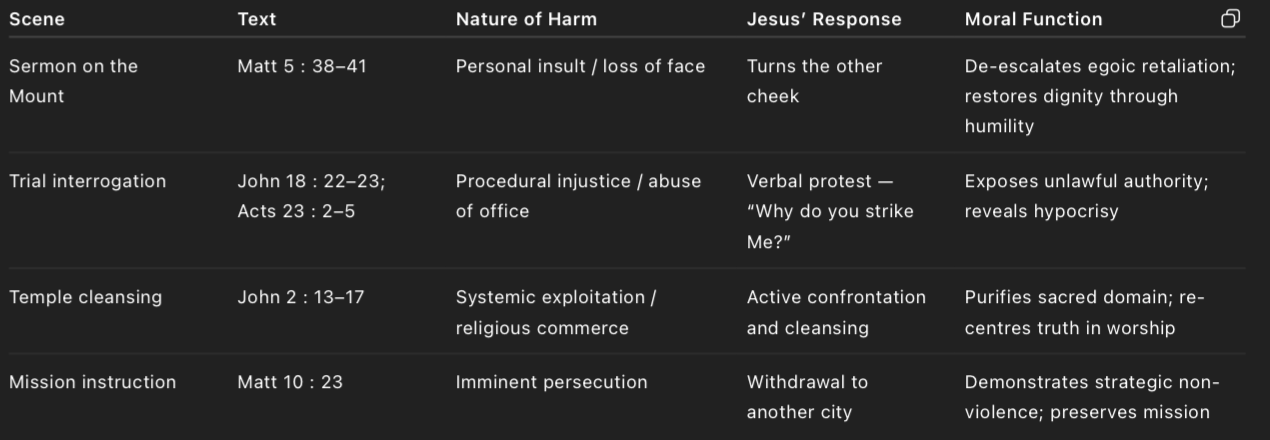
Seen in this light, Christ’s conduct and His command are of one piece. He forbade egoic retaliation but practiced principled exposure. The following Scriptural pattern confirms this moral symmetry.
Mini-Conclusion
Across these scenes the same moral operator—redemptive fidelity—expresses itself proportionally. Private insult elicits restraint; procedural abuse elicits exposure; institutional corruption elicits decisive action; imminent persecution permits withdrawal. The difference lies not in principle but in scale and scope of harm. What appears inconsistent is, in fact, morally harmonic.
The Claritic Filter explains how a single moral operator—redemptive fidelity—manifests differently according to circumstance.Each moral act unfolds through three correlated dimensions:
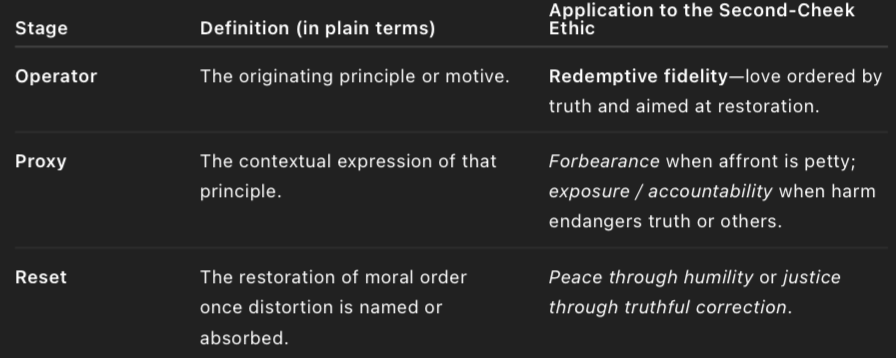
Thus, “turning the other cheek” and “confronting injustice” are not opposites but contextual expressions of the same operator.Both seek to restore correspondence between moral reality and relational order.The disciple’s discernment lies in recognising which proxy will serve restoration rather than pride.
Moral clarity begins before analysis. In the heat of conflict few can calculate scales, but every conscience can pause long enough to ask one question:
“Am I retaliating from ego or responding from principle?”
This instant inquiry exposes motive—the birthplace of all moral error.
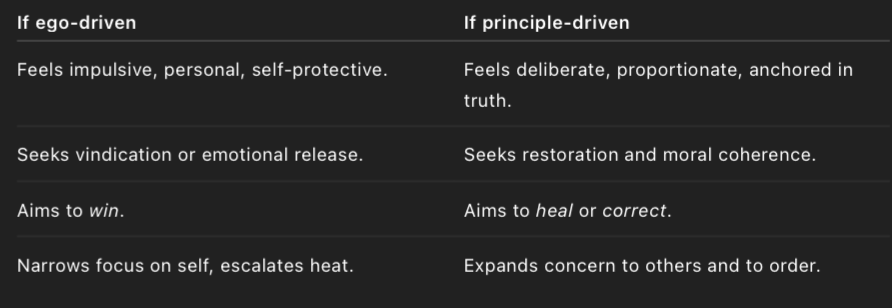
If conscience answers, “I am wounded but not endangered; my pride is speaking,” the proper path is forbearance.If conscience answers, “I am silent while harm multiplies and truth decays,” then confrontation becomes duty.
The Reflex Filter is thus the first motion of the Claritic Filter—testing the Operator (love ordered by truth) within the soul before any outward Proxy or Reset is attempted. It ensures that judgment begins not with circumstance but with posture.
Every axis of discernment moves along a gradient—from harmless irritation to moral hazard.Each has a pivot range where forbearance may still be virtuous but confrontation is becoming obligatory.The sum of these pivots marks the Threshold of Redemptive Necessity—the point where silence ceases to serve peace and begins to enable evil.
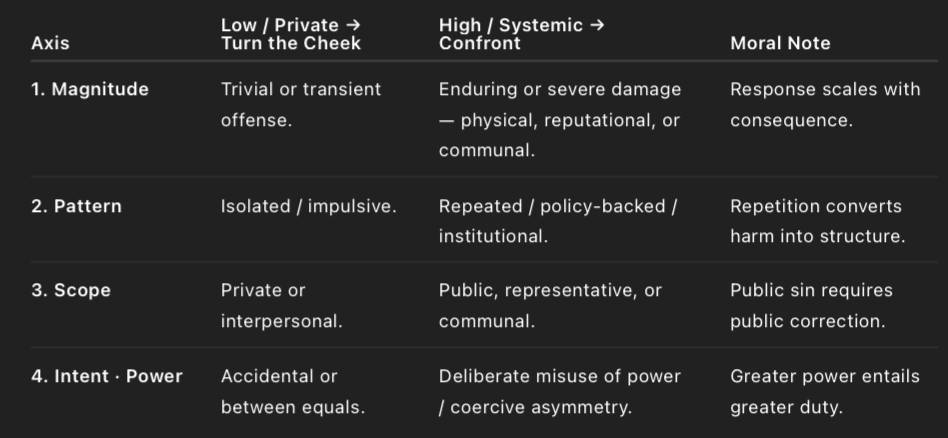
Within pivot zone: seek wise counsel, corroboration, and reflection before acting; question motives and pattern.
Beyond pivot (High): confrontation is morally required; document and appeal through proper channels.
Third-party risk override: if others are harmed or endangered, escalate immediately regardless of personal risk level.
Cumulative effect: several moderate pivots together may equal a High; discernment weighs aggregate moral gravity, not isolated categories.
Low → Pivot: a single harsh remark from an exhausted colleague—address privately or overlook.
Pivot → High: a supervisor habitually humiliating staff—pattern plus power → confront.
High outright: institutional policy harming the vulnerable—public exposure required.
Emotional harm crosses its pivot when it becomes repetitive, manipulative, isolating, or power-weighted—when it reshapes another’s agency or conscience rather than merely wounding feeling.
Safety First “Turn the other cheek” never requires remaining in danger. Immediate separation, help-seeking, and reporting are acts of love for self and others. Where mandatory-reporting laws apply (abuse, harassment, safeguarding), compliance is part of righteous order (Rom 13). Forgiveness may coexist with boundaries; reconciliation does not always restore access. When power asymmetry or third-party risk is high, escalation to authority is charity, not betrayal.
Ego reacts; principle restores.
When peace serves pride it corrupts; when confrontation serves love it heals.The wisdom of the second cheek lies in recognising that boundary.
When confrontation is warranted, it must follow the rhythm of restoration rather than retribution.The Accountability Ladder provides an ordered progression that guards proportion, dignity, and due process.
Question the act — Identify what has occurred and ask for clarification (“Why do you strike Me?”).
Name the violated standard — Law, covenant, conscience, or shared ethic.
Document and involve witnesses — Transparency deters distortion.
Appeal to rightful authority — Use formal channels; avoid vigilante retaliation.
Report when required by law or policy — Safeguarding, harassment, or abuse must be escalated to competent civil or institutional authority.
Separate for safety — Withdraw physically or relationally if harm persists.
Seek restoration, not humiliation — The goal is rectified relation, not moral victory.
Accountability, rightly scaled, becomes redemptive exposure—naming evil without mirroring it.It keeps justice within the bounds of mercy and prevents righteous anger from decaying into pride.
Every moral decision unfolds through the triad of Axiology, Deontology, and Modality—value, duty, and action.The ethic of the second cheek mirrors this architecture, ensuring that moral response remains proportionate and ontologically coherent.
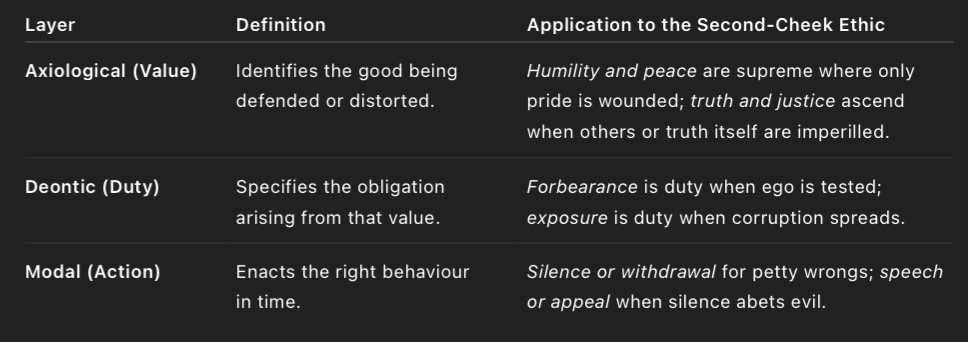
These layers converge at the Threshold of Redemptive Necessity—the moral hinge where continued restraint ceases to purify and begins to enable harm. At that point, love itself demands confrontation. Response must therefore be determined not by temperament but by the kind of reality being injured: relation or order, person or truth.
This triadic calibration corresponds to the vertical–horizontal framework introduced in Supplementum Primum.
The vertical (ontological) axis governs being and truth.
The horizontal (relational) axis governs fellowship and humility.Turning the cheek safeguards peace along the horizontal plane; confronting injustice preserves truth along the vertical.The disciple’s wisdom lies in keeping both axes distinct yet harmonised, so that mercy never betrays justice and justice never abandons mercy.
Principle: Private offense invites private restraint; public wrongdoing demands public accountability. The greater the power asymmetry, the greater the moral obligation to protect the vulnerable.
Some Muslim critiques contrast “turn the other cheek” with Qurʾānic permission for measured retaliation (qisās). Yet this contrast is largely semantic. Christ’s injunction already presupposes measured justice—not its abolition, but its transfiguration through motive. Where qisās limits retribution by law, the Gospel limits it by love. Both seek proportion; the difference lies in ontological orientation: one toward civic balance, the other toward redemptive restoration.
This analysis concerns the ethic of the disciple, not the prerogative of the state (cf. Rom 13 : 1-4). Civil authority rightly restrains injustice by coercive means; the disciple resists moral decay through voluntary grace. The two domains are complementary, not contradictory.
Secular readers often dismiss the command as unworkable idealism. But impracticality vanishes once context and proportion are restored. Turning the cheek is not the suspension of agency but its redirection—away from retaliation toward revelation. The act exposes the aggressor’s moral incoherence without copying it. It anticipates the strategies later called non-violent resistance: power constrained by conscience rather than paralysis.
When caricature is stripped away, the command reveals a universal law of proportion: love scaled to truth. It refuses both passive indulgence and retaliatory escalation. Properly understood, the ethic becomes a bridge for dialogue across traditions—honour culture, Islamic jurisprudence, and secular humanism alike—each glimpsing the same principle: that strength attains perfection only when tethered to mercy.
At its deepest level, the second-cheek ethic reenacts the Divine Double Prerogative within human conduct. Just as God defines, sustains, and rectifies being, the disciple is called to discern, embody, and purify relation.
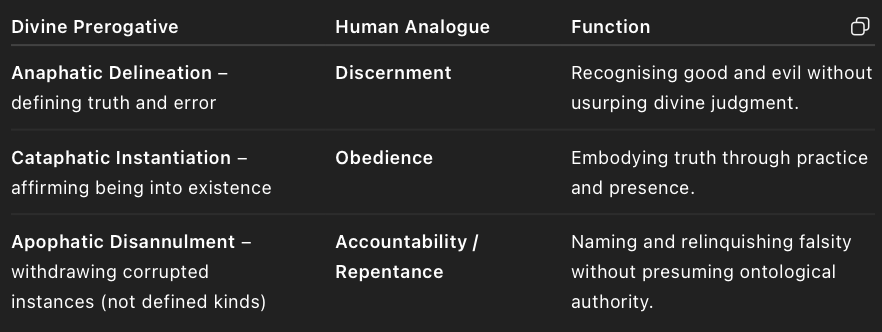
“Turning the other cheek” corresponds to the anaphatic moment of delineation—marking boundary without vengeance.“Confronting injustice” corresponds to the apophatic act of rectification—exposing falsity to preserve being.Both revolve around the cataphatic centre: faithful embodiment of divine truth within history.
Practically, the synthesis is simple:
Private wrongs → restrain, to purify motive.
Public wrongs → confront, to preserve truth.
Systemic evil → expose, to protect others.Each remains an act of worship: humility as reverence, courage as fidelity.
The believer who lives within this rhythm ceases to swing between indulgence and aggression. He acts from ontological clarity: truth governing love, and love restoring truth. In such conduct the second cheek ceases to signify submission; it becomes the emblem of coherence—the cross drawn in conduct, where vertical fidelity meets horizontal mercy.
The command to turn the other cheek is not a summons to passivity but to moral architecture—to the deliberate bearing of truth under pressure. Christ’s ethic does not abolish justice; it re-centres it within mercy. His silence before insult and His protest before hypocrisy arise from the same integrity: love governed by truth.
The disciple who turns the cheek refuses to mirror malice; the disciple who confronts wrongdoing refuses to dignify deceit. Both acts expose disorder by revealing the asymmetry between coercive power and moral clarity. The first restores dignity within relation; the second restores order within being. Together they trace the cruciform structure of divine fidelity—the vertical axis guarding truth in being, the horizontal axis guarding charity in relation. At their intersection lies discipleship itself: where humility safeguards peace and courage safeguards righteousness.
This is the secret strength of the second-cheek ethic. It transforms injury into revelation: power meets integrity, and aggression is unmasked without imitation. Such composure is not weakness but ontological coherence—truth steady enough to suffer without surrender and love strong enough to confront without hatred.
Summary MaximTo yield where love forbids retaliation, and to stand where love forbids silence—this is redemptive fidelity in practice.
Ultimately, the Cross remains its perfect image: voluntary exposure that turns violence into revelation and injustice into disclosure. The one who bears that pattern becomes a living witness that the strength of heaven is measured not by domination but by restraint, and that peace is maintained not by fear, but by proportion.
Across theological history the command “Turn the other cheek” has generated four recurring interpretive streams, each preserving part of the truth yet failing to integrate the whole.Their divergence reveals a persistent vacuum between moral motive, ontological grounding, and practical discernment.
Summary: Reformed and Puritan expositors such as Calvin, Owen, and Watson understood Christ’s command as addressing private vengeance, not public justice. The disciple must bear insult patiently, but magistrates and institutions retain divine authority to punish evil (Rom 13 : 4).
Unresolved tension: This model clarifies office but not motive. It distinguishes who may act, not how discernment operates within conscience. The moral agent’s internal calibration—ego versus principle—remains unexplored. Thus, it safeguards civil order but neglects moral ontology.
Summary: Modern evangelical and moralistic treatments frame the verse as an exercise in personal humility. The aim is imitation of Christ’s meekness—turning the cheek as character formation.
Unresolved tension: While emphasising transformation, this approach collapses all occasions into the same moral register. It risks sanctifying silence where confrontation is needed, offering formation without proportion. It asks the believer to imitate posture but not to discern context.
Summary: Writers from Tolstoy to Gandhi and later Walter Wink read the passage as a charter for non-violent resistance. Wink’s influential exegesis rightly notes the right-cheek insult as social humiliation and interprets turning the other cheek as subversive dignity.
Unresolved tension: This view recovers historical nuance but relocates the centre of gravity from divine prerogative to human agency. It grounds protest in social consciousness, not ontological correspondence. Without a transcendent referent, resistance risks becoming technique rather than obedience.
Summary: Dietrich Bonhoeffer’s The Cost of Discipleship interprets the Sermon on the Mount as the existential expression of grace: the believer’s willingness to absorb evil for the sake of others. Turning the cheek becomes participation in Christ’s own suffering love.
Unresolved tension: Bonhoeffer’s vision captures moral beauty but leaves proportional discernment implicit. His focus on vocation, not architecture, offers inspiration without mechanism. The believer’s obligation to confront structural evil—so central to Bonhoeffer’s life—is assumed rather than defined.
Summary: This framework unites motive, context, and ontology. The Reflex Filter exposes egoic retaliation; the Four-Axis Harm Test scales discernment; the ADM triad grounds action in truth and relation. Redemptive fidelity becomes the single operator harmonising forbearance and confrontation.
Resolution: What earlier streams separate—office from conscience, virtue from justice, pacifism from proportion—this model reunites. It preserves the humility of the disciple, the legitimacy of civil order, and the necessity of confronting falsehood, each within its proper domain.
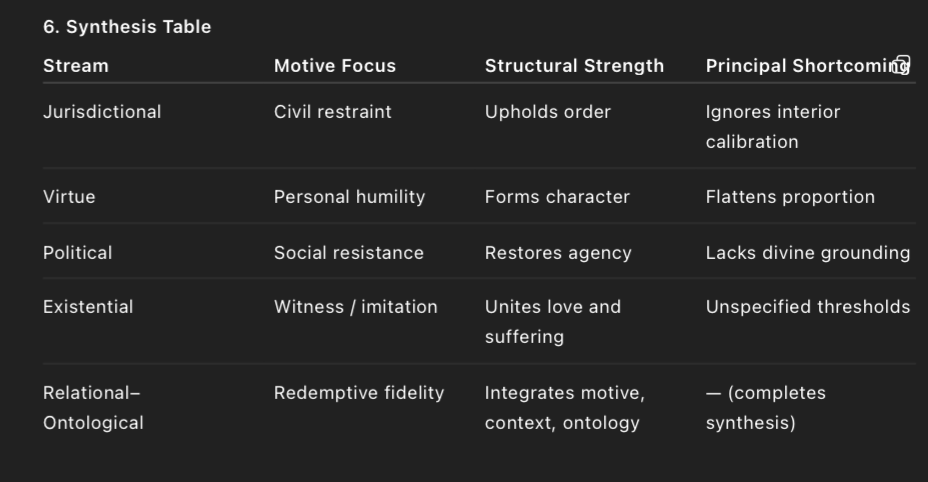
Each historical stream contributes an insight—the Reformed protect justice, the Virtue school preserves meekness, the Political retrieve dignity, the Existential recover participation.Yet none resolve the paradox of Christ’s conduct without collapsing one pole into another.Only when ontology, relation, and discernment are treated as interlocking categories can mercy and justice finally coexist without contradiction.In that harmony the command to turn the other cheek ceases to confuse; it reveals the structure of divine proportion itself.