This essay is offered as a work of theological clarification rather than doctrinal revision. Its aim is not to relax moral seriousness, undermine judgment, or displace established Christian convictions, but to restore order among categories that Scripture itself keeps distinct. This clarification requires distinguishing moral failure from relational rupture. Where longstanding tensions have arisen—particularly around sin, intercession, probation, and judgment—this study proceeds by disaggregation rather than denial. Readers are invited to engage the argument as a diagnostic framework, testing whether its re-ordering resolves interpretive strain without loss of gravity or coherence.
Terminological Clarification. The following terms are used in a technical sense throughout this discussion. Jurisdictionrefers to the relational ordering of moral agency under divine authority — the structure within which standing, accountability, and belonging are determined. Allegiance denotes the fundamental orientation of the moral will toward or against this authority. Standing refers to the recognized relational status of the agent within this order. Alignmentdescribes correspondence between the agent’s allegiance and divine authority. Adoption denotes the juridical establishment of filial standing within the divine order, while regeneration refers to inward moral renewal.
This essay arises from a sustained attempt to resolve a set of dissonance-inducing tensions within the Adventist theological tradition—tensions most clearly felt in its engagement with eschatology, probation, and the close of intercession, particularly as articulated in the Spirit of Prophecy and The Great Controversy. Adventism is unusual among Christian traditions in that it does not leave these themes implicit or metaphorical. It names them directly. Yet precisely because they are named rather than avoided, unresolved structural ambiguities become difficult to ignore.
The dissonance that necessitates this inquiry does not arise in abstraction, but from the attempt to hold together a set of claims Scripture and the Spirit of Prophecy place side by side. The Great Controversy depicts the redeemed surrounding Christ as ordered according to nearness, devotion, and intensity of allegiance, rather than according to degrees of moral flawlessness; yet it also speaks of a people at the close of probation who stand without an intercessor. At the same time, the same framework affirms that moral intelligences prior to Lucifer’s rebellion lived within divine order without yet encountering law as a contested boundary, and yet were unfallen. The issue, then, is not whether law existed, but in what sense it became visible as a contested boundary. Conversely, after the millennial Sabbath—the eschatological rest corresponding to the final day of the cosmic creation week—Scripture does not describe moral perfection as having been newly achieved or completed. The millennium is not presented as remedial or developmental, but as rest, disclosure, and vindication.
If completed moral performance were the criterion distinguishing the final generation, these claims become incoherent: zeal would be morally irrelevant, pre-lapsarian innocence unintelligible, and the Sabbath-shaped character of the millennium distorted.
The unresolved question therefore presses with force: what, precisely, distinguishes those who stand at the close of probation—standing without an intercessor—from those who have walked the salvific path before them? The argument that follows proposes that these tensions arise from a compressed account of sin and a corresponding misapprehension of righteousness. When righteousness is understood not as perfected performance but as settled relational alignment within divine jurisdiction, the relation between sin, intercession, and standing becomes structurally coherent. The tension dissolves only if allegiance, rather than completed moral execution, is what Scripture and the Spirit of Prophecy consistently treat as determinative, and if a jurisdictional account of righteousness restores the full moral grammar of Scripture.
The argument developed here is not that Adventism teaches error, but that it leaves certain foundational assumptions insufficiently interrogated. Chief among these is the operative definition of sin. When sin is functionally treated as exhaustively equivalent to “transgression of the law,” significant downstream consequences follow—especially in how intercession, judgment, and readiness are apprehended. These consequences of such compression are not merely theoretical; they shape lived piety, assurance, and moral psychology.
Scripture itself resists such compression. The law already distinguishes between sins committed in ignorance and sins committed “with a high hand” (Num. 15:27–31, KJV), attaching radically different consequences to each. Any account of sin that treats all failure as morally uniform has therefore already departed from Scripture’s own moral grammar.
Stated plainly: sin cannot be reduced without remainder to transgression, and, correspondingly, intercession cannot be reduced to pastoral support or remedial assistance in response. Neither Scripture nor the Spirit of Prophecy sustains such a narrow symmetry. Where these reductions are assumed, interpretive strain emerges.
Scripture itself robustly resists the equation of sin and transgression. Isaiah writes,
“I have blotted out, as a thick cloud, thy transgressions, and, as a cloud, thy sins” (Isa. 44:22, KJV).
The asymmetry in the text precludes equivalence. Sin and transgression are not interchangeable terms differing only rhetorically; they occupy distinct moral registers.
Scripture operates with a more differentiated moral grammar than is often acknowledged, distinguishing sin, transgression, iniquity, error, and ignorance as non-identical conditions rather than rhetorical variants. The law itself distinguishes failures committed “through ignorance,” providing specific sacrificial provision for such cases and thereby differentiating them from defiant violation (Lev. 4:2, 13, 22, 27, KJV); David speaks of iniquity as a formative condition antecedent to conscious acts—“in sin did my mother conceive me” (Ps. 51:5, KJV); and the psalmist elsewhere distinguishes sin, transgression, and iniquity as morally discrete realities rather than interchangeable terms (Ps. 32:1–5, KJV). Christ Himself prays for those who “know not what they do” (Luke 23:34, KJV), while indicting willful resistance—“ye will not come to me” (John 5:40, KJV)—and explicitly calibrates accountability according to knowledge received: “that servant, which knew his lord’s will… shall be beaten with many stripes; but he that knew not… with few” (Luke 12:47–48, KJV). This grammar is reflected narratively: Rahab’s morally irregular actions are not treated narratively as covenantal defiance, while Rachel’s retention of idols within the covenant household more clearly reflects intentional, premeditated defiance—the kind of known-boundary violation Scripture elsewhere classifies as transgression (Josh. 2; Gen. 31; cf. 1 Sam. 15:24, KJV).
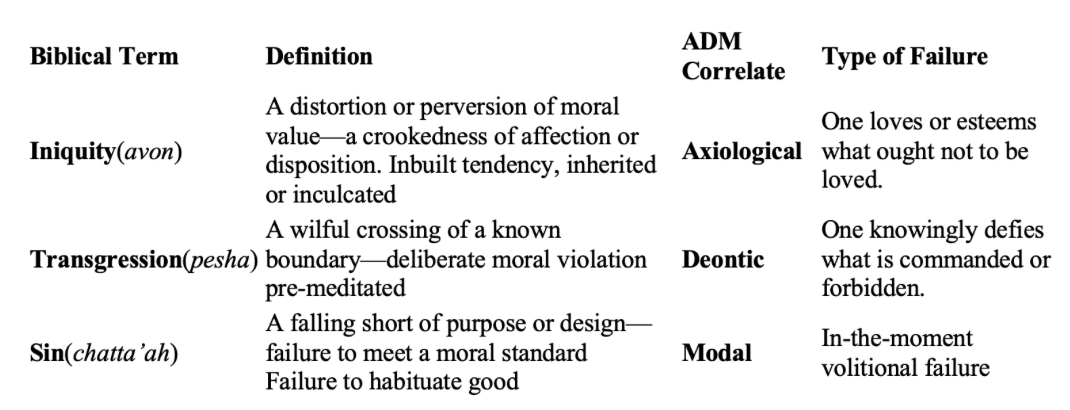
A simplified definition of sin as ‘transgression of the law’—useful in limited pedagogical contexts—cannot therefore be treated as universally exhaustive without distortion. More precisely, sin should be understood as a broader disorder of creaturely misalignment before God, not merely as the discrete act of transgression. At its root, sin begins with displaced allegiance: the creature turns from divine authority toward self-will or rival authority. This inward displacement appears as iniquity — a crookedness or bentness of moral posture. When that posture crosses a known divine boundary, it manifests as transgression. When repeated and normalized, it becomes habituated moral corruption. Transgression is therefore not the whole of sin, but an aggravated and juridically legible form of sin.
- displaced allegiance → iniquity → transgression → habituation/corruption
Sin is expanded to the broader moral taxonomy developed in the Axiological–Deontic–Modal (ADM) framework, where relational posture precedes moral intention and behavioural execution. See ADM Essay for full treatment. Summary slide reproduced below.
A further clarification is required if the tension under discussion is to be properly resolved. The scriptural category of sin appears to operate in more than one register, and the persistent confusion surrounding righteousness and intercession arises in part from a failure to distinguish these registers.
Sin may be understood in at least two distinct senses:
Relational Sin (Separation) — the rupture of allegiance, the rejection of divine authority, or the displacement of the creature from proper jurisdictional alignment with God. This concerns standing, belonging, and covenantal positioning.
Moral Sin (Failure) — the imperfect execution of obedience, developmental weakness, or deviation in conduct occurring within an existing relational alignment. This concerns growth, formation, and the progressive restoration of moral fidelity.
The first concerns jurisdictional position; the second concerns moral performance. The first determines standing; the second describes condition.
The distinction is not artificial but scripturally grounded. Scripture itself speaks of sin both as a condition of separation and as particular acts of transgression. This dual usage is reflected in the declaration of John the Baptist:
“Behold the Lamb of God, who takes away the sin of the world.” (John 1:29)
The singular form is theologically significant. The text does not refer merely to discrete acts of wrongdoing but to a fundamental condition requiring removal — a state of estrangement or separation from God. The work of Christ therefore addresses not merely behavioural failure but the restoration of relational standing.
Failure to distinguish these registers produces a compressed moral model in which every imperfection is treated as a jurisdictional breach. Under such compression, righteousness becomes indistinguishable from flawless performance, intercession becomes a mechanism for compensating behavioural deficiency, and assurance becomes structurally unstable.
Once the distinction is restored, however, the theological architecture clarifies. Judgment concerns relational alignment; sanctification concerns moral restoration. Righteousness pertains to jurisdictional standing; growth pertains to progressive conformity. Intercession therefore operates not to preserve a fragile moral ledger, but to secure the relational position within which moral transformation proceeds.
This distinction provides the necessary conceptual framework for understanding righteousness not as the absence of all moral failure, but as the restoration and maintenance of proper relational alignment under divine jurisdiction.
If sin is understood primarily as jurisdictional rupture — a misalignment of allegiance rather than merely defective moral performance — then righteousness must be understood correspondingly as the correction of that alignment. The two stand in structural symmetry. Where sin represents displacement from rightful authority (Isaiah 53:6; Colossians 1:21), righteousness describes restored orientation within that authority.
Theological discourse has often compressed righteousness into a category of behavioral perfection, treating it as faultless conduct. Yet the forensic and covenantal language of Scripture consistently describes righteousness in terms of standing, recognition, and relational position. Persons are “justified” or “declared righteous” (Romans 3:20–26; Galatians 2:16), righteousness is “reckoned” or “credited” (Genesis 15:6; Romans 4:5), and relational standing may be acknowledged or denied (“I never knew you,” Matthew 7:23). Such language is juridical, indicating status within a covenantal order rather than the completion of moral execution.
Within this framework, righteousness refers primarily to restored relational alignment under divine authority. This positional reality precedes and grounds moral transformation. Scripture consistently places acceptance prior to perfected conduct: the prodigal son is received before restoration of life patterns (Luke 15:20–24), and reconciliation establishes the basis for transformation (Romans 5:1–10; 2 Corinthians 5:18–21). Conduct expresses this alignment but does not produce it (Ephesians 2:8–10; Titus 3:5–8).
Righteousness therefore must be distinguished from perfected execution, though it necessarily produces increasing fidelity. Believers are declared righteous while still undergoing transformation (Romans 5:1; Philippians 3:12–15; 1 John 1:8–2:1). The decisive issue is the ordering of allegiance. Faith itself is presented as relational orientation toward God — trust, submission, and alignment (Hebrews 11:6; James 2:23).
This clarifies the logic of justification. Justification concerns the restoration of standing; righteousness names the state of corrected alignment that results. The declaration of righteousness does not manufacture moral perfection but recognizes the reestablished jurisdictional relation within which transformation proceeds (Romans 8:1–4; Romans 10:3–10).
Such a framework preserves both relational and moral dimensions without collapsing one into the other. Moral failure remains meaningful but is interpreted relative to jurisdictional allegiance. Scripture distinguishes failure within relationship from defiant rebellion: the righteous may fall yet rise again (Proverbs 24:16), Christ intercedes for those who stumble (Luke 22:31–32; 1 John 2:1), yet persistent rejection constitutes rupture of standing (Hebrews 10:26–29).
Righteousness as jurisdictional alignment thus provides the conceptual bridge between sin as displacement and the necessity of its preservation. Scripture describes judgment in terms of “standing” before God (Psalm 1:5; Romans 14:4; Revelation 6:17), denoting maintained alignment within divine jurisdiction. Its stability depends not upon completed moral perfection but upon the fixation of allegiance; where alignment is no longer subject to defection, mediating preservation is no longer required (cf. Revelation 14:12; Daniel 12:1).
Righteousness, therefore, is fundamentally relational, forensic, and jurisdictional. It describes the corrected ordering of allegiance that grounds transformation, stabilizes standing, and defines the agent’s position within the covenantal order — a reality whose preservation directs attention to the nature and function of intercession.
Understanding righteousness as jurisdictional alignment does not imply that the moral agent generates righteousness independently or secures standing by demonstrated fidelity. Scripture consistently describes righteousness as reckoned or credited rather than produced (Gen. 15:6; Rom. 4:5–8), and as a standing grounded in participation in Christ rather than arising from autonomous achievement. The restoration of alignment is mediated through His authority, and the standing that results remains derivative rather than self-originating. To be declared righteous is therefore to be acknowledged as rightly aligned within the jurisdiction established and upheld by Him, possessing a righteousness “not…mine own,” but that which is found “in him” (Phil. 3:9; cf. 2 Cor. 5:21; 1 Cor. 1:30).
This account addresses persistent tensions in Protestant theology since the Reformation concerning the relation between forensic justification and moral transformation. By construing righteousness as jurisdictional standing rather than moral attainment, the present framework offers a structural resolution of difficulties surrounding imputation, legal declaration, and participatory union with Christ.
Probation reveals allegiance, yet the authority under which that allegiance is recognized does not arise from the agent. The declaration of righteousness does not ratify self-generated merit but acknowledges participation in the relational order secured through Christ. Righteousness is therefore neither autonomous achievement nor legal fiction, but derivative standing granted within the covenantal jurisdiction established by divine authority. It is not the reward of moral attainment, but the recognition of covenantal allegiance—the granted standing of one acknowledged as belonging within Christ’s jurisdictional order.
Scripture’s imagery of the robe of righteousness expresses this granted standing. The believer is clothed with a status received rather than achieved (Isa. 61:10; Gal. 3:27), signifying recognized admissibility before God rather than perfected moral execution. This forensic and investiture language is vividly illustrated in the vision of Joshua the high priest, who stands before the Lord clothed in filthy garments and is accused by the adversary, yet is declared acceptable and clothed with clean raiment by divine command (Zech. 3:1–5). The removal of defiled garments and the bestowal of new attire signify not moral achievement but restored standing—granted admissibility within the divine court. The robe marks jurisdictional alignment received rather than righteousness produced.
Imputed righteousness therefore names the granted right to stand within Christ’s jurisdictional order, grounded in His representative authority as the Second Adam. The moral agent’s allegiance is real, yet the standing in which that allegiance is recognized remains wholly derivative and grounded in Him. Justification declares this restored standing, which establishes the basis of the believer’s admissibility before God and defines the condition under which restored allegiance is recognized.
Yet this derivative standing is not to be misunderstood. Allegiance, though decisive, is not self-validating. The creature does not become righteous by producing a rightly ordered will, as though jurisdictional admissibility could arise from alignment alone. Rather, allegiance is the receptive and participatory posture by which the moral agent is found in Christ, in whom alone human righteousness is rightly constituted, authorized, and upheld before God. Thus righteousness, as it appears in the believer, is indeed jurisdictional alignment; yet its validity is wholly derivative, for it is recognized as righteous only within the representative standing and mediatorial fullness of the Son.
This relation is illuminated by Scripture’s own imagery. The righteous are described as “a tree planted by the rivers of water” (Psalm 1), whose stability and fruitfulness arise not from self-placement but from a life received and sustained. Yet this life is not an impersonal provision. Christ Himself declares, “I am the way, the truth, and the life… no one comes to the Father except through me” (John 14:6), identifying Himself not merely as the means of access, but as the living ground in which righteousness subsists. The believer is therefore not sustained by adherence to an external order, but by participation in Him. Alignment, though real, derives its standing not from its own constancy, but from incorporation into Christ, in whom alone righteousness is constituted and made admissible before God.
The nature of this jurisdictional order must therefore be clarified. The relational order established in Christ is not an abstract metaphysical relation but a determinate structure of allegiance grounded in acknowledged authority. Scripture consistently defines this posture as submission to divine authority prior to outcome and independent of visible result—what it names faith (Heb. 11:1, 6; Rom. 1:5; John 14:15). It is characterized by fidelity maintained irrespective of circumstance, supremely embodied in Christ’s filial obedience: “not my will, but thine, be done” (Luke 22:42; cf. Phil. 2:8).
Righteousness therefore describes recognized standing within this structure of allegiance, and justification declares participation in it (Rom. 5:1; Phil. 3:9). The restored relation is thus covenantal, jurisdictional, and concrete: a fixed orientation of trustful submission rather than an indeterminate spiritual condition.
Human righteousness (Isa 64:6) cannot establish relational order before God. Standing is mediated solely through the reconciliation accomplished in Christ; allegiance and receptivity therefore do not generate alignment but receive and maintain the order He establishes.
Because this standing exists under conditions of probation and moral volatility, its preservation requires continuing mediation—a function fulfilled through Christ’s intercessory ministry.
Intercession is the divinely appointed ministration in view of sin, but only insofar as sin threatens allegiance. If sin is reduced to transgression alone, intercession is correspondingly reduced to moral remediation—grace applied to defect, assistance applied to weakness. Yet Christ’s own testimony in judgment resists this framing.
In Matthew 7, those rejected appeal to their religious performance; they are not commended for it. They are rejected on relational grounds: “I never knew you” (Matt. 7:23, KJV). Acceptance is not grounded in output, but in recognition. Likewise, the language of the new birth describes not a progressive condition but a categorical one. One is either born again or not; the decisive change is not temporal achievement but ontological relocation.
Relationship—and more precisely, allegiance—thus precedes performance. Intercession must therefore be understood not merely as the correction of individual failures, but as the preservation of relational standing. Its function is to sustain jurisdictional alignment under conditions of probation, guarding against defection rather than compensating for imperfection. Allegiance does not render obedience optional; rather, obedience is the necessary expression of maintained allegiance (Rom. 6:16–18; John 14:15; 1 John 2:3–6).
Intercession, in this sense, stabilizes the believer’s orientation toward divine authority. It maintains belonging where allegiance might otherwise be displaced, preserving the standing established through restored alignment. Its necessity arises not from the persistence of moral weakness alone, but from the volatility of allegiance under conditions of moral probation.
Many Adventists will respond that salvation has always been understood as relational rather than performance-based. That claim is correct, but often under-examined. The tradition simultaneously affirms probation, the close of intercession, character development, final judgment, and a people who stand without an intercessor at the end of time. It affirms both continued moral development and settled standing. These commitments coexist, but their internal relationships are rarely clarified.
As a result, sin is frequently arrested at the level of transgression, while intercession is treated as the comprehensive remedy—encompassing grace, strength, transformation, and support. Yet many of these operations are not unique to believers. Christ Himself teaches that God “maketh his sun to rise on the evil and on the good” (Matt. 5:45, KJV). If these are intercessory acts, they cannot by themselves explain the distinction Scripture draws at judgment.
Those who wish to avoid reference to the Spirit of Prophecy encounter the same difficulty within Scripture itself. Revelation portrays a final fixity of moral orientation at the close of probation—“He that is just, let him be just still: and he which is filthy, let him be filthy still” (Rev. 22:11, KJV)—indicating that some decisive condition has closed. Yet Christ’s teaching consistently denies that this distinction is publicly discernible or grounded in visible performance. His parables insist that separation is deferred and opaque: the wheat and tares grow together until the harvest, and the net gathers both good and bad without immediate distinction (Matt. 13:24–30, 36–43; 47–50). His judgment warning reinforces the same principle—profession and activity, even works done “in thy name,” do not determine standing; relational recognition does: “I never knew you” (Matt. 7:21–23, KJV).
This logic is made explicit in the case of the thief on the cross, who offers no record of obedience, restitution, or future sanctification, yet is assured, “Today shalt thou be with me in paradise”* (Luke 23:42–43, KJV). His acceptance precedes moral repair or completed obedience and rests upon acknowledged allegiance to Christ’s authority. Scripture thus affirms both final fixity and present opacity: something decisive is settled, yet it is neither publicly legible nor reducible to observable performance. The thief therefore stands as Scripture’s clearest illustration of allegiance fixed without moral completion—jurisdictional alignment secured prior to perfected conduct. He stands forensically justified—declared righteous in standing—his jurisdictional alignment secured prior to perfected transformation.
The tensions addressed here are not uniquely Adventist in origin, but Adventist in visibility. They arise wherever Scripture’s affirmation of final fixity is read through a flattened moral grammar that equates sin with transgression and intercession with remedial assistance. Once this compression is resolved, a jurisdictional account of righteousness restores coherence beyond denominational boundaries wherever similar assumptions have generated anxiety.
*A debate concerning the placement of the comma in this verse lies outside the present discussion.
At this point the pressure in the argument is unavoidable. If Scripture refuses to discriminate finally based on performance, yet still discriminates decisively, then the difference must lie elsewhere. What Scripture consistently assumes—but rarely names—is a jurisdictional boundary.
This jurisdictional distinction is not speculative. Christ Himself treats moral failure differently depending on posture. To some He says, “Neither do I condemn thee” (John 8:11); to others, “Ye will not come to me, that ye might have life” (John 5:40). The acts are not weighed in isolation; the will’s orientation determines the response.
Moral failure is not treated uniformly because it does not occur uniformly. Some failures occur prior to acknowledged authority; others occur within it. Scripture distinguishes between blindness and rebellion, ignorance and defiance, weakness and repudiation—not by minimizing wrongdoing, but by locating it relative to jurisdiction. To sin outside covenantal alignment is not the same moral event as to fail within it.
This distinction is already operative in Scripture’s moral grammar. Christ prays for Peter not that he would not fail, but that his faith would not fail. The issue is not transgression alone, but allegiance. Likewise, Christ’s judgment does not turn on works performed, but on whether the agent is known. These are jurisdictional determinations, not praxeological audits.
The failure to name this boundary—between pre-jurisdictional and post-jurisdictional moral posture—forces Scripture’s categories to collapse. Sin is flattened into transgression alone; intercession is flattened into remedial assistance alone; and the close of probation is misheard as moral completion rather than the fixation of allegiance.
Once this jurisdictional distinction is made explicit, the tensions dissolve. Intercession can have phases without contradiction. Growth can continue without jeopardy. Judgment can disclose without recalibrating. And standing without an intercessor no longer implies moral flawlessness but settled belonging.
The pre- and post-jurisdictional distinction has its origin in Eden. Prior to the Fall, humanity’s moral life was not probationary in the sense later required, because allegiance was unfractured and uncontested. Obedience was neither self-conscious nor secured through mediation; it flowed from unbroken relational alignment with God. The temptation in Eden was therefore not merely to commit a prohibited act, but to accept an alternate authority—to reinterpret reality, goodness, and life itself apart from God’s word (Gen. 3:1–6, KJV). The Fall marks the first jurisdictional defection: not simply moral failure, but a transfer of allegiance that rendered human moral agency unstable. From that point onward, sin assumes multiple forms—error, ignorance, iniquity, and transgression—precisely because humanity now lives under fractured authority. Intercession, probation, and judgment do not arise to repair finitude, but to address this jurisdictional breach. Eden therefore establishes the condition that all subsequent redemptive structures presuppose: moral development now occurs under contested allegiance, until that allegiance is finally fixed.
Once the jurisdictional boundary is made explicit, intercession must be reconsidered accordingly. Contemporary discourse often treats intercession primarily as pastoral support — grace applied to weakness, strength supplied to defect, aid rendered in response to failure. While such descriptions are not false, they presuppose a more fundamental operation.
Scripture presents intercession, especially at moments of crisis, not as therapeutic but as stabilising. Its primary concern is not moral improvement but the preservation of alignment. Christ does not intercede so that failure never occurs, but that allegiance does not collapse under moral stress or failure. His prayer for Peter is decisive:
“But I have prayed for thee, that thy faith fail not” (Luke 22:32, KJV).
Christ does not pray that Peter would not sin, nor that the consequences of sin would be removed, but that his faith would not fail. The distinction is decisive: intercession preserves allegiance, not performance.
Peter’s denial is neither prevented nor excused; what is preserved is jurisdictional orientation. The intercession addresses the risk of defection, not the presence of imperfection. It functions as the maintenance of alignment rather than the repair of conduct.
When intercession is reduced to pastoral support alone, its purpose is mislocated. It becomes merely a response to moral inadequacy rather than a preservative against jurisdictional loss, forcing it to bear explanatory weight it cannot sustain — particularly at the close of probation, where the issue is no longer growth but stability.
Correspondingly, the solution Scripture provides at the jurisdictional level is not regeneration understood as moral renewal, but adoption understood as settled belonging. Regeneration concerns transformation; adoption concerns status and standing. The latter addresses the problem of jurisdictional stability.
Paul is explicit: “Ye have received the Spirit of adoption, whereby we cry, Abba, Father” (Rom. 8:15, KJV).
This distinction does not oppose regeneration to adoption. Regeneration names inward renewal; adoption names juridical standing. Scripture consistently treats the latter as the stabilising category under judgment, without requiring the completion of the former.
Adoption establishes relationship rather than culminating growth. It precedes maturity, training, and formation. An adopted child may be immature or untested, yet their belonging is not provisional; development occurs within security, not toward it.
This clarifies how Scripture can speak of a people who stand at the close of probation without an intercessor. What has been secured is not moral completion but filial alignment. Jurisdiction no longer requires preservation because allegiance has been stabilised. Transformation continues, but jurisdictional mediation has fulfilled its task.
Where adoption and regeneration are collapsed, regeneration is burdened with securing standing, and intercession with producing perfection — tasks Scripture assigns to neither.
Seen in this light, the logic resolves cleanly. Pre-jurisdictional moral posture requires confrontation and disclosure. Post-jurisdictional posture requires stabilisation. Intercession serves alignment, not therapy. Adoption secures belonging, not maturity. And the close of probation marks the end of instability, not the end of growth.
What Scripture forecloses is rebellion, not finitude. What it secures is allegiance, not arrival.
The distinction between allegiance and performance is not an abstract theological construction. It is embodied, decisively, in the life of Christ Himself. Scripture presents Christ not merely as one who performed righteousness flawlessly, but as one whose obedience was fundamentally jurisdictional—rooted in acknowledged authority rather than outcome.
This becomes unmistakable in Gethsemane.
Christ does not approach the cross in a posture of triumphant certainty or untroubled resolve. He trembles. He recoils. He prays that the cup might pass. The moment is not one of visible mastery, but of submission under pressure. Yet it is precisely here that His obedience is perfected—not by performance, but by alignment. Christ’s obedience in Gethsemane is therefore not exemplary because it is emotionally untroubled or morally triumphant, but because authority is acknowledged prior to action. Allegiance is settled before suffering is endured. The order matters.
“Not my will, but thine, be done” (Luke 22:42, KJV).
Nothing is achieved in that sentence. No work is completed. No suffering has yet occurred. What is settled is authority. The question answered is not whether Christ can endure, but whether He will submit. Allegiance precedes execution.
In this sense, Christ’s righteousness consists in invariant allegiance. His righteousness is not merely the absence of transgression, but the uninterrupted maintenance of filial alignment with the Father’s authority. At no point is jurisdiction displaced; at no point does autonomy assert itself. His righteousness therefore consists not simply in flawless conduct, but in the unbroken continuity of relational orientation. What Scripture reveals in Christ is righteousness as perfectly stabilized allegiance.
This is why Scripture can say that Christ “learned obedience”: “Though he were a Son, yet learned he obedience by the things which he suffered” (Heb. 5:8, KJV).
Obedience here is not the accumulation of correct acts, but the maintenance of filial orientation under extremity. Christ does not learn what to do; He manifests to whom He belongs.
To interpret Christ’s life primarily as a record of flawless performance is therefore to miss its governing logic. His obedience is perfect not because it is uninterrupted by strain, but because it is never displaced by autonomy. Even in distress, authority is acknowledged. Even in weakness, allegiance is intact.
Even in distress, authority is acknowledged; even in weakness, allegiance remains invariant. In Christ, righteousness is revealed as unbroken jurisdictional alignment — the exemplar of the standing later secured in those who belong to Him.
Christ’s unwavering allegiance must not be misconstrued as a reduction of salvation to mere jurisdictional alignment divorced from moral purity. His fidelity was not an alternative to sinlessness, but its ontological ground. As covenant head, representative humanity, priest, and sacrificial offering, the Son could not merely remain aligned in intention; He must remain unblemished in manifestation. The sacrificial typology itself requires this: the mediator who stands before God on behalf of humanity must exhibit not only unbroken allegiance but uncorrupted obedience.
It is therefore essential to state plainly that Christ did not sin. His obedience was not incidental but constitutive of His mediatorial vocation. Allegiance, in His case, was not a minimal threshold of jurisdictional loyalty but the uninterrupted communion that issued in flawless moral expression. The Father did not merely accept His intention; the Son’s life was without blemish because the covenant required an unblemished mediator.
This distinction must be carefully maintained. For fallen humanity, restored standing is secured through realignment of allegiance within the covenantal order. Moral formation unfolds within that restored jurisdiction. But Christ is not merely a participant within the covenant; He is its guarantor and embodiment. What is required of the mediator cannot be simplistically equated with what is required of the rehabilitated agent.
Thus, when we speak of allegiance as decisive, we do not diminish the necessity of moral purity in Christ’s life. Rather, we locate its source. His sinlessness flowed from unbroken relational communion. Gethsemane demonstrates not moral deviation but the extremity of fidelity under pressure. There was anguish, but no rupture; struggle, but no rebellion. The integrity of His allegiance preserved the integrity of His obedience.
To confuse this structure would be to invert the logic of mediation. Allegiance grounds obedience; it does not replace it. Allegiance grounds obedience; it does not replace it. In the mediator, both must be perfect.
This Christological pattern clarifies why Scripture consistently resists performance as the final discriminator. If Christ Himself is vindicated first at the level of allegiance— “This is my beloved Son, in whom I am well pleased (Matt. 3:17; 17:5, KJV)”—then the same order must govern those who are “in Christ.”
Standing is established by alignment, not by display. Performance follows, but it does not found belonging. Gethsemane reveals what judgment ultimately weighs: not the absence of struggle, but the refusal of rebellion.
This is why the close of probation cannot coherently be read as the achievement of moral invulnerability. Christ Himself was not invulnerable. What He was, without remainder, was aligned. See footnote.
Allegiance is not progressive but binary, establishing the moral agent’s orientation toward divine authority. Yet this orientation is not inert. Its lived expression is a receptive posture toward divine disclosure during the probationary span of the moral agent.
Such receptivity unfolds according to the measure of light granted and the particular design of God for the individual within His kingdom. Refusal of further light therefore signifies not arrested development but rupture of allegiance itself.
With the grammar of sin restored, the meaning of standing without an intercessor becomes clear. It describes a people whose jurisdictional alignment is no longer reversible, not a people who have transcended finitude or attained moral perfection. What has settled is allegiance, not development. Intercession ceases where its purpose has been fulfilled: if intercession preserves allegiance under probation, its close signals not abandonment but settlement. What ends is not divine involvement, but the possibility of jurisdictional defection.
This is why Revelation declares, “He that is just, let him be just still: and he which is filthy, let him be filthy still” (Rev. 22:11, KJV). The text announces not moral completion but the closure of moral volatility. Scripture forecloses rebellion, not finitude.
This framework also clarifies statements in The Great Controversy concerning the pre-lapsarian relation of moral intelligences to divine law. In this context, “law” does not denote ignorance of divine order, but the absence of any conceivable alternative allegiance. Obedience was not rendered self-conscious because rebellion had not yet become imaginable.
The same clarification explains the depiction of the redeemed surrounding Christ in a gradient ordered by zeal. What is honoured is not differential moral perfection, but allegiance exercised without reserve—even unto death. Proximity reflects intensity of fidelity, not the completion of sanctification. Scripture consistently frames such distinction in terms of fidelity under cost (Matt. 16:25; John 12:25; Rev. 12:11).
This also resolves the question of what distinguishes those who stand without an intercessor from those who have walked the salvific path before them. Salvifically, nothing. The same criterion applies without remainder. Allegiance is fixed prior to the close of probation, whether followed by death or by continued life. The final generation is therefore not more secure, more justified, or more aligned than those who have previously sealed their decision and rested in Christ.
What is unique is not their standing, but their experience. They alone remain alive after the close of probation, maintaining fixed allegiance through the interval between investigative judgment and Christ’s return. Others closed probation and slept; they must close probation and remain. “Standing without an intercessor” therefore names a historical condition, not a superior salvific state. God’s criteria do not change at the end of time; only the conditions under which they are lived.
The entire question resolves at the level of jurisdiction. Where righteousness is understood as corrected alignment and intercession as the stabilization of that alignment, the close of probation marks not the attainment of moral perfection but the fixation of relational orientation. What is secured is standing.
Under this framework the tensions that generated anxiety dissolve without dilution. Sin retains its seriousness without becoming monolithic; judgment retains its finality without arbitrariness; intercession retains its necessity without being extended indefinitely. Sanctification remains lifelong and essential, but it is no longer charged with securing belonging.
Scripture discloses not a calculus of moral sufficiency but a determination of allegiance. The decisive question is not whether enough has been achieved, but whether defection has occurred. Belonging is established prior to completion; performance becomes expressive rather than constitutive.
Accordingly, the close of probation marks a transition in moral condition — not from imperfection to perfection, but from volatility to stability. Growth continues, obedience remains meaningful, and judgment remains real; what ceases is the possibility that ongoing moral development might overturn standing. Jurisdiction is settled, allegiance fixed, belonging secured and standing no longer contingent.
What has been argued here is not a relaxation of moral seriousness nor a redefinition of judgment, but a restoration of order. Scripture consistently treats allegiance as prior to performance, jurisdiction as prior to evaluation, and belonging as prior to completion. When sin is allowed its full moral grammar and intercession is understood as stabilizing alignment rather than compensating for defect, the anxiety long accompanying eschatological reflection dissolves without loss of gravity.
Standing without an intercessor is thus revealed not as the achievement of moral invulnerability, but as the fixation of allegiance — an end to volatility, not an end to growth. What is finally closed is not formation, but rebellion. What remains is obedience without terror, judgment without confusion, and belonging secured in settled allegiance.
The Edenic prohibition structurally anticipates the First Commandment insofar as both concern exclusive allegiance to divine authority and the rejection of autonomous moral self-determination. Yet Eden operates at a more primordial ontological level than the later Decalogical codification. The First Commandment juridically articulates under fallen conditions what Eden ontologically presupposed in unfallen relational order. Prior to rebellion, allegiance existed as lived relational reality rather than consciously foregrounded prohibition. Rebellion therefore did not create the reality of law, but disclosed it contrastively through the emergence of rival allegiance and ontological insurgency.
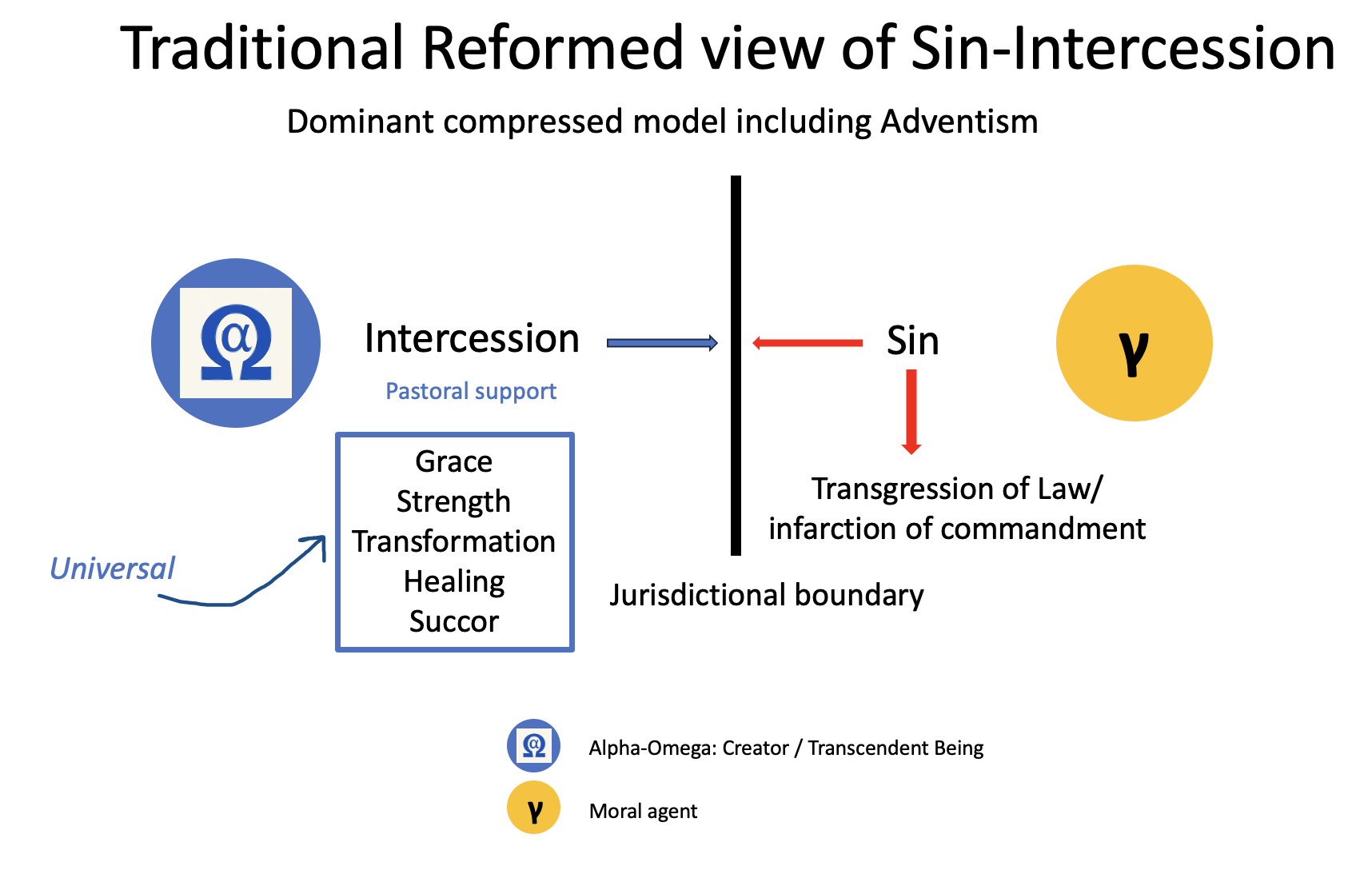
Legend – Compressed Sin–Intercession Model
This diagram represents the dominant compressed model of sin and intercession characteristic of traditional Reformed theology and commonly assumed within Adventism.
Sin is functionally identified with transgression of law, and intercession is correspondingly reduced to pastoral or remedial support addressing moral failure. Jurisdiction is treated as a static boundary rather than a dynamic category of allegiance, with justification and sanctification bearing the weight of standing.
This compression obscures upstream distinctions within sin itself and conflates jurisdictional alignment with formative moral processes, generating downstream tensions in eschatology, judgment, and the doctrine of the close of intercession.
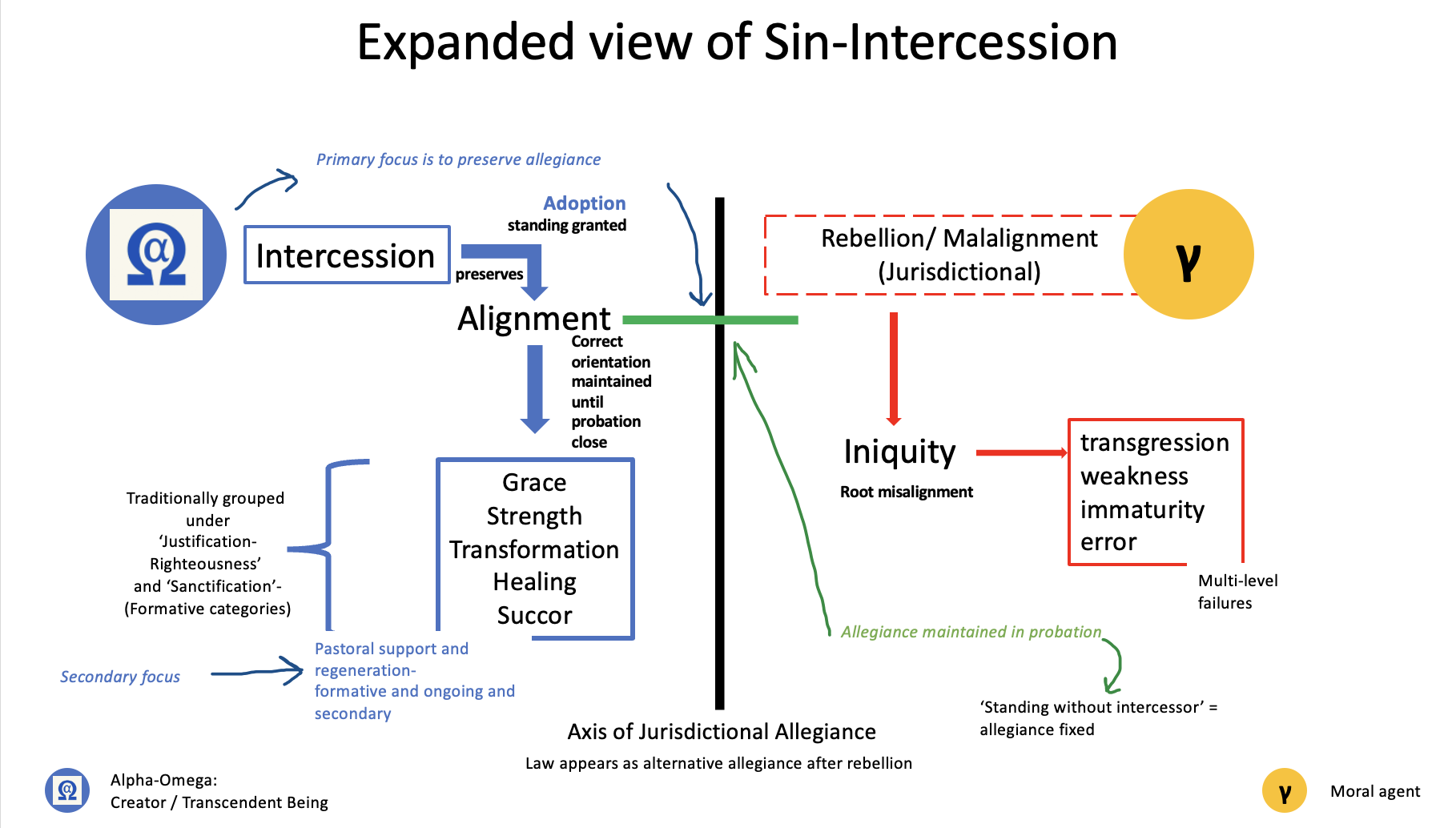
Legend – Expanded Jurisdictional Model
In this expanded model, intercession functions primarily to preserve allegiance during the probationary period.
Jurisdictional alignment secures standing, while regeneration and sanctification remain formative and ongoing.
Sin is structurally differentiated: iniquity names the misalignment of allegiance, from which acts such as transgression, weakness, immaturity, and error proceed.
The close of intercession marks the stabilization of allegiance rather than the completion of moral formation.
Law functions as an alternative allegiance and emerges only where rebellion occurs.
Several recurring biblical motifs resonate with the jurisdictional account of righteousness proposed here. The imagery of investiture in Zechariah 3 portrays Joshua the high priest clothed in defiled garments, accused by the adversary, yet declared acceptable and clothed with clean raiment by divine command. The change of garments signifies restored admissibility within the divine court rather than completed moral transformation, suggesting righteousness as granted standing rather than perfected conduct. Likewise, Pauline descriptions of believers as being “in Christ” (Rom. 8:1; 2 Cor. 5:17; Phil. 3:9; Eph. 1:3–14) depict a sphere of covenantal participation in which acceptance rests upon relational belonging rather than autonomous moral achievement. The designation of Christ as the “Second Adam” (Rom. 5:12–21; 1 Cor. 15:45–49) further grounds this standing in representative authority, locating righteousness within participation in His jurisdictional order. These scriptural patterns collectively support the distinction between granted standing and progressive formation that underlies the present account.
Footnote
This framework does not imply that salvation is restricted to those with explicit cognitive knowledge of Christ. Rather, judgment is rendered according to light received, as Christ Himself teaches: “From everyone who has been given much, much will be demanded” (Luke 12:48). For those who have not known Christ explicitly, allegiance is assessed through faithful response to the moral truth genuinely apprehended, not through meritorious performance but through submission to what is revealed.
Scripture itself distinguishes between incomplete obedience, episodic moral failure, and active moral harm. Kings such as Asa and Jehoshaphat are explicitly affirmed as having hearts aligned with God despite serious omissions and even moments of wrongful action, for which they are rebuked but not declared apostate. Their failures—whether incomplete reform or misguided alliances—are treated as morally significant yet categorically distinct from sustained, coercive wrongdoing.
By contrast, where negative performance becomes persistent and destructive, particularly through the misuse of authority under heightened revelation, Scripture increasingly treats such action not as secondary failure but as evidence of serious moral fracture and escalated accountability. In all cases, Christ remains the ontological ground of salvation; the difference lies not in the standard of justice, but in the degree of revelatory access and in how that light is honoured, neglected, or turned against others.