What happens to morality when nobody else is there? At first the question appears straightforward. Public morality operates within familiar structures of observation, reputation, law, reciprocity and accountability. Other people can see what we do, can be affected by it, and may possess legitimate claims upon our conduct. Remove those people, and much of the ordinary architecture by which moral behaviour is assessed appears to disappear with them.
Christian theology seems to supply an immediate answer: nobody is ever truly unobserved, because God remains. Yet this answer, although true, is insufficiently discriminating. It risks treating God as an invisible human spectator and reproducing public propriety in private simply because an omniscient observer has replaced the human audience. The opposite error is equally unsatisfactory: if nobody else sees an act and nobody else appears to be affected by it, privacy becomes a zone of moral licence. Both approaches confuse observation with moral claim.
An observer possesses epistemic access to an event; a claimant possesses moral standing in relation to it. These frequently coincide, but they need not. The owner of lost property retains a claim upon it while being entirely absent and unaware of its location. Conversely, a person may observe an action without possessing any legitimate claim concerning it. The fact that God sees everything therefore establishes that nothing is epistemically hidden from Him, but it does not, by itself, establish what He has prohibited. Divine observation and divine prohibition are not synonymous.
This distinction opens the first axis of the present inquiry: the relational topology of privacy. What remains morally binding as human observation, interaction and finally anthropic claim are progressively removed? Which obligations survive absence because another person's legitimate standing persists, and which disappear because the relation that generated them is genuinely absent? Christian privacy, on this account, is not the absence of all relationship. The creature remains before God. It is the absence of particular human relationships and claims.
A second axis then emerges within the moral agent himself. Much of private morality occurs before anything recognizable as external conduct has happened. A thought appears; an image is apprehended; anger arises; an attraction is experienced; a morally objectionable possibility becomes intelligible. The mind may reject it, examine it, remain uncertain about it, or deliberately nourish it. These states cannot responsibly be collapsed into the single category of thought. To reject a proposition intelligently, one must first apprehend and sufficiently comprehend it. The presence of morally charged content within consciousness therefore cannot, by itself, tell us what the agent has done with that content.
Scripture places an important constraint upon any account that would collapse these stages. Christ was “in all points tempted like as we are, yet without sin” (Hebrews 4:15). Genuine temptation must become sufficiently intelligible to constitute temptation, yet intelligible temptation is not thereby sin. The wilderness narratives reinforce the distinction: Christ comprehends the alternatives presented to Him and rejects them. Morally objectionable possibilities can therefore be cognitively present without becoming culpable moral possessions.
There must consequently be an interval between apprehension and determination within which the moral agent evaluates what has appeared before consciousness. This essay calls that space the adjudicative interval. Its purpose is not to invent a new catalogue of private permissions and prohibitions, but to map the conditions under which private moral attribution becomes intelligible. The argument will move from the circumference of privacy—observation, relation and claim—into the internal architecture of moral cognition, before testing the resulting model against Scripture and the principal historical grammars of Christian moral agency.
Privacy is easily mistaken for invisibility, yet ordinary moral experience demonstrates why the two cannot be equated. Consider first the road. Traffic regulation exists largely because roads are spaces of actual or potential interaction. A driver may encounter no other vehicle for miles, but the absence of an immediate observer does not automatically dissolve every obligation. The road remains a shared system, other users may appear, and some rules regulate risks whose possible victims are merely absent at the present moment.
Entrusted performance removes observation further without removing responsibility. A postal worker may handle an item while neither sender nor recipient can see what occurs. Nevertheless, the worker remains responsible because the object has been entrusted to him within a relational and institutional chain. Direct supervision is weak, but the claim survives.
Lost property makes the distinction still clearer. The owner of a wallet may be hundreds of miles away and may have no idea who has found it. His absence nevertheless does not extinguish his ownership. Likewise, a vendor who leaves produce beside an honesty box is absent as observer but remains present in the moral field as owner. The purchaser's opportunity to take the goods undetected does not eliminate the vendor's claim.
These examples do not form a simple empirical scale of decreasing supervision. They vary across several independent dimensions: observation, potential interaction, entrustment, ownership, institutional accountability and relational standing. Their function is conceptual. By progressively removing features of the public moral field, they reveal which features actually ground obligation.
The crucial transition occurs not when the observer disappears but when the claimant disappears.
A moral claim can therefore exist in absentia. Ownership, promise, covenant, confidence and entrustment are obvious examples. A spouse need not discover a betrayal in order to have been betrayed. A creditor need not know that assets have been concealed in order to possess a claim upon them. A confidence can be violated while the person to whom it is owed remains entirely unaware.
This means that physical solitude establishes almost nothing about genuine moral privacy. A man sitting alone in a room may be contemplating the misuse of entrusted funds, the betrayal of a confidence or an intention to injure another person the following day. No other person is physically present, yet their claims already enter the moral episode.
Privacy must therefore be defined act-relatively. The relevant question is not simply whether another human being is present, but whether another human agent possesses moral standing in relation to the particular act, intention or decision under consideration.
We can consequently distinguish direct anthropic interaction, entrusted accountability, anthropic claims in absentia, and finally genuine anthropic privacy. The last occurs only when no other human agent possesses a presently operative claim upon the moral episode under consideration. This is a limiting case rather than a synonym for solitude.
Even at that limit, however, the Christian moral field does not become empty. The creature remains in relation to God. This is the invariant relation within the present analysis, whereas human relations are contingent upon the particular persons, obligations and claims involved.
The distinction matters because it prevents privacy from becoming either licence or disguised publicity. Human claims cannot be abolished merely because their holders are absent; equally, human claims cannot be invented where no relevant human relation exists. The first error understates obligation. The second manufactures it.
The moral circumference of privacy is therefore established by asking not merely Who sees? but Who has standing here, and why? Only after those relations have been identified can the substantive moral character of the private act be adjudicated.
Matthew 6 provides an unusually clear theological demonstration that divine observation does not abolish genuine privacy. Christ repeatedly contrasts conduct performed before human beings with conduct performed “in secret.” Almsgiving, prayer and fasting may be removed from the human audience whose approval would otherwise alter their motivational structure, while “thy Father which seeth in secret” remains.
If God's observation simply recreated publicity, the distinction would collapse. Nothing would meaningfully occur in secret because the most important observer would always be present. Yet Christ's argument depends upon the removal of the human audience being morally significant. Divine relation persists while anthropic publicity genuinely disappears.
God's omniscience therefore answers the epistemic question—whether the private act is known to Him—but does not independently answer the normative question of what God requires concerning it. To reason from God sees this directly to God prohibits this would require an additional premise specifying the relevant divine claim.
This is particularly important in private morality because reverence can otherwise become an unspecified source of prohibition. An act may feel inappropriate if imagined as occurring “in front of God,” and that feeling may then be treated as evidence that God forbids it. But the Christian moral question must remain more precise: what claim has God actually made upon this conduct, disposition or expression?
Anger provides a useful example because Scripture itself refuses to make affect and culpability synonymous. “Be ye angry, and sin not” (Ephesians 4:26) establishes at minimum that anger and sin are analytically distinguishable. Anger may arise from wounded pride, malice or envy, but it may also arise from the perception of injustice. Its mere phenomenological presence does not determine its moral character.
The appropriate questions concern its object, motive and telos. Why has the anger arisen? Is the underlying evaluation correct? Is another person's legitimate claim being violated by its expression? Is the agent nourishing malice or simply recognizing that something wrongful has occurred? Does he possess authority to act upon the judgment he has made?
The same reasoning applies to private speech. Suppose a person entirely alone strikes his thumb with a hammer and utters an expletive. The expression has been externally instantiated, yet external instantiation alone cannot establish its culpability. There is no human audience in the immediate episode to insult, intimidate, scandalize or degrade. The example therefore isolates the analytical question rather than predetermining its answer: does the expression itself violate an invariant divine claim?
That question requires separate adjudication. Biblical injunctions concerning corrupt, abusive, obscene, blasphemous or otherwise illegitimate speech must be interpreted according to their actual scope. If those injunctions establish that the private utterance itself violates a divine prohibition, the absence of an anthropic claimant does nothing to legitimate it. If they do not, the fact that God heard the utterance cannot independently supply the missing prohibition. The example therefore demonstrates only that external instantiation and divine observation are insufficient, by themselves, to establish culpability; it does not presuppose a conclusion concerning the morality of profanity.
The conditional principle is consequently more precise: where no anthropic claim is implicated and no applicable invariant divine prohibition has been established, divine observation alone cannot create a prohibition that has not otherwise been demonstrated.
This reveals why private morality cannot be reduced to the external form of an act. Identical words may perform different moral functions in different relational settings. Anger may be legitimate in its perception yet illegitimate in its expression. A correct moral judgment may nevertheless be followed by an action for which the agent possesses no jurisdiction.
The distinction between moral perception and moral jurisdiction will become increasingly important. Recognizing wrongdoing does not automatically authorize punishment. Experiencing justified anger does not confer a right to vengeance. Conversely, relinquishing vengeance does not require the agent to pretend that the wrongdoing was morally insignificant.
Thus privacy does not dissolve morality; it exposes the variables ordinarily concealed by public convention. Once audience and reputation cease to do the analytical work, moral classification must turn toward relation, motive, telos, jurisdiction and the actual content of the divine command.
The relational analysis establishes who possesses standing, but it does not yet explain how the moral agent recognizes that standing. Before a person can determine whether another possesses a claim, whether an impulse is legitimate, whether an intention should be rejected or whether a contemplated response exceeds his jurisdiction, he must judge.
This connects private morality with the broader adjudicative architecture already developed within Submetaphysics. Reality is encountered; something is apprehended; distinctions are made; those distinctions are evaluated; a determination follows; conduct may then instantiate that determination. In simplified form, the architecture is:
reality → apprehension → distinction → evaluation → determination → conduct.
Private morality requires us to increase the resolution within the interval between apprehension and determination. That is because morally charged content can enter consciousness long before the person has decided what relation he will bear toward it.
An unwanted image may appear without invitation. A proposition may be presented by another person. An attraction may be immediately experienced. Anger may precede reflective judgment. Memory may reproduce material the person has already rejected. None of these phenomena, considered merely as phenomenological occurrences, establishes what the moral agent has determined concerning them.
Rejection itself demonstrates why some interval must exist. One cannot reject what has not been apprehended, and intelligent rejection ordinarily requires sufficient comprehension to identify what is being rejected. In difficult cases, comprehension may require sustained evaluation: comparison with moral principles, examination of motive, consideration of relevant claims, or reflection upon possible consequences.
The crucial premise is supplied canonically rather than merely phenomenologically. Christ was genuinely tempted and yet without sin. His temptations were sufficiently intelligible to be answered and rejected. Therefore at least some apprehension, comprehension and evaluation of morally objectionable possibilities can occur without culpability.
The conclusion can now be stated more rigorously:
Because morally objectionable possibilities may be genuinely apprehended, comprehended and rejected without sin, apprehension and the evaluative processing necessary for rejection cannot themselves be sufficient conditions of culpability.
This does not mean that processing is automatically innocent. Deliberation can become rationalization; a person may deliberately avoid an obvious conclusion, selectively manipulate evidence or continue “examining” a proposition because examination provides cover for enjoyment. The argument establishes cognitive latitude, not cognitive immunity.
The distinction required is therefore not simply between thought and action. The moral agent can bear several different relations toward the same cognitive content. He may apprehend it, understand it, evaluate it, reject it, remain genuinely uncertain about it, endorse it, nourish it, authorize a course consequent upon it, or instantiate that determination in conduct.
This suggests a provisional topology:
apprehension → comprehension → appraisal → rejection / suspension / assent → cultivation → consent → instantiation.
The sequence should not be read as a rigid chronology. It is a map of morally distinguishable relations rather than a pipeline through which every moral episode must pass. Some relations may occur almost simultaneously; some may be revisited; and some branches may never occur at all. Rejection may require prolonged processing, while consent to act may follow assent without any intervening period of cultivation. Cultivation identifies sustained voluntary nourishment of content, not a mandatory stage between assent and action.
What matters is that phenomenological presence and moral ownership are not synonymous. A thought can remain present after it has been rejected. An emotional response can outlast the judgment that repudiated the action it initially suggested. Conversely, a thought may be embraced almost immediately and cultivated without ever becoming externally visible.
The next stage of the inquiry must therefore examine these internal relations more closely. In particular, it must distinguish processing from cultivation, because duration, recurrence and emotional intensity cannot by themselves tell us whether the mind is judging morally charged content or has begun voluntarily to nourish it.
The adjudicative interval begins when morally relevant content becomes present to consciousness but before its presence has been adequately classified as moral ownership. The first task is therefore to distinguish the operations occurring within that interval.
Apprehension denotes the presence of content to consciousness. The content may be sought or unsought, voluntary or involuntary in its arrival. A memory may recur; an image may intrude; another person may articulate a proposition; anger may arise before reflective judgment; an attractive object may simply be perceived. Apprehension establishes that something has entered the cognitive field. It does not establish what the agent thinks ought to be done with it.
Comprehension concerns intelligibility. The agent understands sufficiently what the content means for it to become an object of judgment. This distinction matters because morally responsible rejection ordinarily requires some degree of comprehension. One cannot intelligently refuse a proposition whose meaning has never been understood.
Appraisal is the evaluative operation by which the agent begins to determine the moral significance of what has been apprehended and comprehended. Is it true or false? Permissible or prohibited? Legitimate or illegitimate? Does another person possess a claim? Does Scripture speak to the matter? Does the agent possess jurisdiction to act upon the judgment? What motive is operative, and toward what end?
Appraisal may be almost instantaneous where the relevant moral rule is clear. In unfamiliar or complex cases it may require sustained reasoning. Duration therefore cannot itself establish culpability. A proposition entertained for several minutes may be undergoing serious moral interrogation, while another may be embraced almost immediately.
If appraisal were itself equivalent to endorsement, serious moral reasoning would become impossible. The agent would become culpable merely by examining sufficiently carefully the proposition he must decide whether to reject.
Appraisal may terminate in several different relations to the content.
The first is rejection. The agent judges the proposition, impulse or contemplated course illegitimate and refuses it. Rejection does not necessarily cause the corresponding phenomenology immediately to disappear. An image may recur after it has been repudiated; anger may remain physiologically present after vengeance has been rejected; an attraction may persist after the agent has determined that its pursuit would be wrongful. Persistence therefore cannot, by itself, prove that rejection was insincere.
The second possibility is suspension. The agent has not yet reached a determination because relevant information is missing, competing obligations require comparison, or the moral status of the episode remains genuinely unclear. Suspension is not equivalent to endorsement. It can be the appropriate posture of a finite agent who recognizes that judgment has not yet been responsibly completed.
Yet suspension can also be abused. A conclusion that is already sufficiently evident may be indefinitely postponed because the agent dislikes its consequences. What presents itself phenomenologically as continued inquiry may in fact be evasion. The moral significance of suspension therefore depends partly upon the integrity with which adjudication is being conducted.
The third possibility is assent: the agent interiorly endorses the proposition or moral orientation under consideration. Assent need not yet produce externally visible conduct. It nevertheless represents a change in the agent's relation to the content. What was previously merely apprehended and evaluated has now been accepted.
This helps explain why circumstances can become revelatory. An agent may profess one determination while no practical demand yet tests it. When circumstances eventually make that determination operative, conduct can disclose whether the profession represented the governing state of the will. Biblical testing repeatedly exhibits this structure: Israel in the wilderness, Abraham under demand, and Peter under threat each encounters circumstances in which professed or presumed commitments become practically consequential.
A discrepancy between profession and conduct cannot automatically be classified as hypocrisy. It may reveal hypocrisy, but it may also reveal fear, weakness, confusion or a modal failure inconsistent with an otherwise genuine allegiance. Human observers often possess only the external discrepancy from which to infer the upstream state. God, by contrast, judges the heart as well as the act and requires no such inferential limitation. Circumstances may therefore expose what is interior without implying that every failure proves the previous profession fraudulent.
The most important distinction within the adjudicative interval may be that between processing and cultivation, because the two can be phenomenologically similar.
Both can involve attention. Both can involve imagination. Both may involve repetition, emotional engagement and extended duration. The difference lies not primarily in how long the content remains before consciousness but in what the agent is voluntarily doing with it.
Processing sustains or develops content for the purpose of adjudicating it. A difficult moral question may need to be imaginatively instantiated before its consequences can be understood. Anger may need to be examined before its object and proportionality can be evaluated. A troubling proposition may require repeated consideration before the agent can identify precisely why it is false or impermissible.
Cultivation sustains or develops content because the agent has elected to nourish it. Imagination is no longer merely serving adjudication; it is being employed to preserve, intensify or enjoy the content itself.
This distinction prevents mixed language about desire from obscuring the underlying volitional structure. Suppose a person says that he wishes to reject an illicit fantasy but deliberately prolongs it because he enjoys its presence. The wish that he did not enjoy it may itself be genuine, but it does not make the deliberate preservation of the fantasy neutral processing. To the extent that the content is voluntarily sustained for its pleasure, it is being cultivated.
Cultivation, however, is not intrinsically culpable. One may cultivate gratitude, compassion, marital affection, righteous indignation, intellectual curiosity or delight in truth. Cultivation identifies a relation of voluntary nourishment; its moral character depends upon the legitimacy of its object, motive, end and relational context.
The distinction can therefore be stated succinctly:
Processing sustains content for adjudication; cultivation sustains content because the agent has elected to nourish it. Duration is not the threshold. Volitional orientation is.
The adjudicative interval consequently provides neither a presumption of guilt nor a sanctuary from moral responsibility. Its function is discriminatory. It allows morally different relations to cognitively similar content to be identified before culpability is assigned.
If phenomenological presence does not establish moral ownership, content alone cannot supply a complete moral classification.
Similar cognitive material may occur within radically different moral episodes. Sexual imagery may arise involuntarily, be deliberately cultivated toward an illicit object, or be intentionally entertained within legitimate marital intimacy. An image of punishment may express sadistic pleasure, serious reasoning about justice, emotional processing after injury, or an attempt to relinquish vengeance by bringing the matter before God. Anger may arise from wounded vanity or from accurate recognition of wrongdoing.
The question What was in the mind? is therefore necessary but insufficient. Moral attribution also requires the questions Why was it there? What was the agent doing with it? Toward what end? Whose claims were implicated? What authority did the agent possess?
This is not an attempt to dissolve objective morality into subjective intention. An illegitimate object does not become legitimate because the agent reports a benevolent motive. Rather, moral attribution is multidimensional. Object, motive, telos, relation and jurisdiction constrain one another.
Motive concerns why the agent acts or sustains a particular cognitive orientation. Telos concerns the end toward which that orientation is directed.
The two frequently overlap but should not be collapsed. A legitimate end can be pursued from a corrupt motive; an understandable motive can be directed toward an illegitimate end. A person may seek justice because he genuinely values what is right, or because the language of justice provides respectable cover for hatred. Conversely, compassion may motivate an intervention whose intended end exceeds the agent's authority or violates another legitimate obligation.
Relational context further constrains both motive and telos. Where another human being possesses a legitimate claim, the agent cannot evaluate his purposes as though he were morally isolated. Where no anthropic claim exists, the analysis turns more directly toward whatever divine claim governs the object, motive or end.
This is why genuine privacy does not make motive sovereign. It removes certain relational variables; it does not abolish objective moral order.
A further distinction is required between perceiving what ought to occur and possessing authority to bring it about.
A person may correctly judge that another has acted unjustly. He may legitimately desire that justice be done. Neither judgment automatically confers jurisdiction to punish the offender himself.
Romans 12 makes the distinction explicit in the case of vengeance: “Vengeance is mine; I will repay, saith the Lord” (Romans 12:19). The prohibition does not require the injured person to redescribe evil as good or to cease recognizing the injustice. It limits what the injured person may claim as his own moral jurisdiction.
The imprecatory Psalms are instructive in this respect. Severe judgments and demands for divine intervention can be articulated before God without the Psalmist thereby acquiring unlimited personal authority to instantiate the requested judgment. The moral perception and affect are brought before the Judge rather than simply converted into private vengeance.
Other biblical material prevents this distinction from becoming a justification for malice. Proverbs warns against rejoicing when an enemy falls (Proverbs 24:17–18), and Christ commands love of enemies. The desire that justice be done must therefore itself be examined for motive and telos. The fact that one has relinquished personal vengeance to God does not automatically sanctify delight in another person's suffering.
The broader principle nevertheless remains:
Moral perception does not confer moral jurisdiction.
This distinction also clarifies forgiveness. To forgive an offender need not require the injured party to declare that no wrong occurred. Nor does forgiveness automatically restore trust, eliminate legitimate consequences or recreate every previous relation. The wrong, the response to the wrong, the authority to impose consequences, and the future structure of the relationship are distinguishable moral questions.
A final distinction concerns the movement from interior determination toward conduct.
Within the terminology of the present model, assent means interior endorsement. Consent is used more narrowly for action-facing volitional authorization: the determination that the endorsed course may now be instantiated. This usage should be distinguished from historical theological accounts in which consent may itself designate interior willing or endorsement. The terminology here is stipulative and analytical rather than a claim about universal theological usage.
Instantiation occurs when the determination becomes conduct.
The distinction is useful because culpability cannot be mapped simply onto externality. An interiorly cultivated lust may never become bodily action and yet already possess moral significance. Conversely, an externally instantiated act is not culpable merely because it has crossed from thought into behaviour.
The private-expletive example illustrates only this latter analytical point. An utterance can be fully instantiated while occurring without any anthropic claimant in the immediate episode. Its externality does not itself establish its moral status. Whether the expression is culpable depends upon whether its object, motive or character violates an applicable divine prohibition. The example therefore does not establish the permissibility of private profanity; it establishes that instantiation and culpability are separate variables whose relation must be morally demonstrated rather than assumed.
The resulting principle is broader:
External instantiation and culpability are independent variables.
Independence here does not mean unrelatedness. Conduct may aggravate an already culpable determination by injuring another person, violating an additional claim or producing consequences absent from the interior act. Conversely, external conduct may reveal the actual state of the will under conditions in which profession alone was ambiguous. The point is simply that crossing the boundary into observable behaviour is neither a necessary nor a sufficient condition of culpability.
Moral ownership therefore emerges from the interaction of several variables: the content apprehended, the agent's appraisal of it, his volitional orientation toward it, his motive and telos, the relations and claims implicated, the legitimacy of the object, his jurisdiction, and any eventual instantiation.
The adjudicative interval protects necessary cognitive freedom, but that freedom generates a corresponding responsibility. If an agent must be able to apprehend and examine a proposition before determining whether it should be rejected, then he must also bear some responsibility for the integrity with which that examination is conducted.
This does not imply that every ordinary decision requires exhaustive moral analysis. Familiar duties can become habitual; emergencies may require immediate action; information may be limited; and many propositions are sufficiently clear that prolonged deliberation would add nothing. The relevant standard is not maximal analysis but reasonable moral interrogation proportionate to the circumstances, the stakes, and the available evidence that a genuine moral question exists.
Such interrogation may require the agent to ask what he is actually doing, why he is doing it, whose claims are implicated, what he knows, what Scripture requires, whether he possesses authority to act, and whether the determination can responsibly be maintained before God.
The moral significance of the adjudicative interval therefore lies partly in the responsibility not to corrupt it.
This permits a distinction between sincere error and deliberate evasion.
A person may investigate a moral question responsibly and nevertheless reach an incorrect conclusion. Finite cognition makes this possibility unavoidable. Objective moral order is not altered by sincerity: an erroneous judgment remains erroneous. Yet the moral relation of the mistaken agent to that error need not be identical to the relation of someone who deliberately avoids inquiry because he suspects that honest investigation will require him to relinquish what he desires.
In the latter case, culpability begins to migrate upstream. The eventual act may be wrong, but the corruption has already entered the adjudicative process through selective attention, rationalization, suppression of evidence or strategic refusal to ask the relevant question.
Processing itself can therefore become morally compromised. The mere assertion I am still thinking about it does not guarantee that genuine adjudication is occurring. Processing is distinguished from cultivation by its orientation toward judgment, but an agent may falsely represent cultivation as inquiry precisely because the vocabulary of inquiry offers moral cover.
This is another reason why no single phenomenological feature—duration, recurrence, emotional intensity or complexity—can establish innocence or guilt. The integrity of the adjudicative posture matters.
Samson provides a useful biblical warning against another form of retrospective rationalization. Judges 14 places Samson's conduct within a providential development that his parents do not understand: the Lord is seeking an occasion against the Philistines. The text therefore operates simultaneously at the level of creaturely reasoning and hidden divine providence.
Care is required here. The narrative should not be made to establish more than it says, nor should the moral status of Samson's proposed marriage be settled by importing claims the passage itself does not make. The secure principle is narrower. God's providential employment of an episode cannot be retroactively converted into the creature's moral warrant for choosing it. The agent is responsible for adjudicating according to what has been revealed and what he can reasonably know, not according to providential purposes hidden from him at the moment of choice.
Hence:
Divine providential use is not equivalent to creaturely moral warrant.
Reasonable adjudication does not entail infallibility. This raises a final question: what distinguishes sincere moral error from a deeper failure of allegiance?
Micah 6:8 provides an important relational answer. What the Lord requires is “to do justly, and to love mercy, and to walk humbly with thy God.” Justice concerns what is due; mercy concerns the disposition with which the agent encounters others; humility concerns the creature's posture before God.
Humility is broader than corrigibility, but in a fallible creature corrigibility follows from it. To walk humbly with God is incompatible with treating one's own moral judgment as intrinsically incapable of correction. The agent must judge, and may sometimes judge with great confidence, but he remains a creature whose understanding is subordinate to reality and to the God before whom he stands.
This produces an important distinction between objective correctness and relational faithfulness. Sincerity does not make an erroneous judgment objectively true. Nevertheless, an agent who has adjudicated reasonably, remains open to correction, and relinquishes the error when it becomes apparent occupies a different moral position from an agent who recognizes the correction and refuses it because allegiance to his preferred conclusion has displaced allegiance to God.
Corrigibility therefore does not weaken moral commitment. It describes one of the conditions under which commitment remains properly ordered.
The principle can be stated as follows:
Allegiance does not presuppose moral infallibility; in a fallible creature, humble allegiance necessarily entails corrigibility.
Conduct remains important because circumstances can expose whether professed allegiance survives practical demand. Yet inconsistency between profession and conduct must still be interpreted carefully. It may reveal hypocrisy, but it may also reveal weakness, fear, confusion or genuine moral failure within an otherwise continuing allegiance. Human observers may struggle to discriminate among these possibilities. God does not.
The responsibility to adjudicate therefore includes both firmness and humility: firmness sufficient to act upon what has reasonably been judged right, and humility sufficient to permit correction when that judgment proves wrong.
The remaining question is whether this architecture survives sustained canonical scrutiny when the biblical material is allowed not merely to illustrate the model but to place pressure upon it.
The architecture developed thus far has arisen through a combination of conceptual analysis, phenomenological discrimination and biblical inference. That is methodologically useful, but it is not sufficient for a Christian moral topology. Scripture cannot merely be recruited afterwards to illustrate categories already constructed. It must be permitted to interrogate them and, where necessary, revise them.
The relevant question is therefore not whether biblical episodes can be made to resemble the proposed sequence of apprehension, comprehension, appraisal, assent, cultivation, consent and instantiation. Scripture nowhere presents such a formal taxonomy. The stronger and more defensible question is whether the distinctions proposed by the model are required, permitted or contradicted by the canonical evidence. The model is best understood as an abductive reconstruction: its value depends upon whether it can explain otherwise disparate moral phenomena without forcing the texts beyond what they establish.
The temptation of Christ provides the strongest canonical constraint upon any theory that would locate culpability merely in the cognitive presence of morally objectionable content. Hebrews states that Christ was “in all points tempted like as we are, yet without sin” (Hebrews 4:15). The wilderness narratives show that the temptations were not cognitively meaningless events. Christ understood the proposals sufficiently to answer them. Bread, divine protection, kingdoms and worship become intelligible alternatives, and Scripture is brought to bear upon them in rejection.
The deduction should remain deliberately narrow. The narratives do not reveal the detailed phenomenology of Christ's interior cognition, and it would be unwarranted to reconstruct from narrative silence how long a proposition remained before consciousness or precisely what affect accompanied it. What the canonical evidence does establish is sufficient for the present purpose: genuine temptation and sinlessness can coexist, and genuine temptation requires enough intelligibility for the proposed alternative to be recognized. Therefore, apprehension and comprehension of a morally objectionable possibility cannot themselves be sufficient conditions of culpability.
Joseph provides a complementary example. Potiphar's wife makes the proposition explicit, and Joseph's answer demonstrates not merely that he heard it but that he morally appraised it. His refusal identifies both the human relation and the divine one: his master has entrusted everything to him except his wife, and the contemplated act would be “this great wickedness, and sin against God” (Genesis 39:9). Joseph's cognition therefore contains the proposition sufficiently for its relational and moral structure to be parsed, yet the parsing serves rejection rather than moral ownership.
Again, the narrative should not be asked to establish more than it does. Genesis does not provide a psychological transcript of Joseph's internal processing. It establishes the morally relevant distinction between exposure to a proposition, comprehension of it and rejection of it. The higher-resolution topology is an analytical reconstruction of the space that such rejection presupposes, not a claim that Genesis itself formally teaches each stage.
If Christ and Joseph prevent culpability from being moved too far upstream, the Sermon on the Mount prevents it from being moved too far downstream. In Matthew 5:27–28, adultery is no longer morally confined to bodily enactment. Christ identifies an interior relation to another person that can already possess the moral character of adultery “in his heart.”
The passage cannot plausibly mean that mere visual perception is adultery, because perception is required before the object can become morally intelligible at all. The construction concerning looking “to lust after” directs attention instead toward the purpose or orientation of the gaze. The relevant phenomenon is not simply that another person has been seen or found attractive, but that perception has become deliberately ordered toward lust.
This supplies important canonical support for the distinction between apprehension and cultivation. Culpability need not await external instantiation because the will can establish a morally significant relation toward its object within cognition itself.
James 1:13–15 introduces useful counterpressure against making the topology too simple. James describes temptation through desire, enticement, conception and eventually sin. The imagery is developmental, but it should not be forced into a one-to-one correspondence with the present model. In particular, “desire” cannot simply be declared innocent in every instance. Desires themselves may reflect disorder, prior cultivation or settled character. What James does distinguish is temptation from the eventual bringing forth of sin, while simultaneously showing that the movement between them is morally significant.
This requires a qualification to the earlier argument. It is too broad to say that everything prior to assent is morally neutral. The provenance of a desire may itself involve previous agency, and evaluative processing can be corrupted by rationalization or willful ignorance. The narrower proposition survives: the present occurrence of morally objectionable content does not, without further adjudication, establish the agent's present culpable endorsement of it.
The topology therefore does not supply an innocence zone extending automatically from apprehension to assent. It supplies categories by which the agent's actual relation to the content can be examined.
Mark 7 supplies still stronger counterpressure against any attempt to equate interiority with innocence. Christ states that “from within, out of the heart of men, proceed evil thoughts,” before naming adulteries, fornications, murders, thefts, covetousness and other evils (Mark 7:21–23; cf. Matthew 15:19). Scripture can therefore describe thought itself as morally evil before bodily conduct has occurred.
This does not contradict the distinction between apprehension and moral ownership. It prevents that distinction from being redescribed as a simple contrast between thought and action. The relevant question is not whether the morally charged content is interior but what relation it bears to the moral agency of the person from whose heart it proceeds.
An intrusive proposition apprehended and rejected is not analytically identical to an evil thought generated, endorsed or cultivated from within the agent's settled moral orientation. Both occur within consciousness, but interior location is too coarse a category to determine their moral status.
Mark 7 therefore sharpens rather than defeats the topology. Christ's language prevents the adjudicative interval from becoming a morally neutral enclosure merely because its operations are invisible. Interior cognition can itself be the locus of culpability. What must still be established is whether a particular cognitive event represents exposure, processing, endorsement, cultivation or some other morally significant relation of the agent toward its object.
The resulting principle is symmetrical. Externality does not create culpability, and interiority does not confer innocence.Moral attribution depends upon the character of the agent's relation to what is present within the moral field.
The canonical treatment of anger likewise resists categorical collapse. Ephesians 4:26 distinguishes anger from sin—“Be ye angry, and sin not”—while Christ's teaching in Matthew 5 places culpable anger under judgment. These texts need not be treated as contradictory. Together they require discrimination within the category itself.
Anger has an object, a cause, an orientation and a possible telos. It may register genuine injustice, or it may arise from pride, envy or hatred. It may be processed toward legitimate response, cultivated into malice, or surrendered without denying the wrong that occasioned it. The emotion alone cannot perform the entire moral classification.
The imprecatory Psalms intensify the problem because severe negative judgment is not merely experienced but expressed. The Psalmists can desire divine intervention and punishment in language that modern readers may find startling. Yet the canonical presence of these prayers makes it difficult to argue that every severe desire for judgment is intrinsically equivalent to personal hatred.
At the same time, the Psalms cannot function as a blanket authorization for vindictiveness. Proverbs warns against rejoicing at an enemy's fall (Proverbs 24:17–18); Christ commands love of enemies; and Paul locates vengeance with God rather than the individual (Romans 12:19). The canonical synthesis therefore points toward a distinction already identified conceptually: the agent may recognize evil, desire justice and bring severe negative affect before God without acquiring unlimited jurisdiction over the offender.
The texts consequently reinforce rather than abolish the distinction between moral perception and moral authority. A desire that justice be done is not identical to delight in another's suffering, and relinquishing vengeance is not equivalent to declaring the wrong morally indifferent.
Matthew 6 supports another dimension of the topology. The Father “seeth in secret,” yet the removal of the human audience remains morally consequential. The passage therefore confirms that divine observation does not collapse secrecy into publicity. Indeed, the human audience can itself corrupt the act by becoming the object toward which conduct is performed. Relation and motive change even though God's epistemic access does not.
Judges 14 supplies a different distinction. Samson's desire for the Philistine woman becomes incorporated into a providential sequence through which an occasion against the Philistines emerges. The narrator knows something that Samson's parents do not. Whatever complexities attend the precise moral status of Samson's choice, the narrative demonstrates that divine providence can operate through a human episode at a level unavailable to the participants themselves. Hidden providential purpose cannot therefore simply be appropriated as creaturely warrant. The moral agent remains responsible for adjudicating according to what has actually been revealed and what he can reasonably know.
Peter's denial finally demonstrates why conduct must be interpreted within the larger architecture of allegiance. Peter's behaviour is genuinely culpable. It is neither involuntary apprehension nor morally ambiguous affect; he denies Christ under pressure. Yet the failure does not become the final description of the relationship. His grief, repentance and subsequent restoration demonstrate that grave conduct can reveal a serious failure without necessarily establishing permanent abandonment of allegiance.
This does not mean that every grave failure leaves allegiance intact. It establishes the narrower point that a culpable episode and the ultimate relational orientation of the agent cannot always be treated as identical categories.
The canonical evidence does not prove the proposed topology in the manner of a formal theorem. Nor should the essay claim that Scripture explicitly teaches an eight-stage psychology. What the evidence does is impose a series of constraints upon any adequate account of private moral agency.
Temptation can occur without sin. Moral culpability can arise before external action. Scripture can describe interior thoughts themselves as evil, so interiority cannot be treated as presumptively innocent. Desire cannot automatically be classified as innocent merely because it precedes action. Anger and sin are distinguishable, but anger itself requires moral evaluation. Severe judgment can be brought before God without conferring personal jurisdiction to exact vengeance. Divine observation can coexist with genuine anthropic secrecy. Providence cannot automatically be converted into personal warrant. Grave failure need not be identical to final apostasy.
The proposed topology survives those constraints, but not entirely unchanged. Canonical interrogation narrows several of its formulations and prevents cognitive latitude from becoming presumptive innocence. Its claim is therefore not that every stage before external conduct is morally neutral, but that moral attribution requires sufficient discrimination to establish what relation the agent actually bears toward the morally charged content before him.
That is the level at which the model should now be compared with the inherited Christian accounts of interior moral agency.
Historical comparison should not be used to establish novelty by retrospective subtraction. Christian theology has reflected upon temptation, intention, passion, consent, conscience, liberty, infirmity and voluntary transgression for centuries. It would be historically implausible to suggest that earlier Christian thinkers simply collapsed temptation into sin or ignored the interior life.
The more useful question concerns analytical resolution. Which distinctions are already explicit within inherited accounts? Which are present under different terminology? Which categories does the present model further differentiate? And where, if anywhere, does the proposed topology genuinely depart from earlier positions?
Four relationships must therefore be distinguished. Overlap occurs where an earlier framework explicitly recognizes substantially the same distinction. Extension occurs where the present model differentiates more finely within an inherited category. Disjunction requires an actual incompatibility between propositions; different terminology is not enough. Finally, different remit describes cases in which a historical thinker was addressing another problem and therefore had no reason to construct the distinction presently under examination.
The following matrix should therefore be understood as an analytical map rather than a verdict upon the adequacy of earlier theologians. Its final published form requires verification against the relevant primary texts before precise historical claims are made.
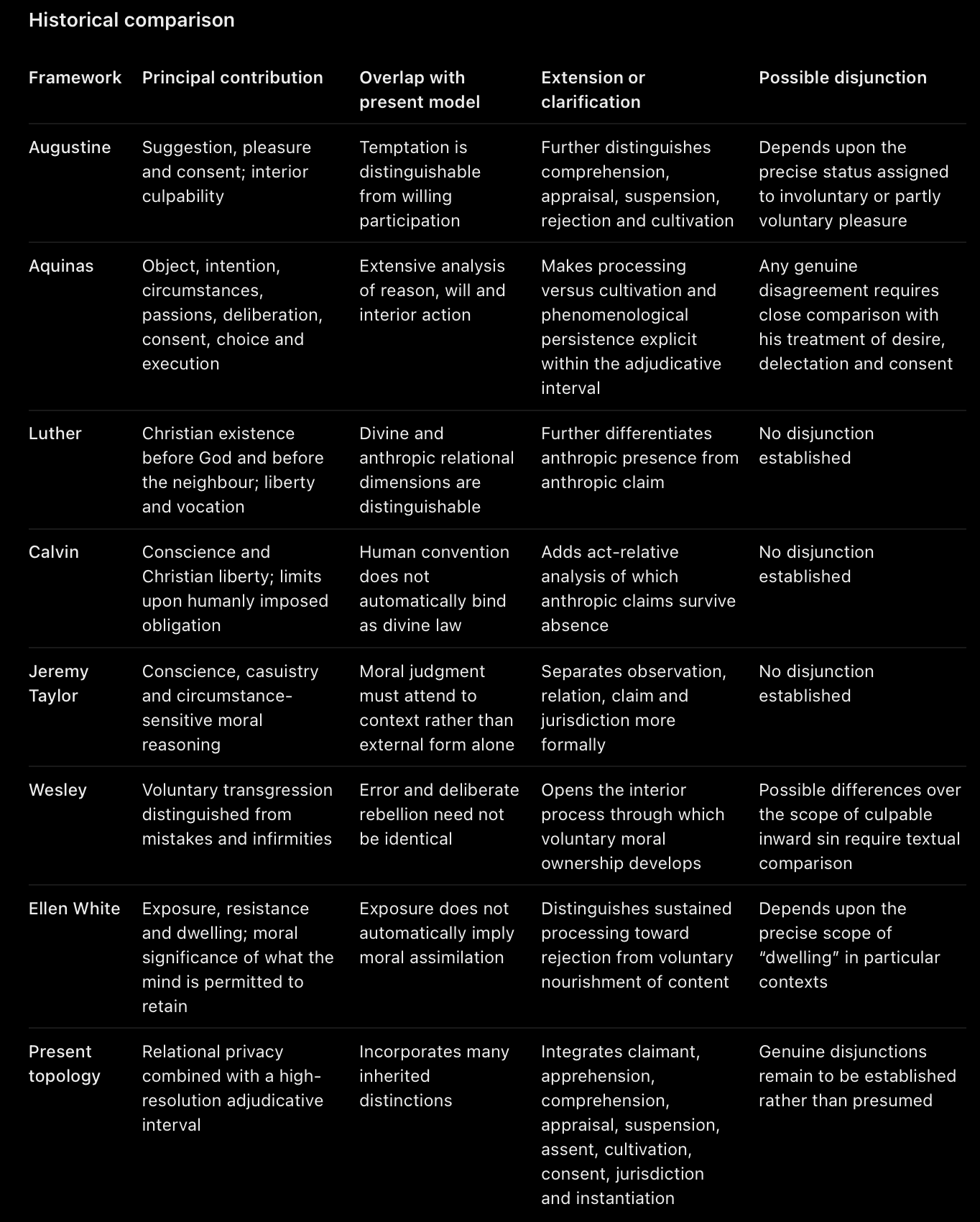
The matrix reveals why claims of novelty should remain modest. Augustine already possesses a grammar of suggestion and consent. Aquinas's analysis of human acts is substantially more granular than any caricature of medieval moral psychology would suggest. Reformation discussions of conscience and Christian liberty already distinguish divine obligation from merely human imposition. Wesley supplies important resources for distinguishing voluntary transgression from error and infirmity. Ellen White's language of exposure and dwelling approaches closely the practical problem of how the mind relates to morally objectionable content.
The potential contribution of the present model therefore lies less in discovering wholly unknown categories than in bringing several inherited dimensions into a single analytical field.
This becomes clearer when the historical question is reorganized around concepts rather than thinkers.
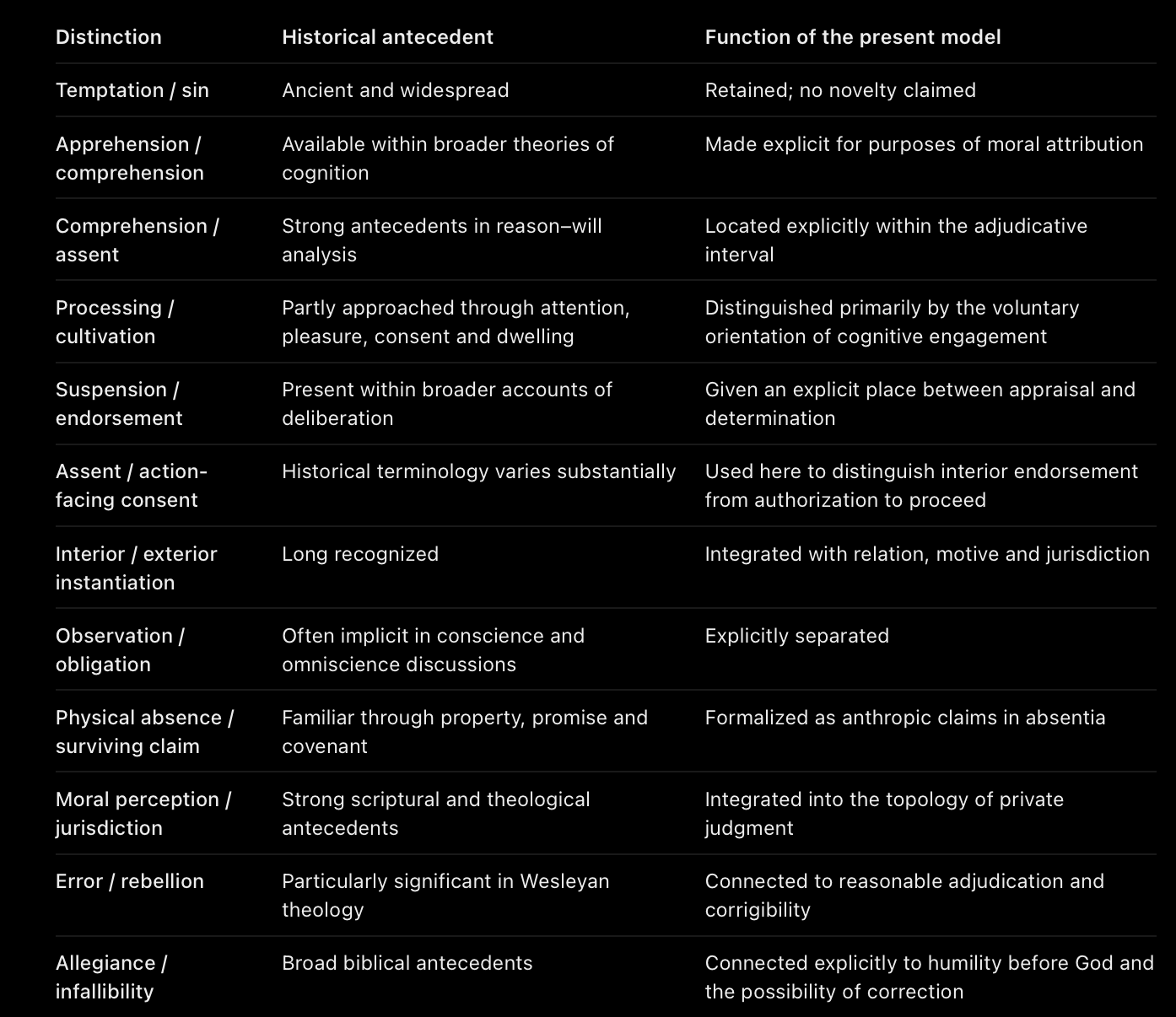
Seen this way, the historical claim becomes considerably more defensible. The model does not need Augustine, Aquinas, Wesley or anyone else to have “missed” interior morality. Its potential contribution lies in integration and resolution: it brings relational claim, cognitive processing, volitional orientation, jurisdiction and outward instantiation into a common architecture designed specifically to explain the limiting case of the unobserved moral agent.
The historical question consequently remains open in the proper sense. Primary-source investigation may reveal that some distinctions presently regarded as extensions were already made with comparable precision under different terminology. If so, the topology should acknowledge and incorporate them. Historical inquiry serves the model by correcting its claims, not by providing a foil against which originality can be manufactured.
The inquiry began with a simple subtraction: remove the observer and ask what remains. That subtraction eventually proved insufficient, because observation was never the decisive variable. A person can remain morally bound to someone who is absent, unaware and incapable of enforcement. The lost wallet retains its owner; the entrusted object retains the claims generated by entrustment; a promise retains its beneficiary. Genuine privacy emerges only when the relevant human claim itself disappears.
Even then, within Christian moral thought, the field does not become empty. The creature remains before God. The resulting moral condition is therefore neither publicity nor moral isolation. It is a relational field in which some claims have disappeared while the invariant divine relation remains.
This produces the first set of distinctions. Observation is not obligation. Physical absence is not absence of claim. Divine observation is not identical to divine prohibition. Human claims may survive physical absence, while obligations that depend upon genuinely absent human relations cannot simply be recreated by appealing to divine omniscience.
Privacy is therefore best understood act-relatively. The question is not whether the person is physically alone but which agents possess legitimate standing in relation to the particular moral episode.
Once this is recognized, public and private morality cease to be distinguished principally by visibility. They are distinguished by the relational architecture within which conduct occurs.
This is why the unattended transaction and the genuinely private expletive are morally different even though both may occur without witnesses. The unattended goods still have an owner. The private expression may involve no anthropic claimant at all. Its moral status nevertheless remains conditional upon the further question already identified: whether the expression violates an applicable divine prohibition. The absence of an anthropic claimant removes one possible ground of obligation; it does not itself establish permissibility.
The second movement of the inquiry proceeded inward. Once external structures are removed, the moral event cannot be adequately described merely by observing conduct. Moral cognition itself requires analysis.
The resulting topology distinguishes apprehension, comprehension and appraisal before considering rejection, suspension or assent; it distinguishes processing from cultivation; and it distinguishes interior endorsement from action-facing authorization and eventual instantiation.
These are not intended as mechanically sequential compartments. They are analytical distinctions between possible relations of the agent toward content. Cultivation, in particular, is not a compulsory stage between assent and action. The topology branches: content may be rejected, held under genuine suspension, voluntarily cultivated, or translated comparatively rapidly from assent into action-facing consent.
Their central implication is that phenomenological presence is not moral ownership.
A morally objectionable thought may appear without invitation. It may require comprehension before it can be rejected. Its emotional or imaginative residue may persist after rejection. Conversely, morally culpable ownership may arise without any public act if the agent deliberately endorses and nourishes content whose object and purpose are themselves illegitimate.
The decisive question is therefore not simply whether the thought was present, nor even how long it remained, but what the agent was voluntarily doing with it.
This is why processing and cultivation require separation. Processing sustains content for adjudication. Cultivation sustains content because the agent has elected to nourish it. The distinction is not supplied by duration, recurrence or emotional intensity but by volitional orientation, always evaluated within the wider questions of legitimacy, motive and telos.
Neither cognition nor relation alone is sufficient. The complete moral field requires their integration.
The moral character of an episode may depend upon its object, the claims implicated by it, the motive from which it proceeds, the end toward which it is directed, the agent's jurisdiction, the degree of volitional ownership and whether the determination is eventually instantiated.
Several propositions consequently follow:
Observation is not obligation.
Absence is not absence of claim.
Apprehension is not assent.
Comprehension is not endorsement.
Processing is not cultivation.
Duration is not consent.
Moral perception is not moral jurisdiction.
Providential use is not creaturely warrant.
External instantiation is not the boundary of culpability.
Moral error is not necessarily rebellion.
The propositions function together rather than independently. A private moral act cannot be classified merely by locating it on one of these axes. They identify the questions that must be answered before classification is warranted.
The existence of an adjudicative interval does not reduce moral responsibility. It explains where responsibility operates.
The agent possesses sufficient cognitive latitude to understand what has appeared before consciousness, to distinguish relevant claims, to examine motive and purpose, and to determine what ought to be rejected or pursued. But this latitude carries an obligation of reasonable inquiry. Willful ignorance, rationalization and deliberate refusal to examine an inconvenient moral question can themselves corrupt the adjudicative process.
Fallibility nevertheless remains.
A finite creature may reason sincerely and reach the wrong conclusion. Objective moral truth is not altered by that mistake, but neither must every mistake be classified as deliberate rebellion. Micah's requirement to “walk humbly with thy God” provides the relational posture appropriate to such finitude. Humility does not abolish judgment; it prevents judgment from becoming incorrigible.
Thus the relevant principle is not that sincerity makes an action right, but that faithful moral agency remains answerable to correction:
Allegiance does not presuppose moral infallibility; in a fallible creature, humble allegiance necessarily entails corrigibility.
The person who refuses correction because it threatens a desired conclusion occupies a different moral position from the person who reaches an erroneous judgment through reasonable inquiry and relinquishes it when the error becomes apparent.
This also explains why conduct matters without becoming the whole of morality. Circumstances can expose discrepancies between profession and operative allegiance. A person who professes one principle and repeatedly acts against it when the principle becomes costly cannot simply appeal indefinitely to the sincerity of his profession. Yet Peter's denial demonstrates why inconsistency cannot automatically be equated with hypocrisy or apostasy. Conduct may disclose weakness, fear or modal failure as well as settled rebellion. God alone possesses sufficient access to adjudicate the whole architecture without inference or uncertainty.
The moral agent therefore stands neither under a regime in which every involuntary movement of consciousness is immediately culpable nor within an interior sanctuary immune from judgment. He stands within an adjudicative relation to God, responsible both for what he determines and for the integrity with which the determination is reached.
That brings the topology to its final question: what remains when observation, audience, reputation and every contingent human claim have been removed? The answer is not moral emptiness. What remains is the person, the content before consciousness, the judgment he makes concerning it, and the God before whom that judgment is made.
The analysis has now reached the limiting case from which it began. Human observation has been removed; direct interaction has been removed; claims in absentia have been distinguished from genuine anthropic privacy; and the internal process by which morally charged content becomes apprehended, adjudicated, rejected, cultivated or enacted has been mapped. What remains is not a morally empty individual but an agent whose relation to God persists when every contingent human relation relevant to the episode has disappeared.
This limiting case reveals something about morality that public conduct can easily conceal. Public behaviour can be produced by many motives: fear of punishment, desire for reputation, conformity to convention, affection for others, recognition of their legitimate claims, or allegiance to God. These motives may converge upon identical observable conduct. The external act therefore provides evidence of morality without exhausting its explanation.
Privacy removes some of those competing explanations. It does not necessarily make the person better or worse. It makes the architecture of his agency easier to see.
This helps locate the present inquiry in relation to the earlier problem of moral capital. The return of lost property, honest payment at an unattended point of sale, reliable handling of entrusted goods and responsible behaviour in low-supervision environments are meaningful social indicators. They reveal something about the extent to which people continue to honour obligations when enforcement becomes weak.
A society in which wallets are routinely returned and unattended goods reliably paid for possesses something morally significant that a society requiring continuous surveillance does not. The behaviour suggests that at least some external obligations have been internalized.
Yet such measurements encounter a limit. They can establish what people do under diminishing supervision; they cannot finally establish why they do it.
Consider three people who return the same lost wallet. The first does so because he wishes to preserve his self-conception as an honest man. The second does so because he recognizes that the property belongs to another person whose claim survives absence. The third recognizes the same human claim but understands his fidelity to it additionally as part of his allegiance to God. The observable act is identical. Its motivational and relational architecture is not.
The distinction does not make the first act worthless or the second incomplete. It establishes the limit of behavioural measurement. Sociology can observe conduct and infer patterns of moral reliability. It cannot finally inspect the entire adjudicative architecture from which conduct proceeds.
Moral capital and moral agency are therefore related but non-identical. Moral capital concerns the observable reliability of persons and communities under varying conditions of accountability. Moral agency concerns the interior and relational architecture by which obligations are apprehended, judged and owned.
The former can be measured imperfectly from outside. The latter ultimately requires access to the person.
Christian theology attributes that access to God.
This gives divine judgment a significance deeper than omniscient surveillance. God does not merely possess more complete observational data than a human authority. He knows the relation between apprehension and assent, between processing and cultivation, between profession and motive, and between outward conformity and actual allegiance.
Biblical testing repeatedly makes this interior-exterior relationship visible. Israel is led through the wilderness “to humble thee, and to prove thee, to know what was in thine heart” (Deuteronomy 8:2). Abraham's allegiance becomes manifest under the demand of Genesis 22. Peter's confidence in his own fidelity is tested by circumstances that reveal a weakness his profession had not adequately comprehended.
Such testing should not be reduced to divine information-gathering, as though God required an experiment to discover facts previously unavailable to Him. Within the biblical narratives, testing also manifests, demonstrates and exposes. What exists within the agent becomes instantiated under circumstances of demand.
This adds a further dimension to the relation between assent and conduct. A professed determination may remain untested because no relevant circumstance has arisen. But when the corresponding moral demand appears, action provides evidence of whether the determination has become operative.
A discrepancy does not automatically establish hypocrisy. Peter prevents such a crude inference. Conduct may expose fear, weakness, confusion or a genuine modal failure rather than demonstrating that the professed allegiance never existed. Nevertheless, the discrepancy is morally significant. An agent cannot indefinitely maintain that his operative allegiance is X while consistently choosing Y whenever X becomes costly.
God is uniquely situated to adjudicate the difference. Human observers see the contradiction and must infer its cause. God sees both the conduct and the upstream architecture from which it arose.
Thus divine judgment concerns not merely what the agent eventually did but the relation between what he apprehended, what he understood, what he determined, what he professed and what he instantiated.
Privacy can therefore function as a diagnostic condition, although not because private conduct is necessarily more authentic than public conduct. Public obligations are real, and concern for another person's judgment may itself be morally appropriate. The diagnostic value of privacy lies instead in the removal of particular incentives and constraints.
If a person returns property when nobody can reward him, his conduct cannot readily be explained by immediate reputational advantage. If he honours a promise whose breach could never be discovered, fear of exposure cannot supply the whole explanation. If he rejects an illicit interior object that no human observer could ever know he entertained, public shame cannot account for the rejection.
As these external incentives disappear, the remaining explanations become progressively more internal and relational.
This does not mean that private behaviour infallibly reveals character. Human motivation can remain mixed even in solitude. Pride can survive without an audience; self-conception can function as its own spectator; habit may produce conduct before conscious adjudication occurs. Privacy is therefore diagnostically clarifying rather than epistemically perfect.
The limiting case remains valuable because it asks what the agent does when the ordinary external inducements toward conformity have been progressively stripped away.
At that point, morality approaches allegiance.
The concept of allegiance requires particular care because it could otherwise become a device for excusing individual failures. If allegiance alone mattered, one might claim fidelity to God while treating particular acts of disobedience as morally insignificant. The biblical material does not permit that move. Conduct matters precisely because allegiance is not merely a proposition asserted about oneself. It is a relationship that becomes instantiated through repeated acts of judgment and choice.
Yet the opposite error is equally serious. If every discrete moral failure were treated as equivalent to the abandonment of allegiance, finite moral agency would become unintelligible. Repentance, correction, restoration and growth would have no coherent place within the relationship.
The distinction is therefore not between an important allegiance and unimportant acts. It is between the trajectory of the relationship and the individual moral determinations through which that relationship is expressed.
Peter again supplies the clearest example. His denial is culpable. Nothing about his subsequent restoration makes the denial retrospectively permissible. Yet the narrative refuses to allow the failure to become the final interpretation of Peter's relationship to Christ.
His failure is real; so is his return.
This suggests that a person may possess an underlying allegiance that is not perfectly instantiated at every moment. Fear, confusion, weakness or deficient judgment may produce conduct inconsistent with the relation the person nevertheless returns to and reaffirms.
This should not be sentimentalized. Repeated conduct can eventually demonstrate that professed allegiance is nominal rather than operative. Nor does the term invariant mean that allegiance is metaphysically incapable of abandonment. It describes the governing orientation that persists through particular failures rather than being overturned by every failure as such. Whether allegiance has itself been relinquished is a further question that cannot be settled merely by counting discrete lapses.
The relevant concept is therefore invariant allegiance, not invariant performance.
Invariant allegiance describes the enduring orientation to which the agent returns under correction, repentance and renewed adjudication. Modal failures can occur within that orientation without being redescribed as harmless. What distinguishes the failure from settled rebellion is not that the act ceases to be wrong but that the agent does not finally convert the wrong into a principle to be defended.
This connects directly with corrigibility. The faithful agent may fall, but he cannot make fidelity compatible with permanent refusal of correction. Once the wrong is apprehended as wrong, allegiance places a demand upon the agent to relinquish it.
Micah 6:8 places this relation within a compact biblical architecture: “to do justly, and to love mercy, and to walk humbly with thy God.” Justice concerns the recognition and discharge of what is due. Mercy prevents justice from degenerating into a purely retributive calculus. Humility situates the moral agent within a relationship in which his own judgments remain subordinate to God.
Humility therefore has an epistemic consequence.
A fallible creature who walks humbly with God must remain corrigible. He may judge; indeed, he is required to judge. But he cannot coherently treat his own judgment as the final source of moral reality. The person who says, in effect, I have adjudicated this question and therefore no possible further light can correct me, has moved beyond confidence into a posture difficult to reconcile with creaturely humility.
Corrigibility does not mean perpetual uncertainty. The agent may be firmly persuaded. Romans 14 itself recognizes the importance of being “fully persuaded” in one's own mind. But persuasion and corrigibility are not opposites. One may act decisively upon the evidence presently available while remaining willing to revise the judgment if that evidence proves incomplete or wrongly understood.
This avoids two symmetrical errors: dogmatic self-infallibility on one side and moral paralysis on the other.
The relevant formulation is therefore:
Allegiance does not presuppose moral infallibility; in a fallible creature, humble allegiance necessarily entails corrigibility.
Objective truth remains objective. Sincerity cannot transform error into truth. But the moral relation of the sincerely mistaken and corrigible agent to his error is not identical to that of the agent who suppresses evidence, refuses scrutiny or knowingly defends what he has already apprehended as wrong.
The foregoing analysis has implications for the language of moral perfection, but it does not require the present essay to construct a complete theology of perfection.
At minimum, the topology cautions against identifying moral perfection either with the complete absence of morally objectionable phenomenology or with epistemic infallibility. The first identification is difficult to reconcile with the canonical distinction between genuine temptation and sin. The second collapses the distinction already established between objective error and deliberate rebellion.
The argument developed here supports a narrower conclusion. Whatever account of moral perfection Christian theology ultimately adopts, it must preserve the distinctions between temptation and culpable ownership, between adjudication and endorsement, and between corrigible error and deliberate resistance to known moral obligation.
This does not settle whether, or under what conditions, a perfected or redeemed creature may continue to make errors of judgment. Nor does it establish a comprehensive account of sanctification, eschatological stability or final moral security. Those questions extend beyond the remit of the present inquiry.
What can be said within that remit is more modest. Moral fidelity cannot be defined simply as the absence of disturbing phenomenology, because morally objectionable content may become present for the very purpose of being rejected. Nor can fidelity require creaturely omniscience, because the responsibility established by the present model is to adjudicate faithfully according to what can reasonably be apprehended and known, while remaining corrigible before God.
The topology therefore contributes a constraint upon theories of moral perfection rather than supplying such a theory itself. Any adequate account must distinguish the presence of evil as an object of adjudication from the voluntary relation by which evil is endorsed, cultivated or defended.
That distinction is sufficient for the purposes of the present argument.
The inquiry began by asking what remains of morality when nobody else is there. The answer is now more precise than either of the intuitive alternatives with which the problem began.
Privacy does not abolish morality, because absence does not abolish claim. An owner, spouse, beneficiary, creditor or person to whom a promise has been made may possess moral standing while being entirely absent. Nor does privacy simply reproduce public morality before an invisible divine spectator. God's omniscience establishes epistemic access, not an undifferentiated field of prohibition.
The first task of private moral analysis is therefore relational: who possesses a legitimate claim upon the moral episode, and on what ground?
The second is adjudicative: what relation does the agent bear toward the morally charged content that has entered consciousness?
Together these questions define the two principal dimensions of the topology.
The circumference concerns observation, relation and claim. Physical presence can disappear while moral standing remains. Conversely, physical solitude does not necessarily establish privacy, because an absent person's rights may already be implicated by the act or intention under consideration. Genuine anthropic privacy is therefore act-relative: it exists only where no other human agent possesses a presently operative claim upon the episode.
Within that circumference lies the adjudicative interval.
Morally charged content may be apprehended, comprehended and evaluated without thereby being endorsed. It may be rejected, suspended or assented to. It may be processed because judgment remains incomplete or cultivated because the agent has elected to nourish it. Assent may become action-facing consent, and consent may become instantiated conduct. These are analytical relations, not a mandatory linear sequence.
The canonical evidence requires at least this degree of discrimination. Christ can be genuinely tempted without sin. Joseph can comprehend a proposition sufficiently to reject it. Matthew 5 can locate culpability before bodily action, while Mark 7 can describe thought itself as morally evil. James can describe desire developing toward sin without making every moment of temptation identical to sin. Ephesians can distinguish anger from sinful anger. The Psalms can express severe demands for judgment while Romans locates vengeance with God. Matthew 6 can preserve divine observation while treating human secrecy as morally real. Peter can fail gravely without the failure becoming the final description of his allegiance.
No single passage supplies the topology. Together they constrain the conceptual field within which an adequate account must operate.
The resulting architecture can be summarized without treating its distinctions as independent moral rules. Observation does not itself generate obligation; physical absence does not extinguish an existing claim; and divine observation does not establish a prohibition that has not otherwise been grounded. Within cognition, apprehension is distinguishable from assent, comprehension from endorsement, processing from cultivation, and persistence from voluntary moral ownership. Moral perception does not itself confer jurisdiction, providential use does not provide retrospective creaturely warrant, and external instantiation is neither the sole location nor an automatic proof of culpability. Finally, objective error need not be identical to deliberate rebellion, while allegiance in a fallible creature remains necessarily corrigible.
These distinctions function together. Their purpose is not to create increasingly elaborate exemptions from moral responsibility, but to identify where responsibility actually resides.
This is also the point at which the historical comparison becomes important. Christian theology has long possessed many of the constituent distinctions: temptation and consent, object and intention, passion and will, conscience and liberty, error and voluntary transgression, exposure and dwelling. The present model need not claim their discovery. Its proposed contribution is principally one of resolution and integration: it places relational standing, cognitive processing, volitional orientation, motive, telos, jurisdiction and instantiation within a single architecture of private moral agency.
Where earlier models already make equivalent distinctions, the present account overlaps them. Where they contain broader categories that can accommodate the distinction without explicitly resolving it, the present account may clarify or extend them. Only where incompatible propositions can actually be demonstrated should disjunction be claimed.
The model therefore remains corrigible in precisely the sense it attributes to the moral agent.
The significance of the adjudicative interval is that it preserves both moral responsibility and moral intelligibility. Without such an interval, morally objectionable content threatens to become culpable at the moment of apprehension, leaving no innocent cognitive space in which rejection can occur. If the interval were treated instead as presumptively innocent regardless of what occurred within it, deliberation could become a permanent refuge for rationalization. The canonical evidence permits neither extreme.
The agent requires cognitive latitude because judgment is impossible without it. That same latitude makes him responsible for the integrity with which judgment is conducted.
He may misunderstand. He may require time. He may encounter desires he did not choose and emotional responses he cannot instantly extinguish. He may reach a sincere but erroneous judgment. He may even fail in conduct after reaching the correct one. None of these possibilities abolishes moral responsibility; they require moral attribution to become sufficiently discriminating to identify what has actually occurred.
What finally matters is therefore not merely what appeared before consciousness, nor merely what became externally visible, but the agent's relation to what he encountered: whether he understood it, how he evaluated it, whether he rejected or nourished it, what end he sought, whose claims he recognized, what authority he assumed, whether he remained open to correction, and what he ultimately chose to instantiate.
This is why the unobserved person provides such a revealing limiting case. As audience, reputation, supervision and contingent human claims are progressively removed, the ordinary external proxies by which morality is inferred become less available. Yet moral agency does not disappear with them.
The person still apprehends, distinguishes, evaluates and determines. He remains capable of fidelity and evasion, cultivation and rejection, justified perception and illegitimate jurisdiction, humility and incorrigibility. Within the Christian account, one relation remains invariant throughout.
Privacy is therefore not the final subject of the inquiry. It is the analytical condition through which something deeper becomes visible.
What it finally exposes is the architecture of the person before God.