
This appendix presents a structural account of how experience becomes intelligible. It describes the minimal conditions under which differentiated structure appears to an agent, stabilises as pattern, and becomes subject to interpretation and projection.
This appendix presents a structural model of intelligibility. It provides a diagnostic architecture of experiential formation — clarifying how signal, constraint, and interpretation interact at the level of encounter.
The theory addresses a basic question:
How does intelligible experience arise at all?
Its answer is that intelligibility emerges through structured interaction between:
a background field of constraint,
a bounded agent,
mechanisms of differentiation,
processes of structural stabilisation,
and interpretive orientation.
The model therefore describes the mechanics of experiential formation rather than the ultimate truth of content. Coherence within experience does not guarantee ontological validity; the framework explains how meaning forms, not whether it is justified.
Within the broader Submetaphysics project, this appendix functions as a supporting architecture for:
encounter and disclosure,
semiotic formation,
noetic posture,
and discursive projection.
It clarifies the structural conditions under which such phenomena become possible.
The account is developed across five tightly structured sections, each corresponding to a stage in the formation of experience.
Introduces the core intuition of the model and presents the canonical structural pipeline. It explains why intelligibility requires constraint and why experience is inherently figure–ground in nature.
Defines the primitive elements of experience:
the constraint field (background reality),
the agent or personality,
their coupling,
and the emergence of signal against ground.
This section establishes the basic conditions of encounter.
Explains how signal becomes detectable through boundary formation. It describes:
admissibility (internal possibility space),
framing operations,
signal gradients,
and resolution limits governing differentiation.
This section addresses how variation becomes noticeable.
Describes how differentiated variation stabilises as structure. It treats:
coherence formation,
multi-scale organisation,
abstraction as compression of informational gradients,
and validation of stable patterns.
This section explains how structure persists.
Explains how structure becomes subject to interpretation and projection. It treats:
invariant structural content,
interpretive posture,
meaning attribution,
and social reinforcement.
The section concludes with stress tests demonstrating the model’s behaviour under pathological or extreme cases.
Together, these sections describe a single continuous process:
constraint → differentiation → structure → interpretation
Experience is not merely the presence of stimuli. It is structured, differentiated, and meaningful. The question addressed here is how such structure becomes possible.
Any account of experience must explain:
why some variation becomes noticeable,
how stable patterns emerge from fluctuation,
how structure becomes meaningful,
and why experience is not undifferentiated flux.
This model proposes that intelligibility arises through constraint-driven differentiation within a structured background.
The initial intuition motivating this model arises from the observation that framing alters perception. A frame does not add content but modifies the conditions under which content becomes visible, segmented, and interpretable. Within the present account, framing operates at multiple levels: as admissibility (what may appear), as differentiation (what is segmented), and as projection (what is stabilised socially). The model may therefore be understood as a structural account of how framing governs the formation of intelligible experience.
All experience is contrastive.
A signal becomes perceptible only insofar as it stands out against a background that constrains and differentiates it. The background is not itself experienced as content but as the limiting condition that allows content to appear.
Experience therefore takes the form:
figure emerging against ground.
Without a structured background, no differentiation would occur; without differentiation, no intelligibility would arise.
The model begins from the principle that intelligibility requires constraint.
Constraint:
limits possible variation,
produces boundaries,
enables distinction,
and allows structure to emerge.
Rather than experience being generated through accumulation of information, it arises through elimination of alternatives and stabilisation of residual structure.
The formation of experience proceeds through a structured sequence of operations:
Constraint Field
→ Agent
→ Coupling
→ Figure–Ground Emergence
→ Admissibility Space (Canvas)
→ Differentiation (Framing)
→ Structural Coherence
→ Invariant Structural Content
→ Posture
→ Interpretation
→ Projection
Each stage represents a distinct condition required for intelligible encounter.
The account presented here is structural rather than empirical or theological in its immediate formulation. It describes the mechanics through which experience becomes organised, regardless of specific content.
Accordingly:
it does not determine the ontological status of what is experienced,
it does not guarantee truth,
and it does not adjudicate metaphysical claims.
It specifies only the conditions under which structure becomes intelligible to an agent.
This appendix therefore describes:
how experience becomes structured,
how structure stabilises,
and how interpretation occurs.
It does not address whether interpretations correspond to reality. The distinction between experiential coherence and ontological truth remains fundamental.
Having outlined the basic intuition and mechanism, the next section examines the primitive conditions that make experience possible: the constraint field, the agent, and their coupling.
Each stage represents a distinct condition required for intelligible encounter.
The preceding section established the central claim of this appendix:
intelligible experience arises through constraint-driven differentiation,
experience is inherently figure–ground in structure,
and experiential formation proceeds through a structured sequence of operations described in the canonical mechanism.
Page 1 therefore defined the general architecture of experiential formation without yet specifying the primitive elements required for such formation to occur.
The present section turns to those primitive conditions.
The theory describes a continuous process of experiential formation.
The present section examines the earliest stages of that process.
→► Constraint Field ◄
→► Agent ◄
→► Coupling ◄
→► Figure–Ground Emergence ◄
→ Admissibility Space (Canvas)
→ Differentiation (Framing)
→ Structural Coherence
→ Invariant Structural Content
→ Posture
→ Interpretation
→ Projection
Current focus: the conditions that make encounter possible.
This section establishes the minimal elements required for experience to occur at all. It defines:
the constraint field as the background condition of differentiation,
the agent or personality as the bounded center of encounter,
the coupling between agent and field,
and the emergence of signal against ground.
These constitute the primitive conditions of intelligibility. Without them, no subsequent stage of experiential formation could arise.
The constraint field refers to the structured background against which all differentiated experience occurs. It functions as the limiting condition of intelligibility rather than as an object of experience.
Its role is to:
delimit possible variation,
provide contrast,
and enable distinction.
The constraint field is therefore not itself experienced as content. Rather, it is encountered indirectly through the boundaries it imposes. It is the condition that allows figure to emerge from undifferentiated possibility.
Without such a structured background, no signal could be distinguished, and experience would collapse into indistinct flux.
The constraint field thus serves as the ground of differentiation.
Experience requires not only a structured background but also a bounded center capable of encounter.
The agent refers to a temporally coherent locus of processing that:
engages the constraint field,
differentiates variation,
and stabilises structure.
Within this model, personality denotes the capacity for coherent processing across time — the ability to integrate present input with retained structure and anticipated consequence within a unified center.
The agent is characterised by:
bounded processing capacity,
finite resolution in differentiation,
and structural continuity across experience.
The agent is therefore not identical with the constraint field but exists in relation to it. Experience arises only through their interaction.
Coupling refers to the active interaction between agent and constraint field. It is the condition under which encounter occurs.
Where no coupling exists, no experience arises. A structured background without an agent yields no intelligibility; an agent without engagement with constraint yields no differentiation.
Coupling may occur through multiple modalities or channels, but its essential function remains the same: to bring the agent into relation with structured variation.
Through coupling, variation becomes available for differentiation.
When coupling occurs, differentiated structure may emerge as figure against the background constraint.
Figure–ground emergence is the first manifestation of intelligible experience. It consists in the appearance of structured variation as distinct from its limiting background.
The background itself is not presented as object but as condition. It is encountered as that which constrains and enables appearance.
Experience is therefore inherently contrastive. Structure appears only insofar as it stands out against a limiting field.
This contrastive emergence constitutes the earliest stage of intelligibility.
The elements described above form a minimal system:
the constraint field provides the condition of differentiation,
the agent provides the locus of encounter,
coupling establishes their interaction,
and figure–ground emergence constitutes the first differentiated appearance.
These conditions together make experience possible but do not yet determine what may appear or how variation becomes structured.
Those questions are addressed in the next section.
Having established the primitive conditions of encounter, the next section examines how differentiated variation becomes detectable and structured through admissibility conditions and framing operations.
It turns from the conditions of encounter to the mechanisms of differentiation.
The preceding section established the primitive conditions of experiential encounter:
a structured constraint field,
a bounded agent,
their active coupling,
and the emergence of figure against ground.
These elements make experience possible but do not yet explain how variation becomes structured, detectable, or organised.
Section 2 addressed the conditions of encounter.The present section addresses the mechanisms through which variation becomes distinguishable.
The theory proceeds sequentially. Having established primitive conditions, we now examine the mechanisms of differentiation.
Constraint Field
→ Agent
→ Coupling
→ Figure–Ground Emergence
→ ► Admissibility Space (Canvas) ◄
→ ► Differentiation (Framing) ◄
→ Structural Coherence
→ Invariant Structural Content
→ Posture
→ Interpretation
→ Projection
Current focus: admissibility and boundary formation.
This section establishes how differentiated structure becomes detectable. It defines:
the admissibility space (internal framing),
framing operations (boundary formation),
signal gradients and informational density,
and the resolution limits governing differentiation.
These mechanisms explain how variation becomes noticeable and structured prior to stabilisation.
Admissibility refers to the structured possibility space within which differentiated variation may appear.
It functions as the internal frame or canvas of experience — the set of conditions determining what may count as distinguishable or meaningful.
Admissibility is shaped by:
prior structure,
retained patterns,
learned expectations,
and reinforcement history.
It therefore defines not the content of experience but its field of possibility.
Admissibility is plastic. It may shift gradually through repeated reinforcement or rapidly under conditions of extreme salience or multimodal convergence. However, at any given moment, it constrains what may appear as structured.
It is within this canvas that differentiation occurs.
Differentiation refers to the segmentation of variation through the formation of boundaries.
Where variation is unlimited, nothing stands out. Noticeability arises through elimination of alternatives.
Framing may arise from:
external constraint (environmental or contextual boundaries),
internal constraint (priors, symbolic structures, expectations),
engineered salience (artificial amplification of thresholds).
Framing therefore operates as the mechanism by which variation becomes segmentable.
It converts figure–ground contrast into discrete distinguishable structure.
Variation is not uniform. Signals contain gradients of informational density — differences in contrast, intensity, frequency, or organisation.
Examples include:
visual contrast gradients,
tonal variation in music,
semantic density in language.
These gradients determine how readily variation may be segmented.
High-density gradients may produce strong differentiation. Low-density gradients may fall below noticeability thresholds.
Differentiation therefore operates relative to gradient structure.
The agent does not possess infinite differentiation capacity.
Resolution limits refer to the finite capacity of the agent to distinguish gradients of variation.
These limits:
constrain what may be resolved,
shape what counts as structured,
and determine the granularity of differentiation.
Two agents exposed to identical variation may resolve structure differently due to differing resolution capacity or admissibility configuration.
Differentiation is therefore both gradient-sensitive and resolution-limited.
Salience may be artificially amplified.
Designed signals may manipulate thresholds of differentiation by:
exaggerating contrast,
increasing repetition,
heightening emotional cues,
or narrowing contextual framing.
Engineered salience increases noticeability but does not guarantee coherence.
It operates at the level of differentiation rather than stabilised structure.
Admissibility and framing operate together.
Admissibility defines what may appear; framing determines what becomes segmented.
Canvas without frame yields undifferentiated possibility.Frame without canvas yields no intelligible segmentation.
Together they produce structured noticeability.
Having described how variation becomes segmented and detectable, the next section examines how such segmented variation stabilises into persistent relational structure.
It turns from differentiation to coherence.
The preceding section established how variation becomes distinguishable through:
admissibility (the internal canvas),
framing (boundary formation),
signal gradients,
and resolution limits.
Differentiation produces segmented variation. However, segmentation alone does not yield stable structure.
Section 3 explained how variation becomes noticeable.The present section explains how it becomes organised and persistent.
The process now advances from segmentation to stabilisation.
Constraint Field
→ Agent
→ Coupling
→ Figure–Ground Emergence
→ Admissibility Space (Canvas)
→ Differentiation (Framing)
→ ► Structural Coherence ◄
→ Invariant Structural Content
→ Posture
→ Interpretation
→ Projection
Current focus: stabilisation of differentiated variation.
This section establishes:
how segmented variation stabilises into relational pattern,
how coherence operates across scales,
how abstraction functions as compression of gradient structure,
and how spurious coherence may arise.
The concern is no longer noticeability, but structural persistence.
Coherence refers to the stabilisation of relational pattern across differentiated variation.
Where differentiation segments variation, coherence organises it.
Coherence emerges when:
segmented elements relate consistently,
variation resolves into repeatable pattern,
relational structure persists across fluctuation.
Coherence therefore reduces instability by compressing variation into organised form.
It transforms segmented noticeability into structured intelligibility.
Coherence operates at multiple levels.
Local coherence refers to pattern stability within limited segments.Global coherence refers to structural integration across larger domains.
These may align or diverge.
For example:
locally consistent fragments may fail to integrate globally,
global narratives may mask local inconsistencies.
The presence of coherence at one scale does not guarantee coherence at another.
The theory therefore recognises scale-dependent stabilisation.
Coherence reduces gradient variation.
When repeated relational structure is identified, informational contrast is compressed into simplified representation.
Abstraction functions as this compression:
eliminating redundant variation,
preserving relational pattern,
reducing gradient density.
Formal systems represent high compression states of structured variation.
Abstraction does not eliminate structure but reduces its informational load.
Thus, structure becomes economical through compression.
Coherence may be falsely stabilised.
Pattern detection mechanisms may impose structure where gradient variation is insufficiently stable.
Spurious coherence arises when:
segmentation is driven by salience without sufficient cross-scale support,
relational patterns are prematurely stabilised,
compression occurs without adequate validation.
Coherence alone therefore does not guarantee correspondence.
Stable coherence may be tested through:
cross-scale consistency,
cross-modal convergence,
repeatability under varied constraint conditions.
Validation does not guarantee ontological truth but increases structural robustness within experience.
The theory therefore distinguishes between:
raw coherence,
and coherence tested across constraint variation.
Coherence depends upon differentiation but is not reducible to it.
Differentiation produces segmentation.Coherence produces organisation.
Together they yield structured variation capable of extraction and interpretation.
Having described how differentiated variation stabilises into relational pattern, the next section examines how such pattern becomes subject to extraction, orientation, and meaning attribution.
It turns from structural formation to interpretation.
The preceding section explained how differentiated variation stabilises into relational structure through coherence formation and abstraction. It established that:
segmentation alone does not produce structure,
coherence stabilises relational pattern,
abstraction compresses informational gradients,
and coherence may be genuine or spurious.
Section 4 therefore addressed the formation of structured pattern.The present section addresses how such structure becomes meaningful and how the model behaves under extreme or pathological conditions
The process now advances from structural formation to interpretation and projection.
Constraint Field
→ Agent
→ Coupling
→ Figure–Ground Emergence
→ Admissibility Space (Canvas)
→ Differentiation (Framing)
→ Structural Coherence
→ ► Invariant Structural Content ◄
→ ► Posture ◄
→ ► Interpretation ◄
→ ► Projection ◄
This section establishes:
the extraction of invariant structural content,
the role of interpretive posture,
the attribution of meaning,
the externalisation of interpretation,
and the behaviour of the model under stress conditions.
It explains how structured variation becomes meaningful encounter.
Before interpretation occurs, relational structure must be extracted from coherent pattern.
Invariant structural content refers to the pre-interpretive relational structure derived from stabilised variation. It consists of:
persistent relations,
repeatable organisation,
and structured regularities.
This extracted structure enables meaning but does not determine it.
Extraction may be partial or scale-dependent. An agent may stabilise global pattern while failing to extract local structure, or vice versa.
Invariant structure therefore forms the substrate of interpretation.
Interpretation depends upon the agent’s orientation toward extracted structure.
Posture refers to the agent’s stance toward encountered structure. It may involve:
acceptance,
resistance,
distortion,
or suspension of judgment.
Posture does not alter invariant structure itself but shapes how it is taken up in interpretation.
Interpretive trajectory therefore depends not only on structure but on orientation toward structure.
Interpretation refers to the attribution of meaning to invariant structure.
Meaning attribution may:
preserve structural relations,
extend them,
or impose additional organisation.
Interpretation may underdetermine or overgenerate relative to extracted structure. Where structural information is incomplete, projection may fill gaps.
Interpretation therefore transforms structured encounter into meaningful experience.
Interpretation does not necessarily proceed indefinitely.
Interpretive stabilisation occurs when:
structural coherence,
admissibility constraints,
and posture converge sufficiently to terminate recursive reinterpretation.
At this point, structure is taken as meaningful.
Stabilisation marks the transition from ongoing encounter to settled interpretation.
Interpretation may be externalised through communication, narrative, or symbolic expression.
Projection embeds interpretation within shared environments. Through repetition and reinforcement, projected interpretations may:
stabilise socially,
function as constraint,
and shape future admissibility conditions.
Thus interpretation may recursively influence subsequent experience.
Experience often involves multiple modalities or channels.
Channel weighting refers to the relative influence of different modes of coupling in interpretive formation. Weighting depends upon:
signal density,
salience,
admissibility configuration,
and reinforcement history.
Conflicting channels may produce unstable interpretation; convergent channels may accelerate stabilisation.
The model may be examined under extreme or pathological conditions to clarify its structural commitments.
These conditions do not invalidate the model but reveal how its mechanisms operate under constraint disruption.
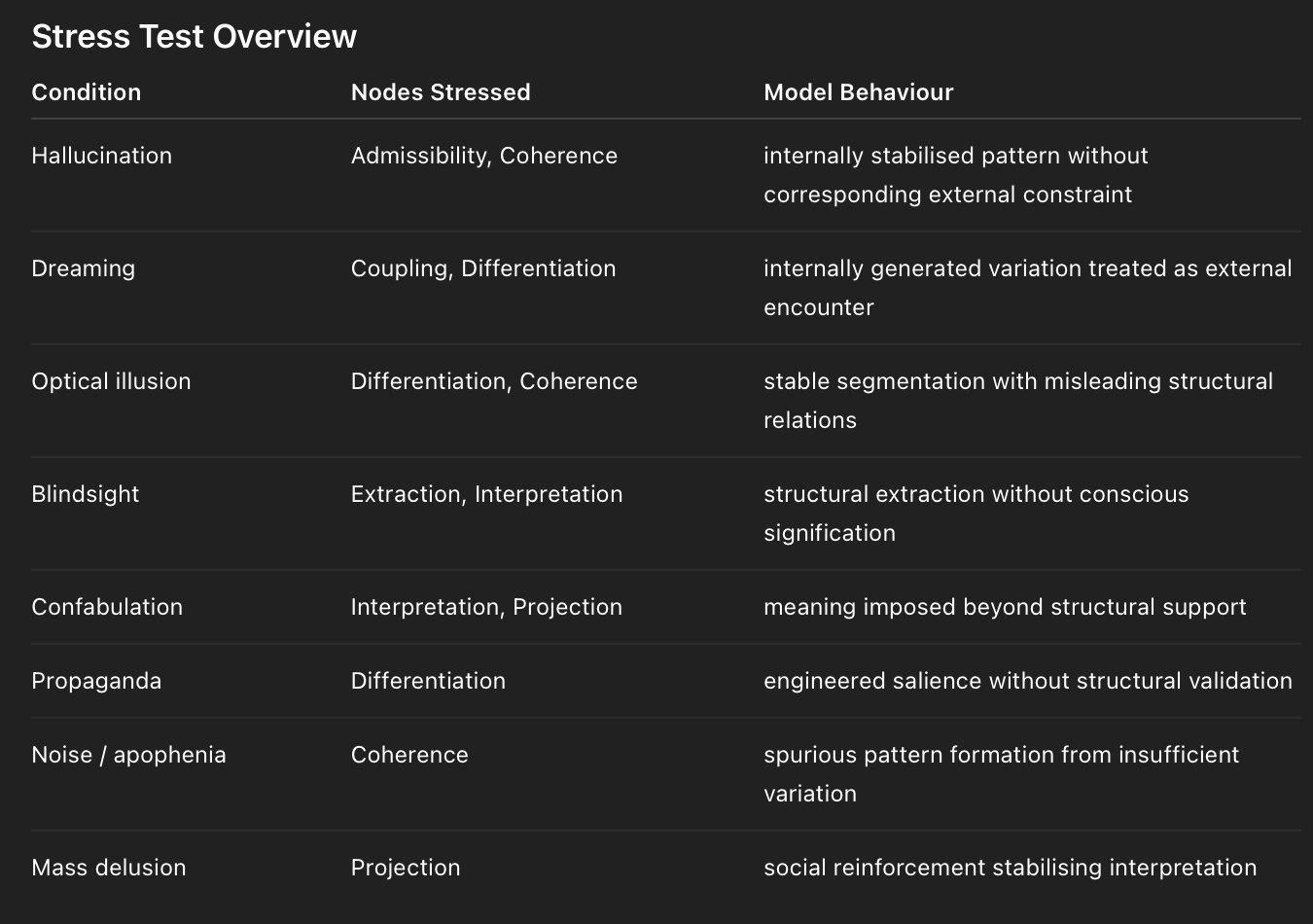
These cases demonstrate that:
differentiation may occur without reliable constraint,
coherence may arise without validation,
interpretation may exceed structure,
and projection may stabilise interpretation socially.
The theory therefore distinguishes experiential coherence from ontological validity.
The account presented in this appendix describes the mechanics through which experience becomes intelligible.
It does not determine:
whether interpretations correspond to reality,
the metaphysical status of encountered structure,
or the ultimate grounds of truth.
It explains how experience forms, not whether its content is justified.
This appendix has described a continuous process of experiential formation:
constraint → encounter → differentiation → structure → interpretation
The account provides a structural model of intelligibility clarifying:
how variation becomes noticeable,
how structure stabilises,
and how meaning arises.
This model is compatible with and may be interpreted within several broader philosophical frameworks. It serves as a diagnostic architecture of encounter and interpretation, clarifying the conditions under which structured experience becomes possible.
This model was developed as a structural account of experiential formation. Its components exhibit significant convergence with several established theoretical frameworks. These convergences do not function as derivations or authorities but as points of structural alignment that reinforce the model’s plausibility and scope.
The concept of admissibility within this model parallels Kant’s account of the conditions of possible experience. Both frameworks recognise that experience presupposes structured conditions that determine what may appear as intelligible.
However, whereas Kant emphasised transcendental categories as universal conditions of cognition, the present model introduces:
The model therefore extends the Kantian insight by specifying operational mechanisms of differentiation and stabilisation within experience.
The account of coherence formation aligns with principles of informational compression associated with Kolmogorov complexity. Stable structure emerges where variation may be reduced to minimal relational description.
Abstraction within the present model corresponds to the compression of informational gradients into simplified representation. Coherence thus represents a reduction in descriptive complexity rather than mere accumulation of information.
The model extends this principle by embedding compression within a full pipeline of experiential formation rather than treating it as a purely mathematical measure.
The differentiation mechanism parallels predictive models of perception in which signal emerges through error detection and constraint-based filtering.
Both approaches recognise:
The present model differs in providing a broader ontological architecture within which such processes operate, incorporating constraint field, posture, and interpretive projection.
The plasticity of admissibility bears structural similarity to models of shifting discursive possibility such as the Overton Window. Both describe the bounded range of what may be recognised as acceptable or intelligible within a given context.
In the present framework, such shifts are treated as transformations of the experiential canvas itself rather than purely sociopolitical phenomena. Changes in admissibility therefore alter the field within which differentiation and interpretation occur.
Across these domains, a common structure appears:
The present model integrates these insights into a unified account of experiential formation while maintaining independence from any single theoretical tradition.