
The relationship between ontology and epistemology has long shaped theological reflection. Whether truth is grounded primarily in being or in justified cognition is not a merely abstract philosophical dispute; it determines the structure of revelation, the nature of knowledge, the mechanics of salvation, and the coherence of divine judgment.
This essay examines the ordering of explanatory priority between ontology and epistemology in the economy of revelation. It argues that saving confrontation must be grounded in ontological disclosure—divine initiative rooted in the person of Christ—rather than in cognitive mediation through articulated propositions alone.
The question is not whether Scripture is authoritative nor whether doctrinal clarity matters. The question is structural: where does saving confrontation become operative? If accountability depends upon contingent epistemic access, theodicy is strained. If confrontation is grounded in ontological disclosure, universal accountability remains coherent.
What follows is a structural analysis of this ordering and its consequences for knowledge, soteriology, and divine justice.
The present inquiry concerns a structural question of explanatory priority: whether epistemology or ontology is primary in grounding revelation, knowledge, and judgment.
This is not merely a methodological preference. The ordering of primacy determines the architecture of revelation, the structure of knowledge, the mechanism of salvation, and the coherence of divine justice. From the determination of this ordering follow distinct accounts of how truth confronts the human agent and how accountability is established.
The central pressure question is therefore this:
How can divine judgment be universally just if saving confrontation is functionally contingent upon unequal access to articulated revelation?
If the saving encounter with truth depends primarily upon cognitive access to articulated disclosure—textual, doctrinal, or interpretive—then historical, geographical, and intellectual contingencies become structurally relevant to judgment. If, however, truth confronts through divine initiative grounded in ontological reality, then confrontation precedes textual access and accountability does not depend upon distribution of information.
The issue is therefore not whether Scripture is authoritative, nor whether Christ is central to revelation. The issue is the locus of saving confrontation: whether divine disclosure confronts the moral agent primarily through interpretive engagement with articulated content, or whether articulated content functions within a prior ontological encounter grounded in the person of Christ.
Scripture itself presents judgment in relational rather than merely cognitive terms. The verdict “I never knew you” (Matthew 7:23) indicates that relational recognition, not doctrinal possession alone, constitutes the decisive criterion. Likewise, the claim that Christ has “other sheep not of this fold” (John 10:16) suggests belonging not reducible to prior textual conversance.
This essay argues that the primacy of ontology is required to preserve universal accountability and the coherence of divine justice. Where revelation is treated as functionally dependent upon epistemic access, theodicy is strained; where revelation is grounded in ontological disclosure through divine initiative, accountability remains universal.
The argument advanced here does not diminish the authority of Scripture nor displace its normative role. Rather, it concerns the ordering of confrontation and articulation within the economy of revelation. Scripture remains the authoritative instruction and correction of disclosed reality. The present inquiry addresses the structural ground upon which such articulation becomes operative.
Interpretation is not confrontation.
The proposed ordering is therefore:
Ontological reality → divine initiative → confrontation → recognition → scriptural clarification.
The ordering of these determines the structure of judgment.
The position articulated here does not arise as a novel construction but reflects a trajectory long present within Christian metaphysical and theological reflection.
Across patristic and Augustinian traditions, truth is frequently understood not merely as propositional correctness but as participation in a reality grounded in God. Knowledge is described in relational terms—illumination, recognition, or participation—rather than autonomous cognitive construction. Classical metaphysical theology, particularly within Thomistic thought, likewise grounds truth in being and treats knowledge as reception of what is rather than production of warrant.
Biblical language itself frequently treats knowledge relationally. To “know” God is covenantal recognition and participation rather than informational possession (Jeremiah 31:34; John 17:3). Knowledge arises through divine initiative and disclosure rather than autonomous discovery (John 6:44; 1 Corinthians 4:7).
Christian soteriological traditions emphasizing divine initiative—most explicitly in accounts of prevenient grace—affirm that divine action precedes and enables human recognition of truth (John 1:9; Titus 2:11).
Across these trajectories several themes recur:
The present framework synthesizes and clarifies this ordering systematically. Its epistemology and ontology discussions articulate these themes not as innovations but as attempts to render explicit the internal hierarchy implicit within these traditions.
What remains to be drawn out, however, is a further architectural implication: if truth is ontologically grounded and revelation is divine initiative, then saving confrontation cannot be reducible to contingent textual exposure. The present essay examines the consequences of this implication.
Confusion in this discussion frequently arises from equivocation regarding “revelation,” “knowledge,” and the role of epistemology. Clarification is therefore necessary before comparing competing architectures.
“Revelation” may refer to distinct but related realities:
Normative disclosure clarifies and instructs; saving confrontation exposes and summons. If these are collapsed, textual articulation is treated as the exclusive channel of divine confrontation rather than as the authoritative articulation of a reality already disclosed.
The present inquiry concerns the locus of saving confrontation, not the authority of normative disclosure.
“Knowledge” likewise admits distinct senses:
Scripture frequently presents knowledge in the relational sense: “This is eternal life, that they know you” (John 17:3). Knowledge is participation in disclosed reality rather than mere informational possession.
Within the present framework, knowledge is understood primarily in this relational sense. Justification does not disappear but becomes derivative of alignment with truth.
Justification clarifies alignment; it does not create access.
To say that epistemology recedes is not to deny doctrine, interpretation, or theological reasoning. It is to deny that justification-centered epistemology functions as the foundation of knowledge.
More precisely:
Epistemology recedes as a foundational discipline, not as an operative discipline.
Epistemology continues to clarify interpretation, expose error, and refine understanding, but it does not determine the subject’s initial exposure to truth. Confrontation precedes interpretation; alignment precedes analysis.
The present discussion does not concern reverence for Scripture or commitment to doctrinal authority. It concerns functional ordering.
An epistemology-first architecture denotes the functional placement of articulated cognition as the primary gateway of saving confrontation, such that exposure to articulated propositions—through text, proclamation, or doctrinal instruction—becomes the principal means by which accountability is established.
This definition concerns functional structure rather than stated intention.
This argument does not deny general revelation, moral conscience, or natural knowledge of God. Scripture itself affirms that divine reality is disclosed universally through creation and moral awareness (Romans 1:19–20; Romans 2:14–15).
The question addressed here is more specific: whether saving confrontation—the exposure upon which judgment ultimately rests—is grounded in divine initiative capable of universal reach or functionally dependent upon distribution of articulated revelation.
General revelation establishes universal witness; the present inquiry concerns the locus of saving confrontation and the ground of judgment.
The decisive divergence between competing architectures lies in the determination of the locus of saving confrontation. The question is not whether Scripture is authoritative, nor whether Christ is central to revelation, but where divine disclosure becomes operative in exposing and summoning the moral agent.
Two possible loci may be distinguished.
In one ordering, divine revelation becomes operative for the subject principally through articulated communication—textual, doctrinal, or proclaimed. The cognitive encounter with articulated truth constitutes the primary interface between the agent and divine reality.
Within this structure, interpretive reception assumes decisive importance. Saving confrontation is functionally mediated through exposure to articulated content and its apprehension. Scriptural proclamation, doctrinal formulation, and interpretive understanding constitute the primary means by which the subject encounters revelation.
Such models may affirm the work of the Spirit and acknowledge forms of general revelation. Nevertheless, where articulated cognition functions as the principal gateway, epistemic access becomes structurally significant. Exposure to articulated disclosure functions as the primary channel through which confrontation becomes operative.
Revelation in this ordering is therefore mediated principally through interpretation.
In the alternative ordering, revelation is grounded in the person of Christ as the ontological embodiment of truth (John 14:6). Divine initiative discloses reality directly to the moral agent, and articulated communication functions within this prior disclosure.
Within this structure, confrontation precedes interpretation. The subject encounters disclosed reality before cognitive analysis of that reality. Scriptural articulation instructs, clarifies, and corrects the response to this encounter but does not constitute its exclusive channel.
Scripture itself presents Christ not merely as bearer of propositions but as the living disclosure of divine reality: “The true light, which gives light to everyone, was coming into the world” (John 1:9). This ontological grounding may be stated more precisely. Scripture does not present truth as an abstract property detachable from personal being, but as embodied in Christ himself. He is not merely a teacher of truth but its living locus: “I am the way, and the truth, and the life” (John 14:6). The biblical wisdom tradition further situates this claim within the architecture of creation itself. Wisdom is portrayed as present “at the beginning,” rejoicing before God and ordering reality (Proverbs 8:22–30). In the New Testament identification of Christ with divine Wisdom and Logos (John 1:1–14; 1 Corinthians 1:24), truth is therefore not informational but ontological — woven into the fabric of being and personally instantiated.
If this is so, then interaction with Christ constitutes exposure to reality itself. Confrontation does not depend upon prior cognitive mastery of articulated propositions but arises from encounter with the embodied standard of truth. The moral agent is not first required to interpret in order to be exposed. Exposure precedes interpretation. Scriptural articulation clarifies and names the reality encountered, but it does not generate the encounter. In this ordering, accountability rests upon response to disclosed being rather than upon possession of doctrinal sophistication. Revelation in this ordering is therefore personal and ontological before propositional.
The determination of the locus of saving confrontation produces distinct architectures of accountability.
Where revelation is functionally mediated through articulated disclosure, access to such disclosure becomes structurally relevant to judgment. Where revelation is grounded in ontological disclosure through divine initiative, confrontation may occur independently of textual exposure, and accountability rests upon response to disclosed reality.
The difference concerns not the authority of Scripture but the ordering of confrontation and interpretation.
The divine initiative described above is not abstract but personal. Scripture attributes the exposure and recognition of truth to the work of the Holy Spirit, who convicts the world concerning sin and righteousness (John 16:8) and bears witness within the human spirit (Romans 8:16). This internal witness does not primarily communicate propositional content but exposes the moral agent to disclosed reality and summons response.
The work of the Spirit therefore illustrates the distinction developed here: confrontation is not reducible to cognitive acquisition but precedes and grounds interpretation. Articulated revelation clarifies what the Spirit exposes; it does not originate the encounter itself.
The differing loci of revelation generate distinct orders of explanatory priority. Each may be stated first in its charitable form and then considered in its functional entailments.
1. Charitable Form
In an epistemology-first ordering, divine revelation is received principally through authoritative articulation. Scripture functions as the normative locus of disclosure, and knowledge of truth arises through interpretive engagement with revealed content. Justification and doctrinal understanding serve as the means by which the subject apprehends and responds to revelation.
Within this structure, cognitive apprehension of articulated truth is central to the subject’s relation to divine disclosure.
2. Functional Entailment: Epistemic Gating
When this ordering functions as primary, saving confrontation becomes mediated through exposure to articulated content. The subject’s relation to revelation is therefore conditioned by access to such articulation.
This structure introduces epistemic gating: the practical dependence of saving confrontation upon cognitive exposure. Historical contingency, geographical distribution, translation, literacy, and interpretive formation become structurally relevant variables.
Such models may appeal to judgment according to available light. Yet unequal exposure remains an explanatory tension unless confrontation is grounded in a form of disclosure not dependent upon textual access.
This functional structure introduces what may be termed structural cognitive contingency: the operative relevance of access to articulated cognition in the economy of salvation. Where saving confrontation is primarily mediated through interpretive engagement with articulated content, variables such as historical location, translation, literacy, and doctrinal formation become structurally significant. The issue is not intellectual capacity but the contingent distribution of articulated access.
1. Charitable Form
In an ontology-first ordering, truth is grounded in the person of Christ as ontological reality rather than primarily in articulated propositions. Revelation is divine initiative that discloses reality directly to the moral agent.
Knowledge is therefore relational recognition or alignment with disclosed truth. Scripture remains authoritative as instruction and reproof, naming and clarifying the reality disclosed (2 Timothy 3:16), but functions within a prior ontological encounter rather than constituting the exclusive site of that encounter.
2. Functional Entailment: Universal Reach of Confrontation
When ontology is primary, saving confrontation arises from divine initiative rather than from prior cognitive possession of doctrinal content. Exposure to truth is therefore not structurally dependent upon distribution of articulated disclosure.
Scripture describes divine initiative in universal terms: the Spirit convicts the world (John 16:8), God draws persons to himself (John 6:44), and divine grace appears for all (Titus 2:11). Such passages reflect a pattern in which confrontation originates in divine action rather than human acquisition of information.
Within this ordering, epistemology clarifies alignment but does not constitute the gateway to confrontation.
If revelation is grounded in ontological disclosure rather than solely in textual mediation, the question arises: how does such confrontation occur without collapsing into subjectivism or private intuition?
The present framework identifies the mechanism as divine initiative traditionally described as prevenient grace.
Prevenient grace denotes the priority of divine action in confronting and enabling the moral agent. The encounter with truth originates not in subjective reflection but in divine initiative that exposes the agent to disclosed reality.
Because the initiative is divine rather than human, confrontation remains objective. The standard encountered is not self-generated but encountered. Scripture consistently depicts knowledge of God as arising from divine action rather than autonomous discovery (John 6:44; 1 Corinthians 4:7).
Confrontation is given before it is understood.
Within this structure, recognition follows exposure rather than producing it. The moral agent does not construct knowledge but responds to disclosed reality.
Scripture frequently describes knowledge as illumination or disclosure: “God…has shone in our hearts to give the light of the knowledge of the glory of God” (2 Corinthians 4:6). Knowledge emerges as response to illumination rather than autonomous warrant construction.
Relational accounts of moral awakening often depict recognition arising from exposure rather than from prior doctrinal instruction. A paradigmatic illustration appears in the parable of the Prodigal Son (Luke 15:11–32).
The son’s “coming to himself” follows a crisis that exposes his condition; the father’s prior posture represents initiative; the return represents relational recognition rather than doctrinal acquisition. Restoration is grounded in relational encounter initiated by the father, not in prior possession of articulated instruction.
The structure illustrates confrontation preceding interpretation without reducing recognition to subjective introspection.
Within this ordering, Scripture serves an indispensable role. It articulates truth, corrects error, names reality, and trains the agent in alignment (2 Timothy 3:16). Yet it operates within a structure in which divine confrontation precedes textual interpretation.
Scripture therefore functions as authoritative instruction under an ontological standard rather than as the exclusive channel of saving confrontation.
The claim that confrontation precedes interpretation must not be misconstrued as subjectivism or private revelation. Ontological disclosure is not self-generated intuition but divine initiative grounded in an objective standard. The Spirit’s witness exposes the moral agent to disclosed reality; it does not authorize autonomous reinterpretation of that reality.
Scripture therefore remains the authoritative articulation of the standard encountered. Ontological primacy does not replace normative disclosure; it orders it. The internal witness does not generate truth but summons alignment with what is objectively disclosed in Christ.
The determination of the locus of saving confrontation necessarily reshapes the structure of knowledge itself.
Within an epistemology-first architecture, knowledge is typically framed as justified belief. The subject encounters articulated content and seeks warrant through coherence, inference, and interpretive correctness. Cognitive justification functions as the condition of access to truth.
If, however, revelation is ontologically grounded and confrontation precedes interpretation, justification cannot serve as the foundation of knowledge. The subject does not first secure warrant and then encounter reality; the subject encounters disclosed reality and subsequently seeks to interpret that encounter faithfully.
Scripture repeatedly presents knowledge in this order: divine disclosure precedes human recognition. God reveals and the subject responds (Matthew 16:17; 1 Corinthians 2:12). Justification therefore changes status. It becomes the clarification of response rather than the condition of access.
Justification clarifies alignment; it does not create access.
In an ontology-first ordering, knowledge is best described as relational recognition under disclosed reality. The subject stands not as autonomous evaluator but as one confronted by truth and summoned into alignment.
Biblical language consistently reflects this structure. Eternal life is defined relationally as knowing God (John 17:3). Those who claim knowledge without obedience are said not to know God (1 John 2:4). Knowledge is therefore participatory before it is propositional.
This corresponds to classical participation accounts in which knowledge is reception of what is rather than production of warrant.
Epistemology retains an essential but transformed role. It clarifies interpretation, exposes error, refines understanding, and guards against distortion. Yet it does not determine the subject’s initial exposure to truth.
Epistemology recedes as a foundational discipline while remaining operative as a diagnostic one. It serves ontological disclosure rather than governing it.
Confrontation precedes analysis; alignment precedes articulation.
The ordering of revelation necessarily shapes the structure of salvation and judgment.
Where saving confrontation is functionally mediated through articulated disclosure, access to such disclosure becomes structurally significant. Historical contingency, geographical distribution, translation, literacy, and interpretive formation enter the economy of salvation.
Many traditions respond by appealing to judgment according to available light (Luke 12:47–48; Romans 2:12). Such accounts preserve moral responsibility, yet they do not fully explain why exposure itself is uneven if divine justice is universal.
The question is architectural rather than speculative: whether the primary locus of confrontation renders accountability structurally dependent upon contingent access.
Where revelation is grounded in ontological disclosure through divine initiative, saving confrontation is not structurally dependent upon distribution of articulated content. Exposure to truth may occur independently of textual access. Because truth is grounded in the person of Christ as the ontological structure of reality itself, exposure is not dependent upon informational distribution but upon encounter with being as disclosed through divine initiative.
Scripture consistently describes divine initiative as possessing universal scope: the true light enlightens everyone (John 1:9), the Spirit convicts the world (John 16:8), and divine grace appears for all (Titus 2:11). These passages reflect a pattern in which confrontation originates in divine action rather than informational possession.
Ontological primacy does not automatically entail universal confrontation, but it renders such confrontation both coherent and necessary if divine justice is to be preserved.
Within this ordering, salvation concerns response to disclosed reality rather than possession of doctrinal articulation.
Judgment therefore concerns recognition and response rather than epistemic possession alone. The decisive criterion is relational alignment with disclosed reality.
This structure is reflected in Christ’s declaration, “I never knew you” (Matthew 7:23), where relational recognition rather than doctrinal claim determines judgment. Likewise, the existence of “other sheep not of this fold” (John 10:16) indicates belonging not reducible to prior textual conversance.
Relational judgment situates doctrinal knowledge within accountability rather than treating it as its foundation.
The deepest consequence of the ordering of revelation appears at the level of divine justice.
Any account of revelation and salvation must preserve the coherence of divine judgment. If saving confrontation depends primarily upon contingent access to articulated disclosure, unequal exposure introduces tension into the universality of accountability.
Scripture affirms that God judges impartially (Romans 2:11) and desires all to be saved (1 Timothy 2:4). A model must therefore explain how judgment remains universally just without rendering justice dependent upon distribution of information.
The problem is architectural: divine justice requires a ground of accountability not determined by historical contingency.
Where saving confrontation is functionally gated by epistemic access, three broad responses typically arise.
1. Contingent Justice
Judgment varies according to historical and cognitive exposure. Accountability reflects available access, though the asymmetry itself remains unexplained.
2. Light-Received Calibration
Judgment is proportionate to the degree of revelation received (Luke 12:47–48; Romans 2:12). Such an approach mitigates inequity yet leaves unresolved the question of why exposure itself is uneven within a framework of universal justice. Reasons for such asymmetry may exist; the question here is architectural—whether the model’s primary locus of confrontation renders justice structurally contingent in principle.
3. Decree-Based Resolution
Some theological traditions ground salvation in divine election or decree, thereby resolving the asymmetry of exposure through sovereign determination rather than distribution of revelation. Historically, this has served as one means of preserving divine justice where epistemic gating is assumed.
Each response reflects pressure generated by locating saving confrontation primarily in epistemic access.
If revelation is grounded in ontological disclosure and confrontation arises through divine initiative, a different resolution becomes available. Universal accountability is preserved because exposure to truth is not contingent upon distribution of articulated content. The ground of accountability lies in exposure to disclosed reality itself, not in possession of interpretive competence.
Ontological primacy therefore provides a coherent basis for divine justice grounded in universal confrontation rather than epistemic distribution.
The argument advanced here is not that ontological priority logically entails universal confrontation, but that it provides the necessary ground for such confrontation if divine justice is to remain coherent.
A contingent gospel yields a strained theodicy. A universal judgment requires a universal ground of confrontation.
The divergence outlined above is not primarily confessional but architectural. It concerns explanatory ordering rather than doctrinal sentiment.
The present analysis does not deny that epistemic-priority traditions affirm Christ as central, nor that they recognize forms of non-textual revelation. The difference lies in the functional placement of saving confrontation within the structure of revelation.
Where articulated disclosure functions as the primary site at which saving confrontation becomes operative, epistemic access assumes structural significance. Interpretation becomes the principal gateway through which accountability is established.
Where ontological disclosure is primary, articulated revelation functions within a prior divine initiative. Confrontation precedes interpretation, and accountability is grounded in response to disclosed reality rather than possession of articulated content.
This distinction does not concern reverence for Scripture but the ordering of confrontation and articulation.
Scripture itself suggests that divine action precedes human cognition: “No one can come to me unless the Father who sent me draws him” (John 6:44). The drawing precedes the doctrinal formulation. The initiative is ontological before it is interpretive.
Epistemic-priority architectures must account for asymmetry in access to articulated revelation. As shown earlier, they typically respond through:
These responses are historically developed and internally coherent within their systems. Yet they reflect structural pressure generated when confrontation is functionally tied to epistemic distribution.
Ontology-first architectures ground confrontation in divine initiative rather than textual possession. This allows universal accountability to rest upon universally available exposure rather than historically contingent access.
The divergence, therefore, concerns explanatory ground rather than sincerity of conviction.
The two architectures cannot be fully integrated without reordering their locus of saving confrontation.
If epistemic access is primary, ontological confrontation becomes derivative. If ontological confrontation is primary, justificatory epistemology becomes subordinate.
The difference is one of first principles. Each ordering generates a distinct account of revelation, knowledge, and judgment, and these differences extend into soteriology and theodicy.
If ontological disclosure grounded in divine initiative constitutes the primary locus of confrontation, the role of epistemology is necessarily transformed.
When confrontation precedes interpretation, justification cannot function as the gateway to truth. The subject does not first secure warrant and then encounter reality; the subject encounters disclosed reality and subsequently seeks to articulate and interpret that encounter faithfully because reality itself confronts prior to interpretive mediation.
Scripture reflects this pattern repeatedly: revelation precedes comprehension (Matthew 16:17; 2 Corinthians 4:6). Epistemology therefore ceases to function as the foundation of knowledge and becomes its clarification.
Justification remains indispensable but relocates. It names and refines alignment rather than securing access. It exposes distortion and guards against error, but it does not constitute the condition under which confrontation occurs.
Epistemology recedes as foundational while remaining operative as corrective.
Knowledge is therefore participatory before it is analytical. It is recognition before it is systematization. The epistemic act remains necessary but secondary.
Confrontation precedes analysis; alignment precedes articulation.
This reordering preserves doctrinal seriousness while denying justificatory primacy.
The argument developed in this essay concerns the ordering of explanatory priority in the structure of revelation and accountability.
If saving confrontation is treated as functionally dependent upon epistemic access to articulated disclosure, unequal exposure generates structural tension within soteriology and the coherence of divine justice. Various theological responses may address this tension, yet the underlying asymmetry remains architecturally significant.
If, however, revelation is grounded in ontological disclosure through divine initiative, confrontation precedes textual access and accountability rests upon response to disclosed reality rather than possession of articulated knowledge.
Under this ordering:
Scripture consistently presents divine judgment as impartial (Romans 2:11) and relational (Matthew 7:23). Such judgment presupposes a ground of accountability that is not merely informational but ontological.
The primacy of ontology is therefore not proposed as innovation but as clarification. Truth is grounded in being; revelation is divine initiative; knowledge is recognition of disclosed reality; epistemology refines response rather than constituting access.
A universal judgment requires a universal ground of confrontation. The primacy of being provides that ground.
Architectural Comparison: Epistemic Priority vs Ontological Priority
Legend (How to Read This Table)
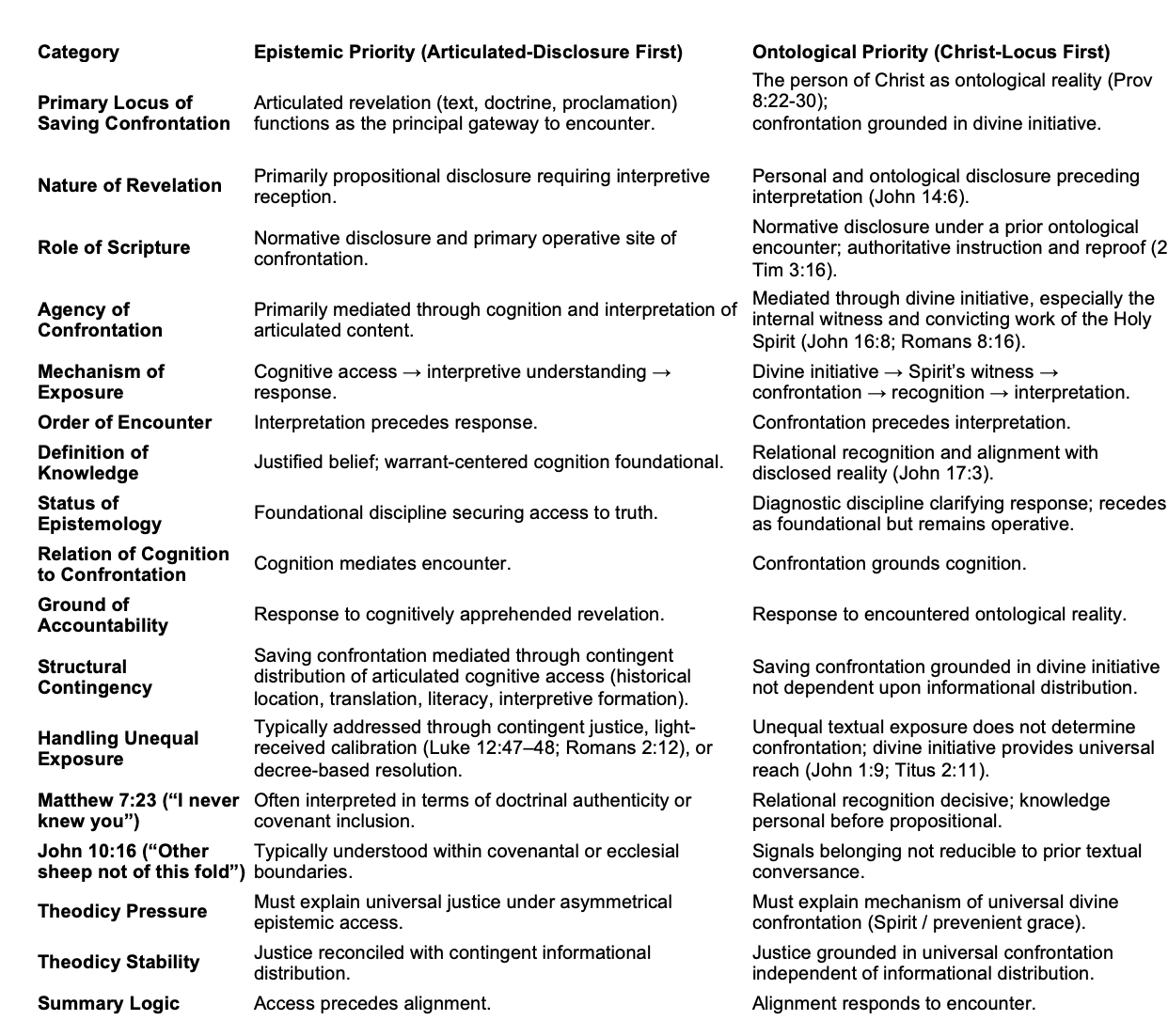
Core Architectural Distinction
Fundamental Difference
Epistemic Priority:
Saving confrontation is functionally mediated through articulated cognition and interpretation.
Ontological Priority:
Saving confrontation arises from divine initiative grounded in Christ and mediated through the Spirit, with cognition interpreting the encounter.
Footnote
This ordering entails that truth is ontologically prior to justificatory cognition. Knowledge arises as recognition under disclosed reality rather than as warrant securing access to reality. Scripture consistently depicts revelation as preceding comprehension and enabling recognition (Matthew 16:17; John 6:44; 2 Corinthians 4:6), and presents knowledge of God in relational rather than merely informational terms (John 17:3; 1 John 2:4). Justification and interpretation therefore clarify and test response without constituting the gateway to confrontation. The priority asserted here is structural rather than anti-intellectual: divine initiative grounds cognition, and reality discloses itself before it is systematized.
This pattern is reflected in Romans 1:18–19, where disclosure precedes knowledge and suppression. Accountability rests not upon informational access but upon response to disclosed reality; cognitive distortion follows moral posture rather than preceding exposure.