
Modern discourse is not collapsing because of a lack of information. It is collapsing because the basic structures that make truth possible are no longer examined.
Political arguments, scientific claims, cultural commentary, theological disputes, psychological theories — across every domain, propositions are confidently evaluated without ever asking the single question that determines whether a statement can even be true:
Are the categories in this claim capable of relating in reality?
This question is almost never asked.
Instead, modern reasoning typically begins at the level of:
logic (Do the arguments follow?)
statistics (Do the numbers support the claim?)
evidence (Are the data valid?)
narrative (Does the explanation sound plausible?)
Yet all of these procedures presuppose that the categories being reasoned about can even relate in the way the proposition asserts. When they cannot, the entire evaluative effort is wasted. The proposition is not merely false — it is ontologically inadmissible. It is a structural impossibility masquerading as a meaningful statement.
This missing first step is the primary reason modern reasoning repeatedly collapses into:
category errors
rhetorical illusions
ideological narratives
metaphysical smuggling
biological reductionism
psychological inflation
pseudo-causal explanations that feel persuasive but lack ontological grounding
To restore the architecture of truth, this essay introduces two tools that formalize the preconditions of meaningful evaluation — and places them in their proper order.
Clarification: OCBM does not test meaning, truth, or evidence. It tests ontological admissibility — the precondition for truth-evaluation and factuality. A statement may be linguistically meaningful yet ontologically inadmissible.
OCBM is the first gate of truth-evaluation.
It determines whether the categories invoked by a proposition are structured in such a way that a relation is even possible in reality. If the categories collapse, mismatch, skip levels, violate boundary integrity, or lack modal coherence, the claim cannot be evaluated logically or empirically because it does not survive the threshold of ontological admissibility.
OCBM restores what modern thought abandoned:
Ontology precedes epistemology
Structure precedes reasoning
Being precedes claims about being
OCBM produces a binary outcome only:
Admissible → further evaluation may proceed
Inadmissible → no truth-evaluation is meaningful
When a proposition fails OCBM yet still appears meaningful, persuasive, or intuitive, RSD explains why.
RSD does not test truth. RSD does not validate claims. RSD is a forensic diagnostic tool.
It identifies the illusion of relation responsible for the appearance of meaning when no genuine relation exists.
All semblant relations reduce to one of four structures:
Adjacency — correlation mistaken for causation
Synecdoche — part mistaken for whole or agent
Analogy — dimensional mapping mistaken for identity
Inversion — contrarian rhetoric mistaken for insight
RSD is applied only when ontological admissibility has already failed. It explains how the mind was tricked — not whether the claim is true.
Logic does not validate reality. It manipulates form.
When applied to ontologically admissible relations, logic clarifies structure and consequence. When applied to ontological failures, logic becomes a coherence-amplifier for illusion.
Logic is therefore never the first tool.
Empirical validation is meaningful only when applied to propositions that have already survived:
ontological admissibility (OCBM)
structural legitimacy (absence of category collapse)
logical coherence
Most contemporary debates never reach this stage — because they fail at the first gate.
The restored order of evaluation is:
Ontology → OCBM (gate) → • Logic → Evidence → Truth (if admissible) • RSD → Exposure of Illusion (if inadmissible)
This architecture exposes hidden fallacies that evade logic, dissolves rhetorical illusions, and re-establishes truth as an ontologically grounded reality rather than a semantic construct.
Every argument assumes that its categories are legitimate and that its relations are meaningful.
That assumption is almost always false.
Reasoning does not begin with logic. Reasoning begins with ontology — with the question:
Are the things being related even capable of relating?
If the categories are malformed, mismatched, or ontologically incoherent, logic becomes the servant of illusion rather than the servant of truth.
This section establishes the most counterintuitive fact in the entire framework:
Logic cannot tell you whether something is true. It can only tell you what follows from what came before.
If what came before is ontologically malformed, then what follows is irrelevant to reality.
Logic assumes:
category compatibility
level alignment
relational possibility
intact identity boundaries
ontic sufficiency
Logic has no tools to test any of these. It is downstream. Ontology is upstream.
Example:
“Genes determine behaviour.”
The statement can be formalised logically. Consequences can be deduced. Arguments can be built.
Yet the claim is ontologically impossible: genes lack ontic sufficiency, structural level, and relational capacity to entail behaviour. Logic “works” syntactically while failing ontologically.
If two terms are syntactically substitutable, logic assumes they belong to the same real category.
Thus:
“the brain” ≠ “the mind”
“self-expression” ≠ “identity”
“survival advantage” ≠ “purpose”
“freedom” ≠ “license”
“chemistry” ≠ “love”
Yet these substitutions dominate modern discourse — and logic obediently reinforces them.
Semantic drift becomes ontological drift, which logic then amplifies.
Logic cannot evaluate whether:
a cause contains enough structure to produce an effect
a micro-level process can instantiate a macro-level phenomenon
a category can entail another category
Examples of ontic insufficiency:
neurons → consciousness
molecules → moral value
genes → identity
random mutation → teleology
serotonin → relational love
Logic cannot see impossibility. It can only manipulate form.
If falsifying a claim requires collapsing a category, the claim was never relational — it was a disguised identity.
Example:
“Truth is subjective.”
To refute this, one must redefine truth as sentiment. That reveals the claim is invalid, not false.
Logic cannot detect invalidity. Only ontology can.
When logic is applied after ontological failure, it strengthens semblance.
Semblance provides:
form
intuitive resonance
surface plausibility
Logic then amplifies these forms, producing the appearance of legitimacy — not truth.
Logic does not create semblance. It amplifies it when misapplied.
The correct order is:
Ontology
OCBM (admissibility gate)
Logic (only if admissible)
Evidence
When this order is violated, reasoning collapses.
Before a proposition can be tested, debated, or reasoned about, a prior question must be answered:
Are the categories in the statement capable of relating at all?
If not, the statement is not false. It is ontologically invalid.
OCBM inspects reality-structure:
what kinds of things exist
how they can relate
what levels they inhabit
what causes can entail
what boundaries prevent collapse
OCBM asks one question:
Do the category-structures permit this relationship?
Failure of any criterion invalidates the claim.
Binary output:
Valid → logic may proceed
Invalid → evaluation stops
Ontology precedes modelling. Ontology precedes logic.
A relational claim is admissible only if all six criteria are met.
Ontic Distinctness (Non-Collapse) The relata must be distinct enough to be related.
Ontic Sufficiency The cause must contain enough structure to produce the effect.
Level Alignment No level skipping or collapse.
Boundary Integrity Categories must remain stable under evaluation.
Category Inclusion (Containment) The effect must reside within the causal domain.
Modal Coherence Capacity must precede manifestation.
Failure at any point is fatal.
OCBM determines whether truth-evaluation is meaningful at all.
Logic follows admissibility
Evidence follows logic
RSD applies only after failure
OCBM is the gateway.
Examples of ontological invalidity:
“Society causes self-hatred.”
“Nature is cruel.”
“Gender is assigned.”
“The universe is meaningless.”
These are not disagreements. They are category failures.
Logic operates on form. OCBM operates on reality.
If the categories are wrong, logic will faithfully amplify delusion.
Claim: “Extraordinary claims require extraordinary evidence.”
OCBM detects:
no category alignment
boundary instability
modal incoherence
ontic insufficiency
non-falsifiability
The claim is not false. It is invalid.
What appears powerful is only semblance.
Although this essay focuses on establishing the Ontological Category-Boundary Method (OCBM) in its formal structure, one of its most powerful applications—the identification of causal limits and relational breakpoints—is demonstrated separately in a dedicated sub-appendix.
In that extended analysis, the OCBM tool is used to resolve one of the most challenging pivot-pairs in classical literature (Proverbs 26:4–5), showing precisely where and why a relational instruction reverses truth-value at a boundary.This standalone treatment is provided in a pop-up box to preserve the flow of the main essay while still illustrating the tool’s full explanatory force.
Readers who wish to see how OCBM determines the exact limits of causality, delineates pivot thresholds, and resolves apparent contradictions through strict boundary analysis may open the sub-appendix by clicking on the button below.
The Ontological Category-Boundary Method (OCBM) performs five indispensable functions:
Identifies whether the relata referenced in a proposition are real or contrived.
Determines whether those relata are capable of meaningful relation in principle.
Rejects all ontologically inadmissible propositions outright.
Prevents logic, rhetoric, or evidence from lending false credibility to structural impossibilities.
Establishes the boundary conditions under which truth-evaluation may meaningfully occur.
OCBM is therefore not a theory of truth. It is the gatekeeper of possibility.
Without it, reasoning collapses before it begins.
Having established the ontological boundary conditions under which any relation can meaningfully exist, we now turn to the symmetrical opposite problem:
What happens when those boundary conditions fail, yet an appearance of relationship still presents itself?
OCBM determines whether reality permits the relation at all. Relational Semblance Diagnostics (RSD) exposes what the mind and discourse construct when reality does not.
When OCBM fails, no causation, entailment, or truth-bearing relation can exist. Yet many such inadmissible propositions continue to appear meaningful, explanatory, or profound.
RSD exists solely to diagnose this phenomenon.
When a proposition passes OCBM, it may proceed to logic and evidence.
When a proposition fails OCBM, the following are categorically ruled out:
no real relationship is possible,
no causation is possible,
no entailment is possible,
no truth-bearing structure exists.
Any perceived “connection” is therefore not weak causation, partial causation, or unverified causation.
It is pure illusion. Logic cannot be applied to OCBM-failed propositions.
When a proposition fails ontological admissibility, there is no real relation for logic to operate on. Any subsequent logical manipulation would apply only to semblance, producing coherent illusion rather than truth.
RSD does not rescue failed claims. RSD does not upgrade illusion into explanation. RSD classifies how the illusion of relation arose after ontology has already ruled relation impossible.
This must be stated with absolute clarity:
Semblance is not a weak form of causation. Semblance is what the mind constructs in place of causation when no real relation exists.
The strongest possible output of semblance is correlation, which has zero causal force.
Semblance is the cognitive, linguistic, and rhetorical scaffolding that gives an appearance of connection where ontology denies one.
RSD does not evaluate truth. RSD does not validate relations. RSD does not establish causation.
RSD is invoked only when a proposition has already failed OCBM yet continues to generate an impression of coherence, insight, or explanatory power.
If a proposition passes OCBM, RSD is not applicable. The claim proceeds directly to logic and evidence.
RSD is therefore:
the diagnostic tool for non-relations,
the classifier of structural illusions,
the interpreter of false coherence,
and the safeguard that prevents resemblance from being mistaken for reality.
All semblance reduces to one of four non-relational illusion structures.
These are not pathways to causation. They are cognitive substitutes for causation.
Each explains how inadmissible propositions acquire the appearance of relation despite ontological impossibility.
Two things appear connected because they occur near one another:
in time (sequence mistaken for cause),
in space (co-location mistaken for interaction),
in culture (co-trending mistaken for meaning),
in psychology (co-activation mistaken for entailment).
Examples:
“Anger leads to violence.”
“GDP growth creates happiness.”
“Studying in cafés boosts intelligence.”
These are correlations at best.
Correlation = zero entailment. Epistemic status: Non-relational. Pure semblance.
A part is mistaken for the whole, or the whole is misapplied to a part.
This is the primary engine of reductionism and collectivist abstraction.
Examples:
“The brain decides.”
“Culture is violent.”
“Society demands compliance.”
These claims sound relational but violate ontic sufficiency and agent-category boundaries.
Epistemic status: Non-relational. A cognitive shortcut mistaken for causation.
Similarity in one dimension is mistaken for equivalence across all dimensions.
Examples:
“DNA is a blueprint.”
“The mind is software.”
“Evolution is an engineer.”
Analogy is pedagogically useful but ontologically disastrous when mistaken for identity.
Epistemic status: Non-relational. Conceptual resemblance only.
A dramatic reversal creates the impression of depth or insight.
Examples:
“Slavery made Rome strong.”
“Fear is clarity.”
“War creates peace.”
Inversion simulates profundity by exploiting contrast.
Epistemic status: Non-relational. Rhetorical, not ontological.
Typophoric semblance occurs when naming itself simulates ontological structure, creating the illusion that a category exists simply because it has been linguistically instantiated. This is a sub-mechanism of analogical and categorical semblance, not a separate causal type.
This is the unambiguous core principle:
Semblance can never, under any circumstances, generate causation.
It produces only the appearance of relation.
Because:
adjacency ≠ force,
resemblance ≠ identity,
correlation ≠ entailment,
analogy ≠ instantiation,
contrast ≠ mechanism,
linguistic structure ≠ ontological structure.
Semblance is cognitive ornamentation over ontological nothingness.
Logic does not validate semblance. Logic manipulates semblance.
When logic is applied downstream of ontological failure, it:
accepts the illusion as real,
treats semblant structure as actual structure,
and generates internally coherent falsehoods.
This is why entire systems can feel rigorous while being ontologically empty.
Examples include:
Marxism
evolutionary psychology
totalising scientism
gender ideology
atheistic materialism
These systems are not valid. They are coherent illusions amplified by logic.
OCBM — Ontological Admissibility Gate
If OCBM passes, the claim proceeds directly to logic.
If OCBM fails, no real relation is possible.
RSD — Post-Failure Illusion Diagnostics
RSD is invoked only after OCBM failure
It classifies the semblance structure responsible for the illusion of relation.
Logic
Logic is never applied to OCBM-failed claims.
Logic is never applied to semblance.
Claim: “Extraordinary claims require extraordinary evidence.”
OCBM has already established that the claim is ontologically invalid.
RSD therefore classifies the source of its persuasiveness:
Adjacency: Rarity of events is mistaken for epistemic burden.
Synecdoche: Emotional impression of strangeness (part) is treated as a universal epistemic rule (whole).
Analogy: Borrowed from legal rhetoric, misapplied to epistemology.
Inversion: The claim feels profound because it reverses expectation.
The statement is not merely invalid. Its sense of validity is supplied entirely by semblance.
Relational Semblance Diagnostics provides:
a systematic map of illusion-types,
the ability to detect when correlation is being mistaken for causation,
the ability to classify non-relational claims after ontological inadmissibility has been established,
and the safeguard that prevents logic from being misapplied to ontological failures and their semblant scaffolds.
The decisive insight:
Semblance does not weaken relation. Semblance replaces relation.
With both diagnostic instruments now established — OCBM for ontological admissibility and RSD for post-failure semblance classification — we are prepared to integrate them into a single evaluative architecture.
Taken individually, each tool identifies a different failure mode. Taken together, they restore the proper hierarchy of reasoning:
Ontology → OCBM (gate) → logic/evidence (if admissible) Ontology → OCBM (gate) → RSD (if inadmissible)
The Integrated Pipeline shows how these tools interlock, ensuring that logical inference is never applied to ontologically impossible claims, and that the illusion of relation is not mistaken for relation when ontology has already ruled relation impossible.
Section V operationalizes the framework as a step-wise evaluative sequence that moves from possibility → diagnosis → truth-admissible reasoning.
The mind moves too quickly. It leaps from language → intuition → reasoning without checking whether the categories allow a relationship to exist at all.
The modern world exploits this haste.
To prevent illusion from masquerading as knowledge, the diagnostic order must be restored:
Ontology → OCBM (admissibility gate) → • Logic → Evidence → Truth (if admissible) • RSD → Exposure of Illusion (if inadmissible)
Reversing or skipping any step produces epistemic illusion rather than truth.
We begin with the most fundamental question:
Are the relata capable of relating in reality?
This requires checking:
distinctness (non-collapse),
sufficiency,
level alignment,
boundary integrity,
domain containment,
modal coherence.
If any condition fails:
the proposition is not false,
the proposition is invalid,
logic is barred,
and any perceived connection is illusion.
This step eliminates the bulk of modern statements before they ever reach reasoning.
Example: “Genes determine behaviour.” — fails ontology; cannot be reasoned about. Example: “Extraordinary claims require extraordinary evidence.” — fails ontology; cannot be reasoned about.
OCBM isolates the possible from the impossible.
Relational Semblance Diagnostics (RSD) is not a general evaluative stage. It is a post-failure diagnostic tool, invoked only when OCBM has already ruled a proposition ontologically inadmissible.
When OCBM fails, no real relation is possible. Yet many such propositions continue to appear meaningful, explanatory, or profound.
RSD exists solely to diagnose the illusion of relation that substituted for causation after ontological failure.
RSD classifies the specific semblance mechanism responsible for that illusion:
adjacency (correlation mistaken for causation),
synecdoche (part substituted for whole or agent),
analogy (dimensional resemblance mistaken for identity),
inversion (contrast mistaken for depth).
If a proposition passes OCBM, RSD is not applicable. In such cases, failure to establish causation reflects evidential underdetermination or weak inference — not semblance.
Logic is never the first tool.
It is the final truth-functional tool, engaged only when:
the relation is ontologically admissible (OCBM passes).
Only then can logic reliably:
test entailment,
evaluate structure,
follow inference,
detect contradiction.
Why so late?
Because logic cannot detect:
invalid categories,
non-relations,
category collapse,
level mismatch,
boundary erosion.
If applied to an OCBM-failed claim, logic does not validate semblance — it only amplifies semblance’s coherence.
This is the root cause of entire intellectual systems that “feel rigorous” yet are ontologically empty.
“Matter produces consciousness.”
OCBM: fails (ontic insufficiency + level mismatch)
RSD: synecdoche + analogy (as the primary semblance structures)
Logic: barred
Verdict: invalid
“Poverty causes crime.”
OCBM: passes (relation is ontologically admissible)
Logic & Evidence: causal mechanism not established; correlation and confounds remain
Verdict: admissible but causally underdetermined
(RSD is not invoked.)
“Neglecting sleep impairs judgment.”
OCBM: passes (biological → cognitive → behavioural chain is coherent)
Logic: allowed
Evidence: supports causal relation
Verdict: truth-evaluable
The pipeline prevents:
emotional impression from becoming ontology,
correlation from becoming causation,
analogy from becoming identity,
rhetoric from becoming mechanism,
category collapse from becoming “truth,”
coherent illusion from being mistaken for reality.
This is the single most powerful epistemic safeguard a mind can possess.
The pipeline enables:
truth-grounded reasoning,
clarity without cynicism,
discernment without paranoia,
logic without illusion,
ontology-driven analysis,
falsifiable evaluation,
and the neutral, surgical disassembly of propaganda, ideology, and scientism.
It restores confidence in the possibility of reasoning because it restores reasoning to its proper order.
Ontology first. Admissibility second. Logic last.
Although logic is the final step in the pipeline, it is not an abstract or informal process. The logical operations applied here are the classical ones:
Used to test the internal structure of propositions:
Modus Ponens (If P → Q; P; therefore Q)
Modus Tollens (If P → Q; ¬Q; therefore ¬P)
Disjunctive Syllogism (P ∨ Q; ¬P; therefore Q)
Conjunction / Simplification
Contraposition, biconditional elimination, etc.
These operate on propositional form.
Used when propositions include quantifiers and predicates:
universal instantiation,
existential generalisation,
predicate substitution,
identity reasoning.
These operations still evaluate form, not reality.
Determines whether a conclusion follows from premises in every model where the premises hold.
Entailment evaluates:
validity of structure,
not validity of the categories themselves.
The Integrated Pipeline establishes:
OCBM: determines whether truth-evaluation is even admissible here.
RSD: classifies the illusion of relation only after ontological failure.
Logic: evaluates structure only where ontological admissibility has already been secured.
Every step is necessary. Every step eliminates illusion.
This pipeline converts what the world treats as “debate” into a surgical evaluation of reality.
The Pipeline now stands complete:
OCBM establishes ontological possibility,
RSD diagnoses semblant substitutes only when possibility fails,
Logic operates only where reality has already been secured.
Section VI puts this evaluative order into practice. We apply the Pipeline across biology, psychology, politics, ethics, theology, science, and culture — not to demonstrate novelty, but to reveal how many dominant claims derive their persuasive force not from truth, but from patterned illusions that arise when ontology is ignored.
This section demonstrates the diagnostic pipeline in action across multiple domains. It reveals how entire disciplines and cultural narratives derive persuasive force not from truth, but from ontologically inadmissible claims that continue to appear meaningful.
Each example follows the correct diagnostic order:
OCBM — Ontological Admissibility: Is a real relation even possible between the referenced kinds?
RSD — Relational Semblance Diagnostics (conditional): Invoked only if OCBM fails, to classify the illusion that substituted for relation.
Logic & Evidence: Applied only if OCBM passes.
Where OCBM fails, logic is barred and RSD explains why the claim nevertheless feels coherent. Where OCBM passes, the claim proceeds to logic and evidence; absence of causation in such cases reflects underdetermination, not semblance.
OCBM: Fails due to
ontic insufficiency (genes encode protein sequences, not agency),
level mismatch (molecular → intentional),
modal incoherence (dispositions ≠ decisions).
Because OCBM fails, no real relation is possible.
RSD:
Synecdoche (part → whole: genes substituted for persons),
Adjacency (correlation mistaken for causation).
Logic: Barred. Verdict: Ontologically invalid proposition sustained entirely by semblance.
OCBM: Fails due to agent-boundary violation (brain tissue is not a volitional subject).
RSD:
Synecdoche (organ → agent),
Analogy (computational metaphor: “brain as computer”).
Logic: Barred. Verdict: Non-relational illusion masquerading as neuroscience.
OCBM: Passes. Both constructs inhabit the same psychological domain; relation is ontologically admissible.
RSD: Not applicable (OCBM passed).
Logic & Evidence: Causal mechanism is not established; current evidence supports correlation and confounds. Verdict: Ontologically admissible but causally underdetermined. This is not semblance; it is evidential insufficiency.
OCBM: Fails due to level mismatch and category collapse (experience substituted for ontological identity).
RSD: Synecdoche (experience substituted for essence/being).
Logic: Barred. Verdict: Ontologically invalid claim sustained by reductionist illusion.
OCBM: Fails. “Society” is not an agent; this is category collapse and boundary erosion.
RSD: Synecdoche (aggregate treated as agent).
Logic: Barred. Verdict: Invalid claim with rhetorical force but no ontological footing.
OCBM: Fails due to
ontic insufficiency (emotion lacks causal structure for macroeconomic outcomes),
level mismatch (affective → economic).
RSD:
Adjacency (co-occurrence mistaken for cause),
Analogy (virtue-signaling treated as mechanism; moral sentiment mapped onto economic productivity).
Logic: Barred. Verdict: Ontologically impossible causal structure.
OCBM: Fails categorically due to
physical → axiological category jump,
random → normative jump,
survival → value substitution.
RSD:
Analogy (selection mapped onto goodness),
Inversion (self-interest reframed as altruism / obligation).
Logic: Barred. Verdict: Entire discourse is sustained by semblance where ontology is absent.
OCBM: Fails. Molecules cannot instantiate moral posture or relational obligation.
RSD:
Synecdoche (chemical state substituted for personhood/agency),
Analogy (psychology reduced to chemistry).
Logic: Barred. Verdict: Invalid proposition wearing scientific language.
OCBM:
First clause admissible (predicate attribution).
Second clause fails: attribute ≠ subject (ontic collapse).
RSD:
Inversion (predicate elevated to subject),
Synecdoche (attribute substituted for being).
Logic: Barred. Verdict: Structural collapse exposed instantly.
OCBM: Fails. Faith is relational trust (covenantal/relational category); “psychological state” is intrapsychic affect. This is level/domain collapse.
RSD:
Adjacency (faith often accompanied by emotion, mistaken for identity),
Analogy (trust equated with feeling-state).
Logic: Barred. Verdict: Ontologically invalid reduction.
OCBM: Fails. Material structures cannot instantiate semantic or axiological categories.
RSD:
Inversion (scale mistaken for value),
Analogy (cosmic vastness mapped onto existential negation).
Logic: Barred. Verdict: Category-invalid metaphysics framed as science.
OCBM: Fails due to
modal incoherence (non-being → being, without ontic sufficiency),
ontic insufficiency (chemistry described as if it contained life’s category).
RSD:
Analogy (self-organisation equated with life),
Adjacency (laboratory sequencing mistaken for ontological generation).
Logic: Barred. Verdict: Illusion of explanation without ontological capacity.
OCBM: Passes. Agents influencing agents is ontologically admissible.
RSD: Not applicable (OCBM passed).
Logic & Evidence: Causation is not established at this generality; categories require disaggregation and mechanism specification. Verdict: Admissible but empirically underdetermined.
OCBM: Passes.
RSD: Not applicable (OCBM passed).
Logic & Evidence: Influence exists; causation is not demonstrated as a general law. Verdict: Influence and correlation are shown; causation remains underdetermined. No semblance diagnosis is required.
Across every domain, the pattern is consistent:
Many dominant claims fail OCBM outright.
When OCBM fails, RSD explains why impossibility still feels meaningful.
When OCBM passes, absence of causation reflects evidential limits, not illusion.
Logic is legitimately applicable far less often than assumed.
This distinction collapses entire ideological systems without debate because it relocates the dispute from “arguments” to ontological admissibility.
Section VI demonstrates that:
OCBM stops impossible claims at the gate.
RSD classifies the illusion only after ontological failure.
Logic operates exclusively within admissible reality.
Truth becomes surgically accessible. Modern discourse becomes transparent. Ontology is restored as the condition of reason.
Sections VII and VIII form the evaluative and ethical horizon of the OCBM–RSD framework. The pipeline does far more than repair isolated arguments. It reveals a structural displacement in the way modern culture approaches truth itself.
Most people — including academics — treat reasoning as though it begins with:
evidence,
arguments,
models,
frameworks,
statistical inference,
or formal logic.
But reasoning begins far earlier.
It begins with ontology — with the question:
Are the things being related capable of relating in reality?
This single shift carries transformative consequences for:
epistemology,
scientific interpretation,
political rhetoric,
cultural narratives,
moral discourse,
personal discernment,
and the very possibility of truth itself.
Section VII articulates these consequences.
Reasoning does not produce truth. Reasoning tests truth claims.
But truth claims are only testable if they first survive ontology.
Thus the restored hierarchy is this:
truth is ontological,
evaluation is epistemological,
coherence is logical,
semblance is rhetorical.
The OCBM–RSD pipeline restores this order.
This overturns a long philosophical drift — from Aristotle’s reduction of truth to propositional form, through Kant’s bracketing of noumenal reality, to analytic philosophy’s fixation on structure over being.
The insight is simple:
Logic is only truth-preserving when applied to what is already true in reality. Everything else is illusion shaped by grammar.
Nearly every “explanation” in modern science attempts category transitions that OCBM explicitly prohibits:
physical → mental
chemical → moral
genetic → volitional
random → teleological
evolutionary → axiological
neural → personal
environmental → existential
OCBM shows these claims are not merely incorrect. They are ontologically impossible.
RSD then explains why they nevertheless seemed persuasive:
adjacency (co-occurrence mistaken for cause),
synecdoche (parts substituted for wholes or agents),
analogy (mechanical metaphors mistaken for identity),
inversion (counterintuitive framing mistaken for depth).
Thus the authority of scientism dissolves without refuting empirical data. Ontology collapses the narrative before the debate even begins.
Cultural claims gain their power through semblance:
“society wants,”
“history teaches,”
“progress demands,”
“identity expresses,”
“the universe is indifferent.”
These are not insights. They are ontological impossibilities carrying rhetorical gravity.
OCBM exposes their category errors. RSD explains why they retain emotional force.
Once diagnosed, their persuasive depth evaporates.
Modern ethics commonly assumes that:
evolution,
psychology,
social dynamics,
neurochemistry
can “explain” or “produce” moral value.
OCBM reveals:
no lower category can entail a higher one,
matter cannot generate value,
biology cannot generate duty,
evolution cannot generate obligation.
RSD then explains why these claims felt compelling: synecdoche, adjacency, analogy, and inversion.
Morality is restored to its proper ontological footing.
The dominant engines of deception in modern discourse are:
category drift,
logical form applied to non-relational content,
rhetorically reinforced adjacency,
metaphor mistaken for mechanism,
linguistic substitution taken as identity.
OCBM and RSD neutralise these engines.
The rhetoric remains. The illusion dissolves.
Individuals equipped with this framework gain:
immediate clarity,
immunity to propaganda,
immunity to ideological framing,
protection against false profundity,
resistance to pseudo-scientific rhetoric,
confidence in distinguishing reality from noise.
The mind is no longer deceived by:
form,
resemblance,
analogical drift,
conceptual adjacency,
or logical coherence unsupported by ontology.
Discernment becomes a tool, not a feeling.
Once ontology is restored, epistemology follows, and logic assumes its proper role.
This hierarchy mirrors the biblical pattern:
Being precedes knowing (“I AM”).
Relation precedes revelation (covenant → communication).
Truth confronts, not emerges (revelation, not construction).
Falsity begins with category inversion (Genesis 3; Romans 1).
The OCBM–RSD pipeline therefore does not merely repair epistemology. It reinstates the biblical structure of reality and reason.
Section VII consolidates the entire framework:
Truth is ontological — not logical, empirical, or rhetorical.
OCBM tests the possibility of relation.
RSD diagnoses illusions of relation only after ontological failure.
Logic can refine only what ontology already permits.
Modern culture mistakes semblance for causation. The pipeline dissolves coherent illusion at its root.
A restored hierarchy of being → relation → reason reopens the path to truth.
The consequences of ontological diagnostics make clear why modern discourse collapses so easily:
reason is applied where ontology has not been secured,
logic is misapplied to semblance,
rhetoric is substituted for reality.
Yet not all illusions are accidental. Some are deliberately manufactured.
Section VIII therefore shifts from passive illusion arising from structural error to the active engineering of semblance for persuasive, political, and ideological ends.
Here we examine how:
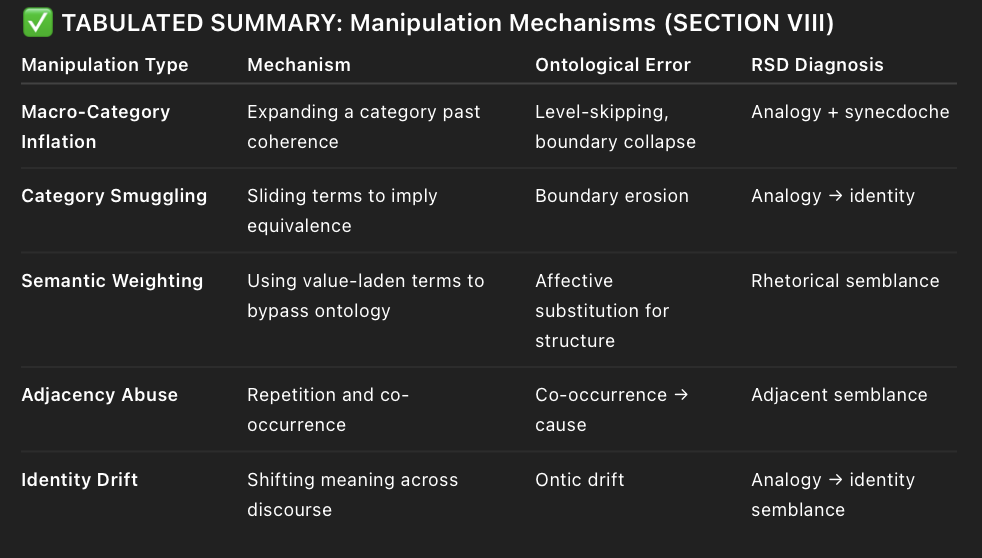
macro-category inflation,
category smuggling,
semantic weighting,
rhetorical adjacency
manufacture the appearance of depth where no ontological grounding exists.
What OCBM and RSD expose as impossibility becomes, in Section VIII, a study in how impossibility is systematically disguised as coherence.
Relational Semblance Diagnostics (RSD) explains how semblance naturally arises in human cognition when ontological boundaries are violated. But semblance is not always accidental.
It is often deliberately constructed.
Manipulation occurs when:
Agents intentionally engineer semblance in order to mask ontological impossibility, allowing inadmissible claims to appear coherent, reasonable, or morally compelling.
This is not psychology. It is not persuasion theory. It is not mere rhetoric.
It is onto-semiotic engineering: the deliberate construction of symbolic structures that simulate relation where no ontological relation exists.
This section exposes the forms of that engineering — not the techniques for executing it.
The most common manipulative tactic is the invention or invocation of an artificial superordinate category that appears to contain incompatible kinds.
Examples:
“The nation feels safer.”
“The economy is angry.”
“Society wants justice.”
“Humanity is moving forward.”
These macro-categories do not exist as causal agents.
They are syntactic shells — abstract linguistic containers that:
erase agent boundaries,
collapse levels of organization,
and conceal category mismatch.
Macro-category inflation allows non-agents to masquerade as agents, granting rhetorical force without ontological legitimacy.
RSD identifies this as synecdoche reinforced by abstraction.
A second manipulative strategy is category smuggling: the covert insertion of an incompatible category that allows an otherwise impossible relation to appear permissible.
Example:
“Equity is good for democracy.”
Here:
equity is axiological,
democracy is structural–political,
but smuggling both into the undifferentiated moral space of “goodness” creates a false hinge of relation.
The relation appears valid only because ontological distinctions have been erased.
RSD identifies this as analogical bridging combined with boundary erosion.
A third strategy is axiological colouration: the use of evaluative language to simulate coherence where none exists.
Adjectives, adverbs, and evaluative nouns — such as:
“responsible,”
“progressive,”
“inclusive,”
“ethical,”
are applied as semantic weights.
Their function is not to clarify meaning, but to:
pre-load moral approval,
suppress ontological scrutiny,
and induce assent prior to evaluation.
RSD identifies this as cosmetic semblance: rhetorical polish applied to ontological absence.
This essay exposes the logic of manipulation. It does not provide operational techniques for its execution.
The purpose of this framework is:
to clarify ontology,
to restore epistemic integrity,
to protect against rhetorical fraud,
not to equip manipulation.
Accordingly:
all examples are diagnostic,
all mechanisms are descriptive,
and no procedural guidance is offered.
This is a framework for discernment, not control.
Section VIII completes the arc begun in Sections I–VII:
OCBM exposes ontological impossibility.
RSD explains why impossibility still appears meaningful.
Section VIII reveals how that appearance is deliberately engineered.
What begins as structural error becomes, here, strategic distortion.
The framework now stands complete:
Ontology secures reality.
Semblance explains illusion.
Diagnostics expose manipulation.
Reason is restored to its proper ground.
The Ontological Category-Boundary Method (OCBM) establishes a structural truth:
A proposition cannot be factual unless the kinds it references are capable of real relation.
This single insight reorders the entire architecture of reasoning.
The correct evaluative order is:
Ontology — OCBM: Are the referenced kinds capable of entering a real relation?
RSD (conditional): If not, what illusion produces the appearance of coherence?
Logic: Only if ontological admissibility is secured may arguments be tested for validity.
Evidence: Empirical confirmation is meaningful only within an ontologically admissible field.
Manipulation awareness: How rhetorical or ideological structures deliberately simulate coherence when relations are impossible.
This framework restores ontological grounding to discourse that has long operated without it. It explains why so many modern debates are irresolvable: the disagreements are not about facts, but about impossible relations mistakenly treated as factual claims.
Restore the ontological boundary, and truth becomes visible again.
Carl Sagan popularised the slogan:
“Extraordinary claims require extraordinary evidence.”
It has become a cultural axiom. Yet under ontological analysis, the statement contains no admissible relational structure.
The proposition attempts to relate:
an aesthetic magnitude (“extraordinary”),
to an epistemic standard (“requires more evidence”).
These categories cannot form a causal, normative, or logical relation.
Aesthetic descriptors do not determine evidential thresholds.
OCBM verdict: Ontologically inadmissible. The kinds lack relational capacity.
If the relation is impossible, why does the statement feel persuasive?
RSD reveals the semblance structures that supply false coherence:
Analogical semblance: Borrowed proportionality from pragmatic contexts (“greater risk requires greater precaution”), falsely mapped onto epistemology.
Cosmetic semblance: “Extraordinary” carries affective weight, which the mind misreads as epistemic relevance.
Typophoric semblance: “Extraordinary evidence” introduces a pseudo-category that does not exist in epistemology, yet naming simulates a legitimate type.
Correlative semblance: The slogan implies a scaling function (greater extraordinariness → greater burden), despite no ontic hinge enabling such scaling.
The appearance of sense is entirely supplied by semblance.
In practice, the slogan is applied selectively:
miracles → labelled “extraordinary” → dismissed
Big Bang → extraordinary → accepted
abiogenesis → extraordinary → accepted
consciousness-from-matter → extraordinary → accepted
The slogan therefore functions not as an epistemic principle, but as a rhetorical boundary.
It constructs a pseudo-standard that shields naturalistic claims while disqualifying theistic ones.
Result:
OCBM: impossible
RSD: coherent only via semblance
Manipulation: easily weaponised
Epistemology: contributes no genuine guidance
This example demonstrates why OCBM must precede all reasoning, and why RSD must diagnose the illusions that arise when ontological impossibilities are rhetorically stabilised.
With OCBM and RSD in place, the reader stands in a fundamentally different epistemic landscape from where the essay began. What first appeared as a technical clarification reveals itself as a reordering of how truth must be approached if reasoning is to remain tethered to reality.
Only now can the full implications be stated plainly.
The discovery is simple but decisive:
A proposition cannot be factual unless the kinds it references are capable of real relation in the structure of being.
This is not a linguistic rule or a logical constraint. It is a meta-foundational ontological requirement.
Logic presupposes admissibility. Epistemology presupposes ontology. Truth presupposes real relational capacity.
Kant uncovered the conditions that make experience possible. OCBM uncovers the conditions that make factuality possible.
The hierarchy was always operative. It merely lacked articulation.
The inherited structure of reasoning has been:
propositions → logic → evidence → truth.
The correct structure is:
Ontology: Are the kinds capable of relation?
RSD (conditional): If not, what illusion simulates coherence?
Logic: Is the admissible structure internally valid?
Evidence: Does reality confirm the permissible relation?
This is not refinement. It is structural reversal.
Modern discourse is saturated with claims that cannot be true because the kinds they relate cannot interact:
“The universe prefers justice.”
“History rewards courage.”
“Hope drives economic outcomes.”
“Nature wants diversity.”
These are not merely vague or poetic. They are ontologically impossible.
OCBM names what has long gone unnamed: many debates persist because the relations cannot exist.
This is not semantics. It is ontological surgery.
OCBM closes a pervasive epistemic loophole:
Correlation matters only when an ontic hinge exists between the kinds.
Without relational capacity:
correlation cannot mature into fact,
cannot imply causation,
cannot become evidence.
This restores a missing constraint to scientific reasoning.
Popper’s criterion of falsifiability is secondary to a deeper truth:
A claim must be ontologically admissible before it can be falsifiable.
If the kinds cannot relate, the claim cannot be falsified — and therefore cannot be scientific, philosophical, or meaningful.
OCBM supplies the missing ontological dimension of epistemology.
OCBM exposes impossibility. RSD exposes the illusion of possibility.
RSD diagnoses the mechanisms by which inadmissible propositions appear persuasive:
typophoric drift,
analogical semblance,
macro-category inflation,
axiological coloration,
narrative fusion.
The model does not manipulate. It unmasks manipulation.
The deepest implication is this:
Facthood is not a property of statements. Facthood is a property of ontologically permissible relations.
A statement becomes factual only when:
the kinds can truly relate,
the logic is coherent,
the evidence corresponds.
Truth does not emerge from human reasoning. It begins in being, not in thought.
If one sentence captures the entire model, it is this:
OCBM identifies the ontological preconditions for factuality; RSD diagnoses the illusions that arise when those preconditions are violated.
Everything else in the essay follows from this axiom.
In an age where discourse drifts untethered from reality, this framework restores what modern thought abandoned:
the anchor of being.
Once restored, the rest — philosophical, cultural, and theological — follows necessarily.