
(Standalone Section Demonstrating Boundary–Pivot Analysis)
Having established the Ontological Category-Boundary Method (OCBM) as the foundational tool for determining whether a relation is even possible within reality, and having used it across scientific, psychological, ethical, and cultural domains, we now present one of the strongest classical demonstrations of OCBM in operation: the canonical pivot pair in Proverbs 26:4–5.
These verses present two instructions that appear contradictory, yet both are affirmed as equally true within Scripture.This makes them an ideal substrate for OCBM’s boundary–pivot evaluation, which identifies the precise threshold at which a relation changes truth-value without collapsing into contradiction or relativism.
Proverbs 26:4 “Do not answer a fool according to his folly, lest you also be like him.”
Proverbs 26:5 “Answer a fool according to his folly, lest he be wise in his own eyes.”
At first glance the two statements impose opposite obligations.Many readers have treated them as:
paradox,
contextual relativism,
or rhetorical juxtaposition.
But formally, they are a case of pivot-dependent relational truth.
OCBM exposes why both are simultaneously true.
Before we examine pivot thresholds, OCBM requires we test whether the relation is ontologically possible.
“Fool” and “wise respondent” remain distinct categories. ✔ Ontological boundaries intact.
Answering or remaining silent both have genuine relational consequences. ✔ Both actions have sufficient ontic structure.
Interpersonal discourse ↔ interpersonal influence. ✔ Same level of agency.
A fool’s folly and the respondent’s integrity are morally and epistemically discrete within Proverbs. ✔ No category blur.
Both verses operate within the moral-relational domain. ✔ Same ontic family.
Both actions are possible and real. ✔ No modal impossibility.
Conclusion: Both verses pass OCBM.The relation “answering a fool” is ontologically valid in principle.
Therefore the question is not “Can one answer or not answer?” but “Under what pivot conditions does each become correct?”
This is precisely what Boundary–Pivot Analysis resolves.
Proverbs 26:4–5 demonstrates a relation that is valid in two domains, with a pivot in between. The truth does not contradict — it flips at a threshold.
“Do not answer… lest you also be like him.”
Boundary Condition: When answering would draw you into the fool’s logic.
Pivot: The relation becomes corruptive → answering collapses your integrity.
Instruction: Do not answer.
“Answer him… lest he be wise in his own eyes.”
Boundary Condition: When silence would embolden the fool’s self-deception.
Pivot: The relation becomes harmful through omission → silence legitimises folly.
Instruction: Answer.
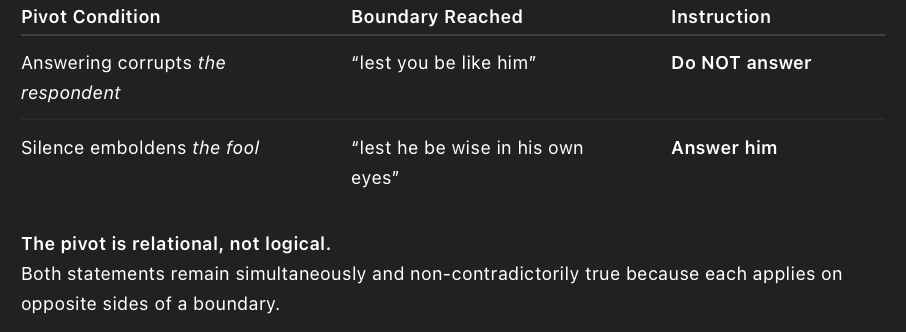
This example demonstrates the power of OCBM’s boundary–pivot mechanism:
There is no contradiction at the level of being.
The action flips at a structural hinge.
There is no relativism, no contextual vagueness, and no dual-truth.
Wisdom discerns not “whether” a relationship exists, but “where” the relationship changes.
Although RSD is not invoked here, this case explains why pivot failures produce illusions of contradiction.
Proverbs 26:4–5 provides a canonical case of OCBM applied to real discourse, showing:
categorical admissibility,
proper level alignment,
boundary determination,
pivot thresholds, and
relational truth that changes domain without collapsing into contradiction.
This case stands as the most precise biblical exemplification of the OCBM tool’s capacity to resolve apparent contradictions by restoring ontological boundaries and identifying pivot-sensitive truth.
Although the Proverbs 26:4–5 case illustrates a single pivot threshold along one relational axis, it is important to note that real-world claims often sit within multi-dimensional relational spaces.A statement may contain several overlapping domains—biological, psychological, moral, modal, teleological, or relational—and each axis may possess its own boundary and pivot point.
In such cases, OCBM does not seek a “flat” overlap (as in a two-circle Venn diagram) but evaluates overlap across multiple ontological axes simultaneously, identifying where each dimension admits relation and where each dimension breaks it.Complex claims therefore require multi-axis pivot mapping, where truth-value may shift across several thresholds rather than a single one.
The Proverbs example provides a clear, pedagogical instance of a one-pivot domain, but the OCBM tool is fully equipped to analyse multi-boundary, multi-pivot relational structures whenever a statement demands a deeper dimensional mapping.
“Social media causes depression.”
Most people treat this as either true or false.But the truth depends on three distinct ontological axes:
Psychological Axis (internal emotional regulation)
Physiological Axis (neurochemical substrates)
Social-Environmental Axis (relational belonging, comparison, exposure)
Each axis has its own category-boundary and pivot.
OCBM evaluates them separately before any causal inference is allowed.
Mood regulation, identity formation, narrative framing.
Social media can influence self-comparison, anxiety, fear of missing out.
The pivot occurs at the internalisation threshold:
Above threshold → correlation becomes contributing factor
Below threshold → no effect
Beyond threshold → effect inverts (e.g., validation-seeking becomes dependence)
Partial admissibility. There is real domain overlap.
But correlation ≠ causation.
Serotonin pathways, dopamine reward loops, circadian interruption.
Social media is not in itself a physiological agent.It does not biochemically “cause” depression.
The pivot lies in behavioural mediation:
Sleep loss
Blue-light exposure
Reward-loop overstimulation
These are behaviours, not inherent properties of social media.
Category violation. Social media cannot directly cause neurochemical depression. Only behaviours can mediate this domain.
Group belonging, peer pressure, validation economies.
Social media can shape perceived social status.
The pivot occurs at relational saturation:
Limited exposure → neutral or positive
Moderate exposure → heightened comparison
Excessive exposure → identity destabilisation / isolation
Partial admissibility. Effects exist, but only as secondary phenomena.
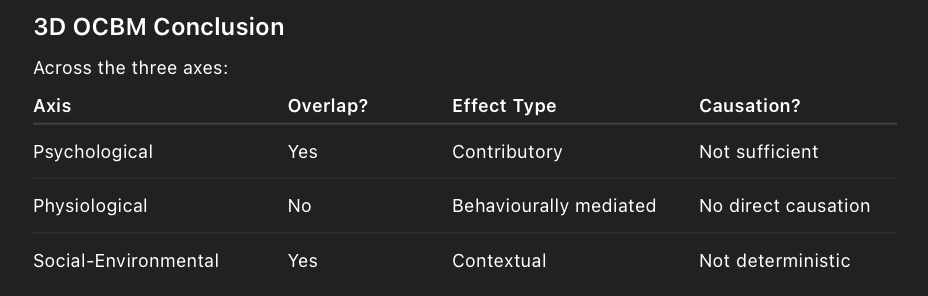
There is no axis on which the proposition “social media causes depression” admits direct categorical causation.
There are two axes where it has correlative effects and one axis where it has zero ontological admissibility.
Thus OCBM says:
The claim is invalid as a causal proposition. It is valid only as a multi-axis correlative cluster.
This is something no first-order logic system can reveal.