
A legitimate ontic category maintains fixed identity, articulates its internal axes explicitly, forbids substitution and inversion, preserves directional grounding, survives time and pressure, maintains boundary integrity, exercises explanatory modesty, exposes structural vs derivative dimensions under negative testing, and remains portable across domains. Where any of these fail, the category is malformed prior to falsifiability, evidence, or moral evaluation.
Ontological Syntax is applied in two modes.
In statu nascendi (pre-hoc) it functions as a constructive constraint: when a category is being proposed, defined, or formalised, ontological syntax tests whether the category can be coherently articulated at all—whether its identity is fixed, its axes are explicit, its directionality is preserved, and its boundaries hold.
In post-hoc mode it functions as a forensic constraint: when a category already exists in discourse (or practice), ontological syntax tests whether the category is being used with integrity or has drifted—whether derivative dimensions have begun to arbitrate grounding ones, whether pressure has rewritten definition, or whether boundary bleed has converted phenomenology into ontology.
Why Both Modes Matter (and where it sits in the pipeline)
This dual applicability matters because many failures occur before relational evaluation (OCBM), logic, evidence, or moral appraisal. A malformed category can be rhetorically persuasive and even internally coherent while remaining structurally invalid. Ontological syntax therefore operates upstream of falsifiability and downstream diagnostics: it screens the articulation of kinds (pre-hoc), and it audits their continued integrity in use (post-hoc), ensuring that subsequent evaluation is not performed on a category that has already collapsed in formation or mutated in application.
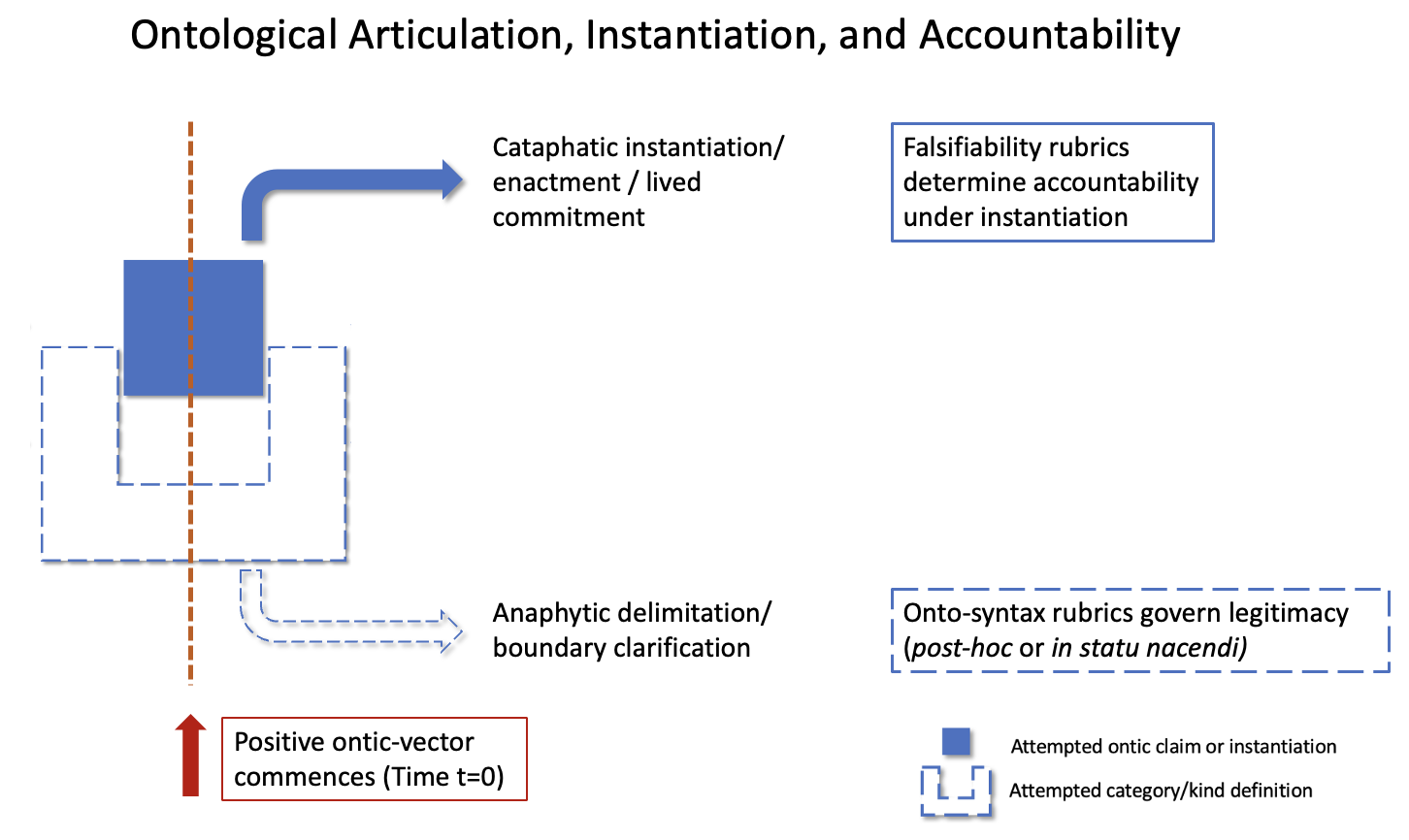
Diagram Legend
■ Solid Blue Shape Positive ontic instantiation (active commitment)- cataphatic
▢ Dashed Blue Shape Anaphatic ontological delimitation (no instantiation)
┃ Red Vertical Line (Time t = 0) Commencement of positive ontic vector
→ Solid Arrow (Cataphytic) Forward enactment of instantiated ontic kind
→ Dashed Arrow (Anaphytic) Ontological syntax analysis (pre-hoc or post-hoc)
Governing Rubrics
Ontological Syntax (Negative Constraint) Determines category legitimacy (applies in statu nascendi [state of being born] or post-hoc [after this])
Falsifiability & Accountability (Positive Constraint) Applies only after instantiation(exposure · cost · consequence)
Boundary Conditions
• No instantiation → no falsifiability
• Syntax precedes instantiation
• Falsifiability follows instantiation
• OCBM applies only to relational statements, not category formation
Negative constraints govern what may be formed; positive constraints govern what must answer once enacted.
Ontological Syntax governs category formation; OCBM governs relational statements between already-instantiated kinds.
These are all negative constraints: violations invalidate the category before truth, falsifiability, or causation are even discussable. See diagram above for clarification. For falsifiability rubrics, see here .
Rule: A category must retain stable identity across contexts.
Marriage is consistently treated as a covenantal ontic kind, whether the discussion is about permanence, suffering, joy, or failure.
Experience is always discussed within marriage, never as marriage.
Marriage is defined as covenant when arguing permanence,but redefined as emotional fulfillment when justifying dissolution.
🔁 Cross-domain:
Truth treated as correspondence in theology, but as sincerity in ethics.
Rule: Internal dimensions must be named and kept orthogonal.
Marriage is analysed along at least two explicit axes:
Postural (allegiance, covenant)
Praxeological (daily conduct, tone, restraint)
Each axis is evaluated independently.
“The marriage is bad” without distinguishing which axis is failing.
🔁 Cross-domain:
Faith collapsed into emotion.
Authority collapsed into popularity.
Rule: Derivative dimensions may not arbitrate grounding ones.
“The covenant is intact, but the lived experience is corrosive and requires repentance and formation.”
“Because the relationship feels unbearable, the covenant must be invalid.”
🔁 Cross-domain:
Poor outcomes used to redefine moral truth.
Discomfort used to redefine justice.
Rule: Ontological vectors must not be reversed.
Covenant → shapes conduct → produces experience.
Posture informs praxis; praxis does not redefine posture.
Experience → redefines covenant.
Praxis failure → retroactively nullifies allegiance.
🔁 Cross-domain:
Epistemology redefining ontology.
Pragmatics redefining truth.
Rule: Categories must survive time, not just moments.
Recognising that micro-behaviours, repeated over years, can suffocate a marriage without negating its legitimacy.
Distinguishing acute failure from chronic deformation.
Judging the category based on a season, crisis, or peak emotional state.
🔁 Cross-domain:
Crisis redefining institutional legitimacy.
Momentary outrage redefining moral law.
Rule: Stress must expose structure, not rewrite it.
Under fatigue or conflict, a spouse’s tone worsens — revealing lack of formation, not invalidity of marriage.
Pressure clarifies where repentance or growth is needed.
“Under stress, marriage stops working — therefore marriage is the problem.”
🔁 Cross-domain:
Suffering used to deny God.
Difficulty used to deny vocation.
Rule: Categories must not bleed into adjacent domains.
Emotional pain is treated as phenomenological data, not ontological verdict.
Psychology informs pastoral care but does not redefine covenant.
Trauma used to redefine moral responsibility.
Emotional harm used to redefine ontological legitimacy.
🔁 Cross-domain:
Neuroscience redefining personhood.
Sociology redefining agency.
Rule: A category must not claim more explanatory power than it can bear.
Marriage explains relational order and covenantal obligation.
It does not explain every psychological wound or personality trait.
Expecting marriage to heal all trauma, validate identity, or supply meaning.
🔁 Cross-domain:
Biology explaining morality.
Economics explaining value.
Rule: If removing a dimension collapses the category, it was malformed.
Removing emotional fulfillment does not dissolve marriage.
Removing covenant does dissolve marriage.
This shows which dimension is structural.
A model of marriage that ceases to exist the moment affection fades.
🔁 Cross-domain:
A truth model that collapses without consensus.
A moral system that collapses without enforcement.
Rule: The category must generalize without mutation.
The same structural distinction (ground vs expression) applies to:
marriage,
faith,
governance,
truth,
moral law.
A framework that only works in therapy, or only in theology, or only in politics.
🔁 Cross-domain:
Any concept that must be “redefined” to survive application elsewhere.