
This section addresses the accountability of positively instantiated ontic commitments—that is, realities that have been enacted, inhabited, or lived in time. It does not evaluate statements, definitions, or proposed categories. Its jurisdiction begins only after an ontological type has crossed from articulation into existence.
Here, falsifiability names ontological exposure, not epistemic testability.
Falsifiability in this framework applies only to cataphatic instantiation: the forward enactment of an ontic type that binds agents, structures conduct, and generates consequence.
It does not apply to:
Those are governed upstream by Ontological Syntax and downstream by OCBM respectively.
Falsifiability applies only where reality has already begun.
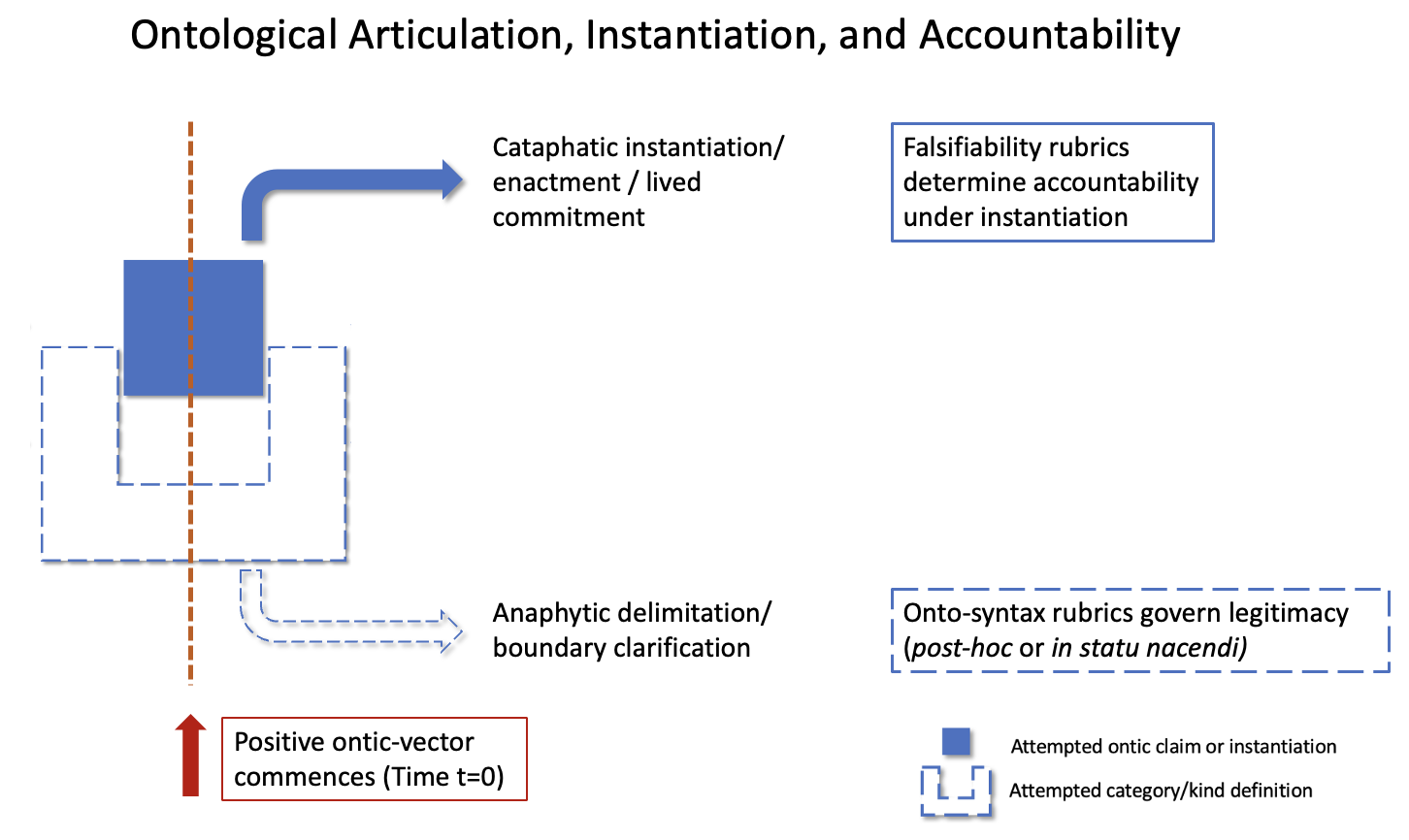
Diagram Legend
■ Solid Blue Shape Positive ontic instantiation (active commitment)
▢ Dashed Blue Shape Anaphatic ontological delimitation (no instantiation)
┃ Red Vertical Line (Time t = 0) Commencement of positive ontic vector
→ Solid Arrow (Cataphytic) Forward enactment of instantiated ontic kind
→ Dashed Arrow (Anaphytic) Ontological syntax analysis (pre-hoc or post-hoc)
Governing Rubrics
Ontological Syntax (Negative Constraint)
Determines category legitimacy (applies in statu nascendi [state of being born] or post-hoc [after this])
Falsifiability & Accountability (Positive Constraint)
Applies only after instantiation(exposure · cost · consequence)
Boundary Conditions
• No instantiation → no falsifiability
• Syntax precedes instantiation
• Falsifiability follows instantiation
• OCBM applies only to relational statements, not category formation
Negative constraints govern what may be formed; positive constraints govern what must answer once enacted.
Ontological Syntax governs category formation;
OCBM governs relational statements between already-instantiated kinds.
A cataphatic instantiation occurs when:
and future action is constrained by past commitment.
Examples include:
Once instantiated, the ontic type no longer exists as an idea. It exists as a trajectory.
In this context, falsifiability means:
The instantiated ontic commitment must expose itself to identifiable conditions under which its legitimacy, fidelity, or coherence could be shown to fail.
This exposure is not hypothetical. It is enacted through:
An instantiation that cannot fail is not robust enough to be real.
A legitimate cataphatic instantiation must satisfy the following positive accountability features:
Where these are absent, the instantiation is ontologically unserious, regardless of rhetoric.
Falsifiability here is not a test of propositional truth. It is a test of ontic accountability.
The question is not:
Is this claim false?
But:
Can this lived commitment be violated, betrayed, or shown unfaithful in reality?
If the answer is “no,” then the instantiation is insulated from reality and therefore lacks ontological weight.
Syntax prevents malformed kinds.Instantiation reveals whether a legitimate kind is actually inhabited.
They are complementary, not overlapping.